My wife and I visited the Champagne Wine Region in northeastern France, about 150 km east of Paris. Reims is the region’s capital. Epernay is the wine capital. The four “cradle villages” of Champagne are Dizy, Hautvillers, Cumières, and Damery. It is the only region authorized to produce Champagne, so if your wine sparkles but does not come from Champagne, it cannot be called Champagne. Here is what we learned and experienced.
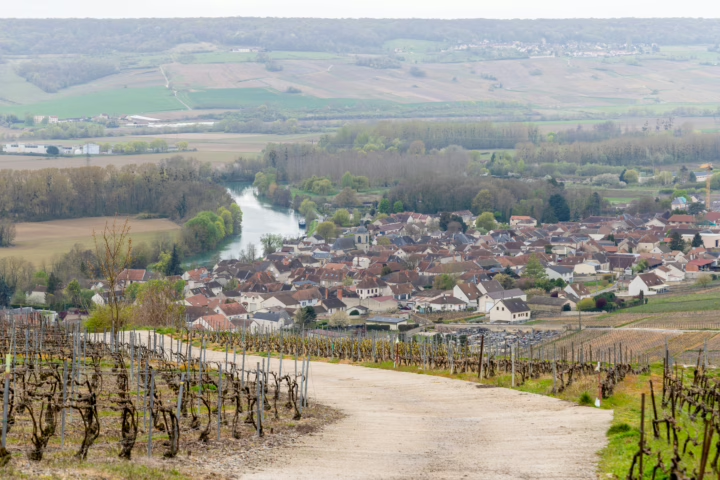
A view of the Cumières commune and the Marne River in Champagne, France
History
Champaign has a unique history. It first produced red and white wines, but as Champagne gained popularity, local producers shifted to making Champagne because it was a luxury product with better profits.
Terroir
It is all about the hills and the soil.
Climate
Champagne’s vineyards experience a mix of continental and oceanic climates. This combination is unique to Champagne and does not occur in any other French wine region.1
In practice, these two climates interact in Champagne. The oceanic influence brings mild temperatures, so winters are not too cold, and summers are not too hot. The average yearly temperature is 11°C.
But the continental climate can cause sudden winter freezes. In some places, temperatures have dropped below -10°C, causing frosts that damage the vines. In summer, the opposite can happen, with high temperatures sometimes leading to strong storms.
These climate conditions also help the vines in several ways. Champagne gets lots of summer sun, which helps the grapes grow. Rainfall is steady and moderate year-round, providing the grapes with nearly ideal water conditions.
Grapes
Champagne wines are made solely from three main grape varieties (Chardonnay, Pinot Noir, and Meunier), but that’s not quite true! Five other varieties are also authorized within the AOC area and are used to make some: Arbane, Petit Meslier, Chardonnay Rose, Pinot Blanc, and Pinot Gris.
How Champagne is made
The vines and the pressings: first, second, and third, and the “extra” wine
Vintage versus non-vintage Champagne
Non-vintage is made from a blend of multiple years to ensure consistency. At this level of wine, each Champagne maker’s goal is to provide a consistent expression, flavor profile, and brand year after year.
Vintage Champagne is different. All the Champagne in the bottle comes from grapes from a single year. Champagne makers declare a vintage only when everything aligns in the vineyard, allowing them to create a unique expression that is not possible with non-vintage Champagne.
Producers
There are large Champagne Houses that grow their own grapes and make their own Champagne, such as Moët & Chandon, owned by the luxury goods conglomerate LVMH (Moët Hennessy Louis Vuitton). LVMH is a multinational luxury goods company, and has been since 1987.
The interesting point is that only 20% of the wine in a bottle of Moët & Chandon comes from grapes grown by Moët & Chandon. The Moët & Chandon has to buy. This brings us to the next level, growers and producers, which are divided into two categories.
First, there are small growers/producers who grow their own grapes, make their own Champagne, and, in many cases, also sell their excess to large Champagne Houses such as Moët & Chandon. Second, there are growers who do not produce Champagne at all and just sell to Champagne Houses such as Moët & Chandon. There are all kinds of nuances, but this is the basics.
Finally, there are a few key points: Magnums are better because they allow less air. You can store Champagne at home for the same amount of time it was kept in the Champagne maker’s cellar before disgorgement, meaning if it were stored for 15 months, then you can store it for 15 months. Light is the enemy of Champagne, so buy Champagne that has been stored in boxes out of the light and keep it in the box out of the light. After
What to do
We hired a private expert Champaign guide to take us around for the day. He picked us up at our hotel in Reims and drove us to Epernay.
Along the way, we discussed the Champagne wine region. When we arrived in Epernay, he drove us up and down the “L’Avenue de Champagne” (English: Champaign Avenue), pointing out key factoids.
He dropped us off for our private Moët & Chandon tour. The Moët & Chandon tour was well done and finished with a tasting of two Champagnes.
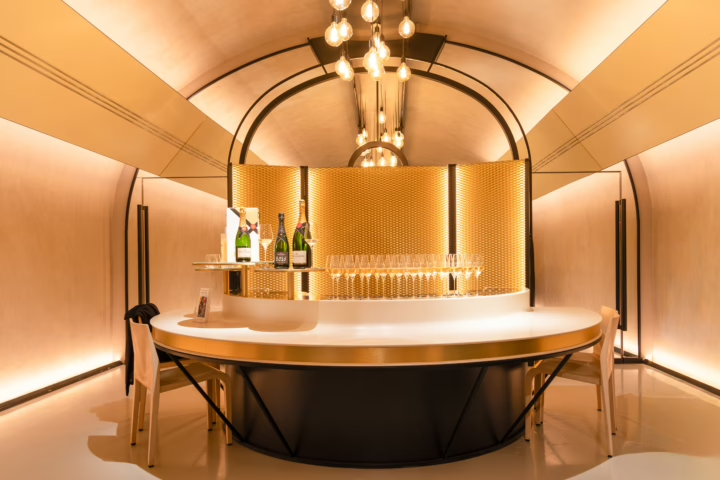
Moët et Chandon tour tasting room, Epernay, France
Then, we visited Boutique Champagne Pierre Mignon for small bites and to taste Maison Pierre Mignon Champagne. We tried nne different Champaigns. It was a good lunch!
Next, he drove us to BLAH, a small village, where we finished with a Dom Pérignon photo op.
After that, we drove through the countryside, stopped for a scenic view, and visited the Champagne Roger-Constant Lemaire, a small Champagne grower, producer, and maker. We met Gilles and Bernadette Tournant. Lemaire is Bernadette’s maiden name.
Finally, he returned us to our hotel.
Where to stay
We stayed at the Hyatt Reims because it was only six months old, and I thought it would be cleaner than the other hotels, especially the carpets. We do not like carpet. But after visiting Reims, I think the Gregorian Hotel would also be a good option. It is right across from the Cathedral. I looked at it but decided on the Hyatt because it was new.
As an alternative, if I did not want to stay in Reims, I would stay in Epernay on the “L’Avenue de Champagne” (English: Champaign Avenue). There are two good choices: Château Comtesse Lafond and La Villa Eugène. Both are located on the Avenue and allow you to walk from Champagne house to Champagne house.
Where to eat
Brasserie Excelsior
On Easter Sunday, we stopped by the Cathedral and then had lunch at Brasserie Excelsior, located in the heart of Reims. This was a great choice.
Brasserie Le Jardin is a MICHELIN Bib Gourmand restaurant located a short drive from the center of Reims. It is one of the restaurants at Domaine Les Crayères, a luxury hotel located in a seven-hectare park in the heart of Reims.
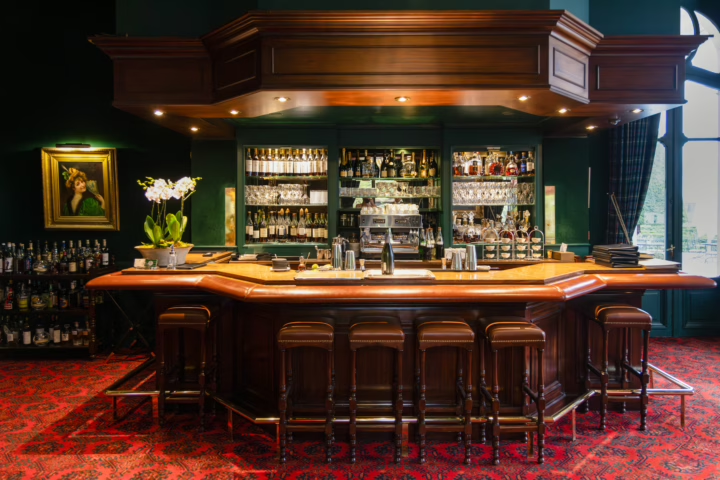
Bar La Rotonde, Reims, France
We arrived early, had a drink at Bar La Rotonde at the Hotel Domaine Les Crayères, and then went to dinner. Both were excellent choices.
Brasserie Le Jardin Adresse: 7 av. du Général Giraud, 51100 Reims Phone: 03 26 24 90 90 https://lescrayeres.com/
Café du Palais
Café du Palais Reims is not in the MICHELIN guide. Café du Palais, in the center of Reims, has been a family business for more than seventy years. Over time, children and grandchildren have taken on the management, now representing the fifth generation of the Vogt family. It was a good choice.
(n.d.). Champagne and its climate. Comité Champagne. Retrieved April 14, 2026, from https://www.champagne.fr/en/about-champagne/the-champagne-terroir/champagne-and-its-climate ↩︎
The Rungis International Market is the “belly of the Ile-de-France region.” It is the most populous of France’s 18 regions. It was created as the “District of the Paris Region” in 1961 and renamed after the historic province of Île-de-France in 1972 (English: ‘Island of France’). The region comprises eight administrative departments, including Paris.1
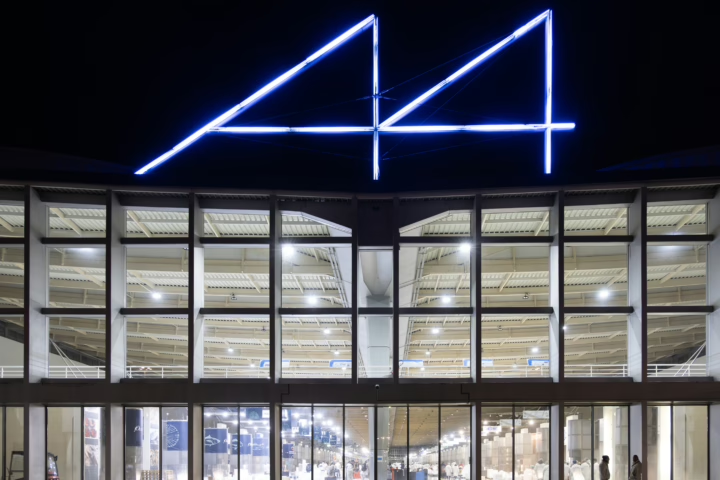
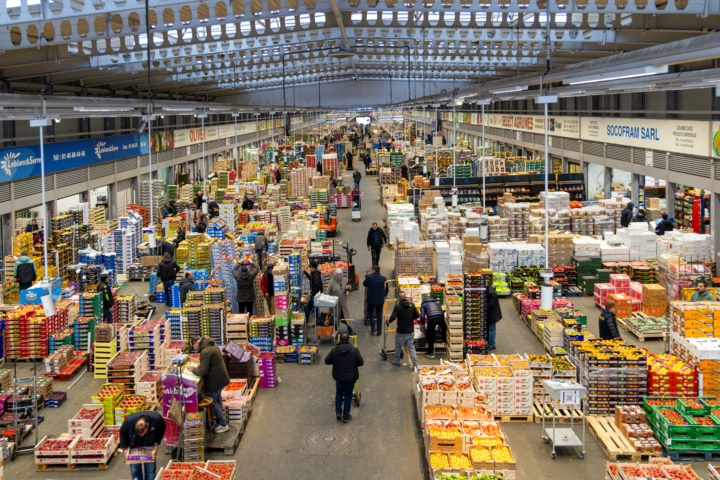
Rungis Market, situated adjacent to Orly Airport south of Paris, is the largest fresh food market in Europe. It operates as a wholesale business-to-business market, requiring professional membership for both buyers and sellers. At the time of this post, Rungis covers 232 hectares, accommodates over 1,200 companies, and employs nearly 13,000 individuals. The market provides stringent guarantees regarding food hygiene, traceability, and regulatory compliance, although some argue this comes at the expense of production quality.2
Rungis Market is a large market comprising submarkets: seafood and freshwater products; dairy products; fruits and vegetables; gastronomy and organic pavilion; butcher shop; pork, offal, poultry, and game; cut flowers, potted plants, and nursery growers; and accessories and decoration. Market openings are staggered to accommodate trucking logistics, which involves planning and coordinating freight transportation to maximize efficiency across the market’s supply chain.
Today, my wife and I went to the Rungis International Market on a field trip with FERRANDI Paris. We met at 3:00 AM and took a bus with the other international business students to get there. Rungis is a wholesale market, so only professional sellers or buyers are allowed to enter. However, you can find different tour options online if you want to visit.
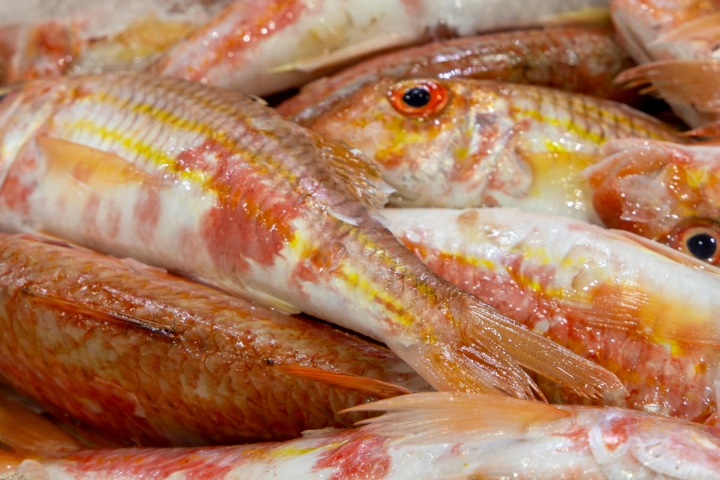
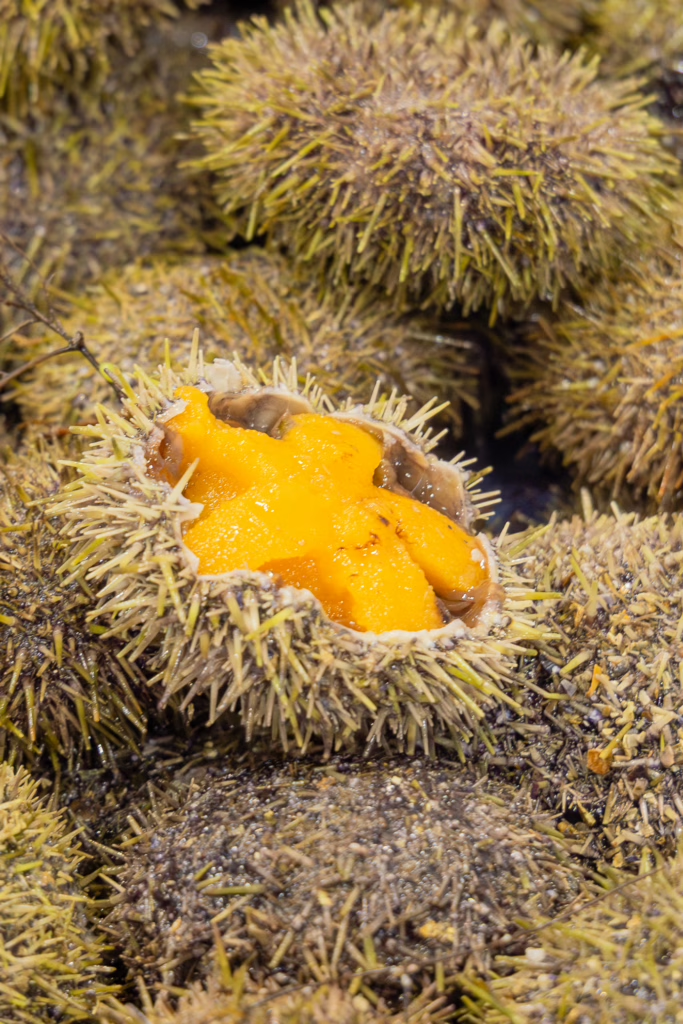
We started at the fish pavilion. When we got there, the vendors were finishing up their sales, counting their stock, and preparing to close. Still, we walked through, got a feel for the market, and saw many kinds of fish and shellfish.
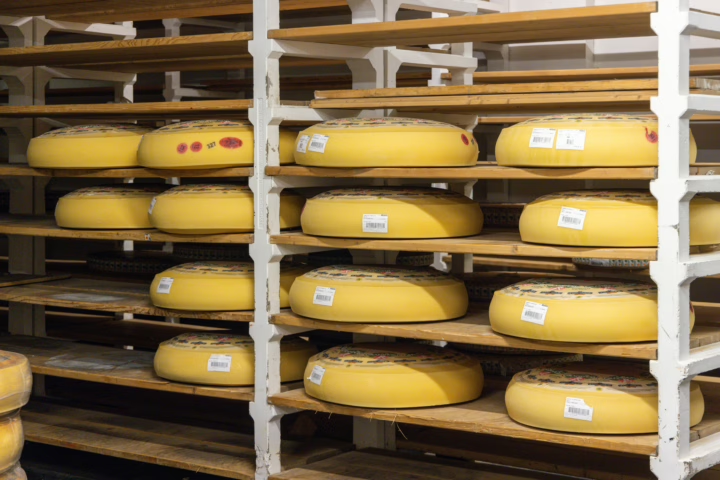
After that, we went to the pavilion for dairy, poultry products, and gastronomy.
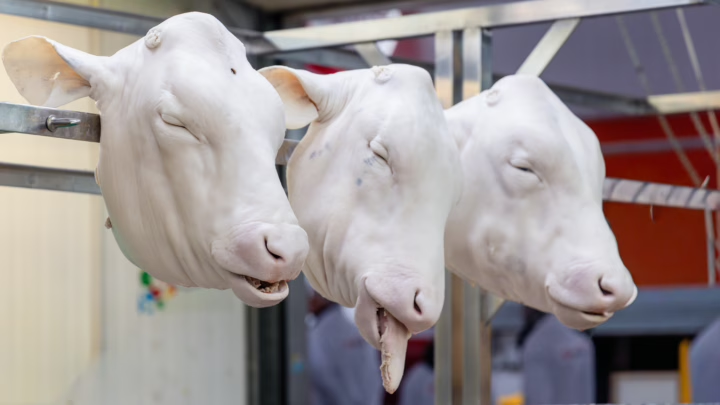
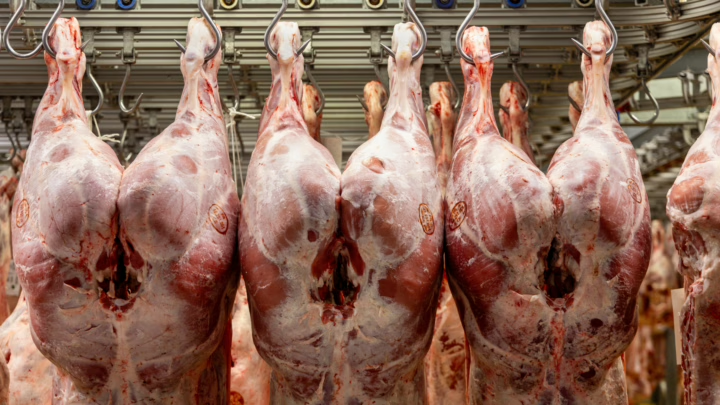
Next, we visited the butcher shop, which included pork, offal, poultry, and game.
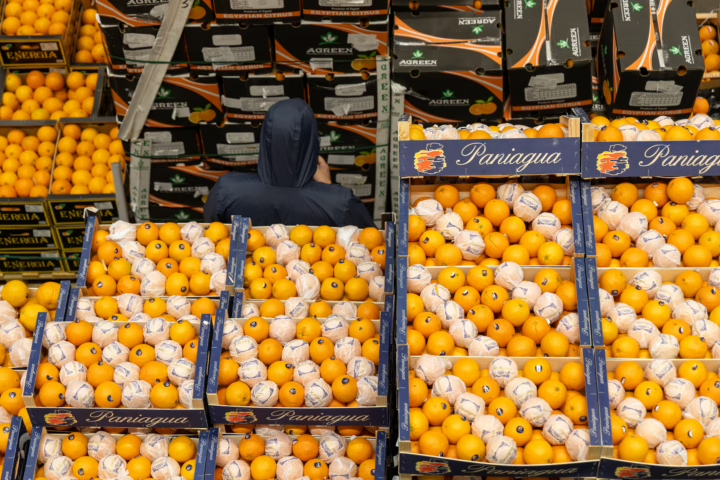
Then we went to the fruit and vegetable market, the largest section of the Rungis market. Our guide also took us to visit Masse House.
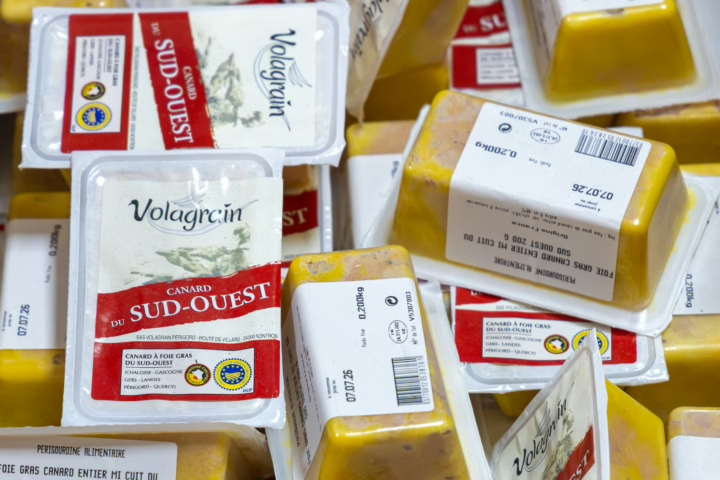
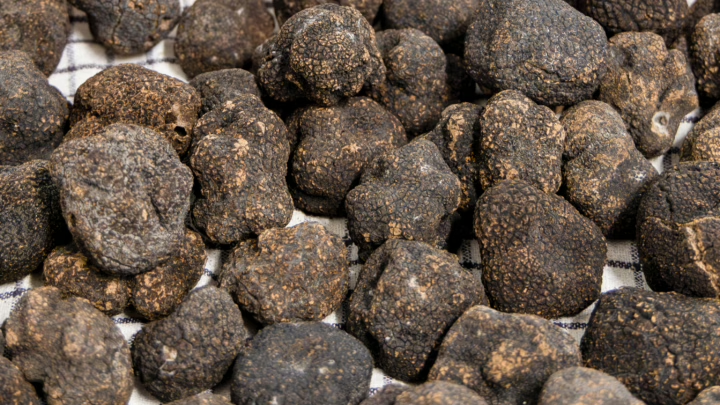
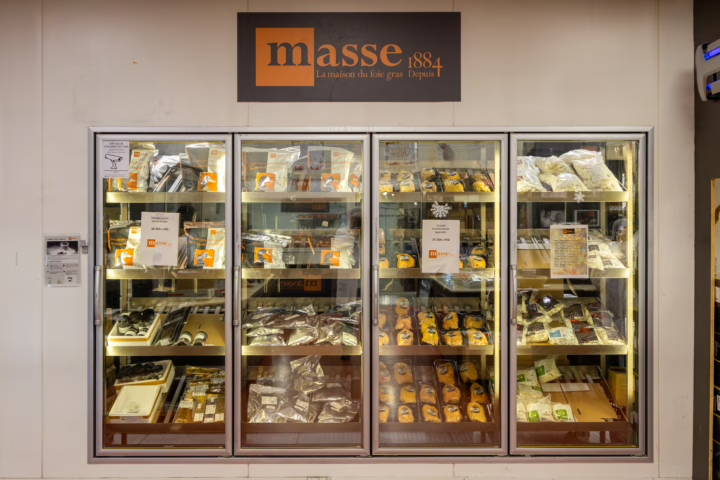
Masse House has focused on raw foie gras and truffles since 1884, selling only to chefs worldwide. They have locations in four regions of France and now also offer a variety of Spanish products, such as Ibérico Bellota ham and cecina.
At the end of our tour, the school hosted a breakfast for us before we returned to Paris.
My wife and I are currently in Paris, France, where we’re studying at FERRANDI Paris, an international culinary arts school. In our free time, we love searching for great places to eat. According to Google, with around 45,000 restaurants in the city (half are probably kabab houses), it’s a tough challenge. Here are some of the best restaurants in Paris that we’ve tried and recommend.
ANONA
ANONA is a MICHELIN 1-Star restaurant located in the 17th arrondissement. At lunchtime, ANONA offers several ways to enjoy your meal. The Petit Étoilé menu lets you experience Michelin-starred cuisine at a great price. If you prefer more options, you can choose from the à la carte menu. For those who want to sample it all, tasting menus are also available.
My wife ordered the INITIATION menu. She was able to select three vegetarian items from the à la carte menu. Since I did not want to have all vegetarian options, I ordered à la carte. There were larger tasting menus available, but we were not interested in so much food.
To start, I had the green peas with pistachio and morel mushrooms. It was just okay. For my main course, I chose the Tarn pork with Jerusalem artichoke, mint, and capers. It came with a small hot dog on the side, topped with yellow mustard. That dish was excellent and a lot of fun.
We usually share desserts, so instead of ordering two, I went with the “Cheese Experience.” I expected a cheese plate, but it turned out to be something different—more of a creative cheese dish. I get that people can buy good cheese and make a classic cheese plate at home, so maybe they want something new when dining out. Personally, I prefer cheese served simply, and I like to see what kinds of cheese restaurants offer.
The wine-by-the-glass selection was decent and priced as you’d expect at a MICHELIN 1-Star spot in Paris. I began with an espresso martini, then chose Domaine de Geyl’s Alsace Métitis, 2023. This blend of Alsace AOC grapes was light, refreshing, and a bit mineral, pairing nicely with everything I ordered.
I enjoyed ANON and recommend it.
Ambiance, vibe, service: 3 Wine by the glass options or pairing: 4 Presentation and plating: 4 Yummy quotient: 4 Dessert quality: 4
Bonvivant365 score: 19
ANONA Address: 80 Bd des Batignolles, 75017 Paris Phone: 01 84 79 01 15 https://www.anona.fr/
Automne
Autumne is a MICHELIN 1-Star restaurant in Paris’s 11th arrondissement. We went there for lunch. I had booked the reservation back on March 22, and now it was May 9. That morning, I tried to check the menu, but there wasn’t one online—just a note about 5-course and 7-course options. We really didn’t know what to expect. After reading some Google reviews, I started to worry. But since I’d already given my credit card, it was too late to cancel. So we went, not expecting much.
I’m glad we chose Autumne. It’s a fantastic MICHELIN 1-Star restaurant, one of the best we’ve tried. We’re still talking about the chef’s skills. They do not offer à la carte options, and the menu is the same for everyone at the table. There are no choices. We both had the Discovery Menu, which included five courses. Every dish was excellent.
My wife can’t stop talking about the “White asparagus from the Loire Valley with whelk, corn, and sorrel.” The asparagus was served three ways: as a cold soup, a perfectly grilled spear, and a puree of green asparagus.
It is true that the restaurant is small, the interior is simple, but the service is great. There is no wine-by-the-glass menu. So you work with the sommelier to make a selection. The choices were just adequate but at a very fair price for a MICHELIN 1-Star restaurant in Paris. What really stands out is how the chef creates complex dishes that taste amazing. My wife and I attend the FERRANDI Paris International Culinary School Program, so we appreciate how challenging it is to make food that looks beautiful, has many elements, and tastes great.
I highly recommend Automne.
Ambiance, vibe, service: 4 Wine by the glass options or pairing: 3 Presentation and plating: 5 Yummy quotient: 5 Dessert quality: 5
Brigade du Tigre is a MICHELIN Bib Gourmand restaurant located in the 10th arrondissement.
I am not going to waste much time writing about this MICHELIN Bib Gourmand restaurant. To sum up, Brigade du Tigre aims for French-Asian fusion but ends up feeling more like “expensive” asian street food. Overall, I thought it was pretty mediocre. I wanted asian street food, so I would go over to the 13th arrondissement.
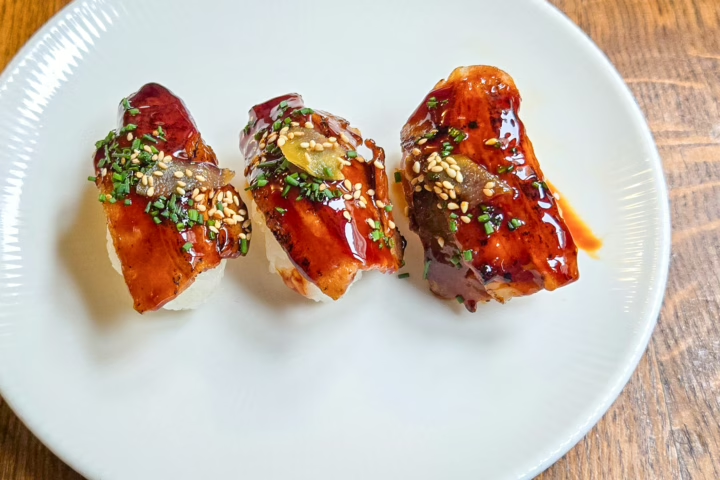
Brigade du Tigre roast pork sushi, Paris, France
If I wanted a MICHELIN Bib Gourmand French-Asian fusion, I’d choose Double Dragon from the list below. Still, Brigade du Tigre was full of locals enjoying themselves, so it might be worth a try. Maybe you’ll have a different impression.
Ambiance, vibe, service: 3 Wine by the glass options or pairing: 3 Presentation and plating: 3 Yummy quotient: 3 Dessert quality: 3
Bonvivant365 score: 15
Brigade du Tigre Address: 38 rue du Faubourg Poissonnière, 75010 Paris Phone: 01 45 81 51 56 https://www.brigadedutigre.fr/
COMER
COMER is a Mexican restaurant in the 10th arrondissement of Paris. It’s a small, casual spot run by the owner-chef. It is one of the few “authentic” Mexican restaurants in Paris, though the menu is somewhat adapted for the French market. The food and wine were fine, but overall, I thought it was just average. Still, if you’re nearby, hungry, and craving Mexican food, it’s worth a try. The lunch menu is pretty limited, but the dinner menu is much bigger and really shows what the chef can do.
Ambiance, vibe, service: 3 Wine by the glass options or pairing: 3 Presentation and plating: 3 Yummy quotient: 3 Dessert quality: 3
Double Dragon is a MICHELIN Bib Gourmand bistro in the 11th arrondissement, created by two sisters, half Filipino, half French, whose focus is fusion cuisine with a Filipino twist.
We arrived for lunch, the door opened, and we grabbed a table. The ambiance and vibe are casual, almost like a coworking café. The service was friendly and efficient. The menu is small and à la carte.
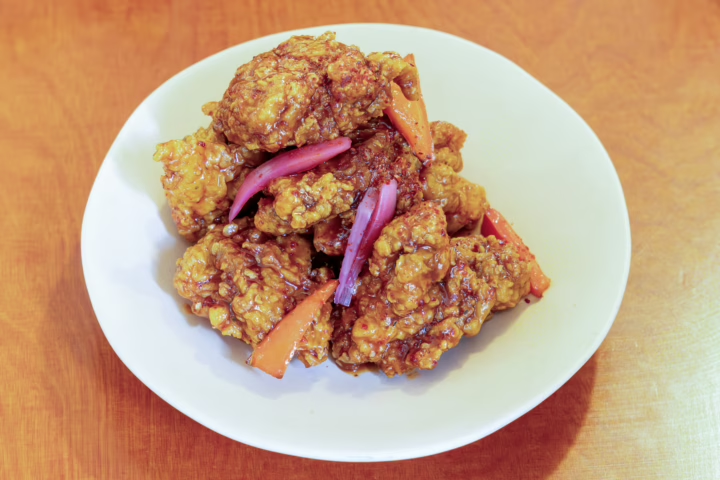
We ordered plates to share: Pork simosa, chili chutney, crème fraîche; KFC: Korean fried chicken, Tuna katsu, smoked mayonnaise, teriyaki; Peanut lettuce with kare kare sauce; and a bowl of white rice. The dishes came out fast and were perfect for sharing. Everything was delicious.
Double Dragon’s KFC: Korean fried chicken, Paris, France
For wine, we both ordered a glass of the Noëlla Morantin, Stella Maris, Sauvignon Blanc, 2023, a Vin de France from the Lorie Valley made with 100% Sauvignon, with aromas of green apple, peach, and a hint of minerality. The palate was bright, with citrus notes and a touch of honey, balanced acidity, and a fresh, lingering finish that paired well with the dishes.
Even though we weren’t hungry, we decided to try the house specialty for dessert: a Bicho-Bicho, which is a cinnamon-rolled donut served with coconut ice cream. As Lawrence Garfield (Danny DeVito) said in the 1991 movie Other People’s Money, “Gotta be hungry to eat a donut? I never heard of such a thing.”
Double Dragon is a fun Bib Gourmand bistro in Paris. It is worth a visit if you are in the 11th and in the mood for fun, tasty Asian fusion.
Ambiance, vibe, service: 3 Wine by the glass options or pairing: 3 Presentation and plating: 4 Yummy quotient: 5 Dessert quality: 4
Caillebotte is a Bib Gourmand bistro in the Pantruchoise family of restaurants in Paris’s 9th arrondissement. There are four: Pantruche, Caillebotte, Belle Maison, and Café Coucou.
We had high hopes since we had lunch at Pantruche (see below), which exceeded average by all measures. Caillebotte did not make the cut, which reinforces our view that we should stop going to Paris Bib Gourmands (generally a waste of calories, time, and money in our experience) and instead go to at least Paris 1-star restaurants.
I have no time to write anymore about Caillebotte. It was just average in every way except for the service.
Ambiance, vibe, service: 4 Wine by the glass options or pairing: 3 Presentation and plating: 3 Yummy quotient: 3 Dessert quality: 3
Restaurant Frederic Simonin holds one MICHELIN star and is located in Paris’s 17th arrondissement. The chef, Frédéric Simonin, is a Michelin-starred chef and has been named Meilleur Ouvrier de France, which means Best Craftsman of France. He trained at top restaurants and earned two Michelin stars as head chef for Joël Robuchon. In 2010, he opened his own place in Paris and received a Michelin star the next year. A friend of mine at Ferrandi Paris is a big fan of his, so I decided to try the restaurant on my own while my wife was out to lunch with a friend.
The restaurant offers a lot of options, including an à la carte menu. I chose the four-course lunch with wine pairing. What impressed me most was how beautiful each dish looked. Every plate was a masterpiece and tasted just as good, which is not easy to achieve. A pastry teacher once told me that if the chef is a MOF (Meilleur Ouvrier de France), you should go, because they are the best at what they do. In this case, he was right.
Ambiance, vibe, service: 4 Wine by the glass options or pairing: 5 Presentation and plating: 5 Yummy quotient: 5 Dessert quality: 5
Bonvivant365 score: 24
Restaurant Frederic Simonin Address: 25 Rue Bayen, 75017 Paris Phone: 01 45 74 74 74 https://fredericsimonin.com/
Gaya par Pierre Gagnaire
Restaurant Gaya is a MICHELIN 1-star restaurant in the 8th arrondissement of Paris. Pierre Gagnaire is a leader in the French fusion cuisine movement. “The term fusion cuisine, added to the Oxford English Dictionary in 2002, is defined as ‘a style of cookery which blends ingredients and methods of preparation from different countries, regions, or ethnic groups; food cooked in this style.”1
My wife ordered the single-option lunch menu that included white asparagus in broth with calamari as a starter. Seabream brandade as the main course, with chocolate, vanilla, and blackberry ice creams, blackberry sauce, and a biscuit for dessert. Typically, Brandade is an emulsion made from salt cod, olive oil, and usually potatoes. It is eaten in the winter with bread or potatoes. In this case, it was made with seabream.
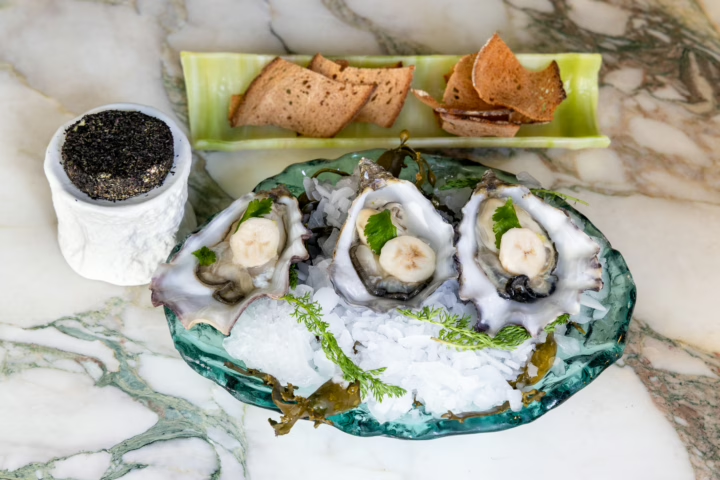
Not wanting to order the same meal as my wife, I built my own à la carte menu. I began with the “Gaya #2 Oysters,” served with a slice of banana, sardine cream, and rye bread dentelles with seaweed butter. I paired the oysters with a “Jean Chartron 2023 Pouilly Fumé Tradition” from the Loire Valley. Gaya #2 Oysters is a vintage Pierre Gagnaire dish.
Gaya #2 Oysters,” Paris, France
For the starter, I selected “Jumbo shrimps poached in a white asparagus broth flavored with chervil and grey chanterelle mushrooms,” which I paired with a “Bourgogne Chardonnay Vieilles-Vignes, 2023.”
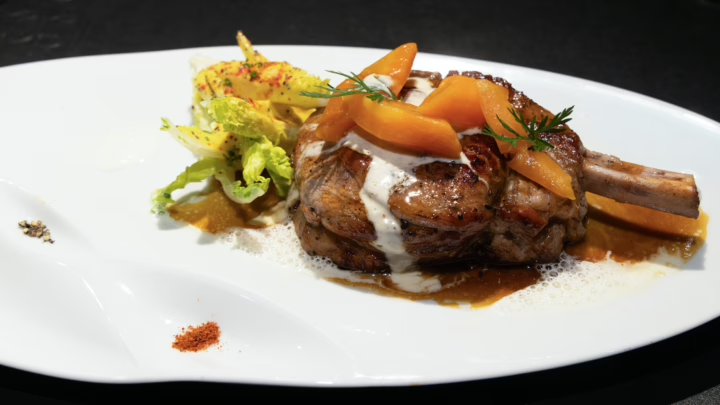
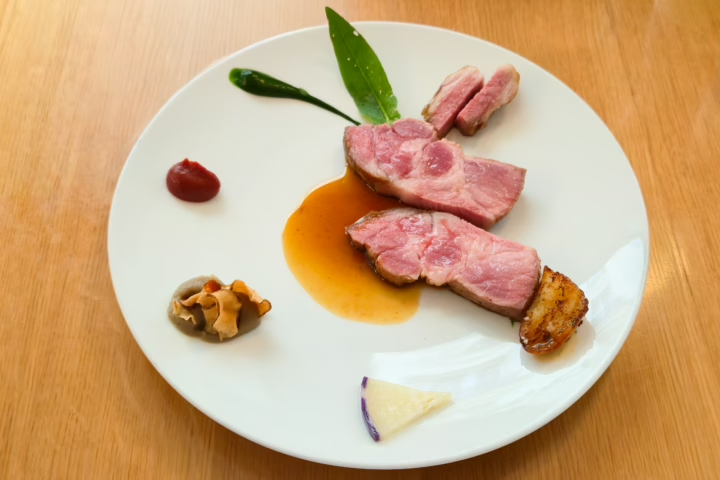
For the main course, I chose the “Medallion farm pork flavored with sage, red cabbage jam, crunchy parmesan cheese, and prune Eriang paste” paired with a “Domaine André Perret AOP Saint-Joseph red 2023.”
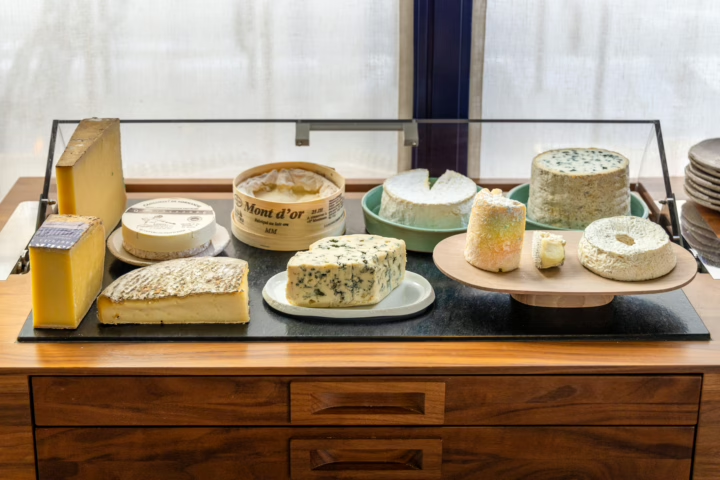
Instead of dessert, I opted for the cheese plate. I selected three cheeses. My favorite was the Fourme d’Ambert. Fourme d’Ambert is a French AOC cow’s milk cheese made in the Auvergne-Rhône-Alpes region, specifically in Auvergne. It is a member of the blue cheese family, with a balance between the blue and the white, making it the mildest. 2
Fourme d’Ambert is among the oldest cheeses in France. It is made from cow’s milk and has been produced since the Roman occupation, about 1,000 years ago, by people living in the green, volcanic Auvergne region. A clear image of Fourme d’Ambert, carved in stone at La Chaume, dates back to the 9th century.3
The cheese plate I paired with a”Domaine de la Rectorie” Pierre Gagnaire Banyuls.
From the way the staff greeted guests, it was clear that many regulars came for lunch. That seems to be the restaurant’s secret: the three-course lunch menu. In my opinion, the lunch menu offers the best experience, while the à la carte menu options feel overpriced and underwhelming.
Ambiance, vibe, service: 4 Wine by the glass options or pairing: 5 Presentation and plating: 4 Yummy quotient: 4 Dessert quality: 3
HANDO Parisian Handroll Sèvres is a sushi spot in Paris’s 6th arrondissement. It’s fantastic. They make sushi hand rolls right in front of you, and there are a few locations around the city. This one is just a block from our Airbnb, so it’s become our favorite sushi place in Paris. I highly recommend it.
HANDO Parisian Handroll Sèvres Address: 89, rue de Sèvres 75006 Paris Phone: 1 73 74 94 83 https://www.hando-paris.com/
Imperial Treasure
Imperial Treasure is a MICHELIN 1-star Chinese restaurant in Paris’s 8th arrondissement. My wife and I had just visited Shang Palace, another MICHELIN 1-star Chinese restaurant in the city, last Saturday. So, we decided to try Imperial Treasure to compare our Shang Palace experience while it was still fresh in our minds (See my Shang Palace review below).
We both ordered the six-course lunch menu. My wife added the wine pairing option. I selected my own wine from the wine-by-the-glass menu that offered nice choices. In our view, the food was standard Chinese cuisine served in a stylish setting, with a nice selection of wines by the glass. It was nothing special.
If you want the best Chinese gastronomic experience in Paris, visit Shang Palace. It will cost you 20-30% more, depending, but it is worth every penny.
Ambiance, vibe, service: 4 Wine by the glass options or pairing: 4 Presentation and plating: 3 Yummy quotient: 3 Dessert quality: 2
We discovered Junk Smash Burgers in Lyon, France, about a year ago. They also have spots in Paris and other cities across France. JUNK SÈVRES is less than a block from our Airbnb in Paris, so we often pass by and order a burger to go. Our favorite is the “Small.” It has a great balance of brioche bun, good meat, and their homemade junk sauce—perfect when you need a burger fix. You can add jalapenos, crispy onions, or extra pickles. I usually keep it simple, but my wife likes to add jalapenos and extra pickles. If you’re in the mood for a burger, Junk Smash Burgers is a great choice.
L’Atelier de Joël Robuchon Étoile is a MICHELIN 1-star restaurant located near the Arc de Triomphe de l’Etoile, below a drugstore, which was kind of weird.
Once you get past that, it is a nice restaurant with a cool vibe, though touristy. If you do not know who the late Joël Robuchon is, you should. He was awarded the Meilleur Ouvrier de France in cuisine in 1976 and was named “Chef of the Century” by the guide Gault Millau in 1989. He held 31 Michelin Guide stars by the time of his death in 2018, the most any restaurateur has ever held.
The kitchen is completely open, allowing you to sit at the very large counter and see all the action unfold. There are a variety of menu options for all budgets. You can order the three-course menu, which is very affordable and allows you to try some of Chef Robuchon’s signature dishes.
If you go off-menu and order dishes that charge supplements, pair a glass of wine with every course, and end with cognac, as I did. You will receive the typical Paris one-star check, ranging from 400 to 500 euros.
I started with Robuchon’s signature foie gras and caviar entrée. It is totally old school. I was not a big fan, but I completely appreciated how innovative it must have been back in the day.
JOËL ROBUCHON’s LA CÔTE DE VEAU, roasted veal chops with thyme and sautéed mushrooms, Paris, France
For her main course, my wife had the LA JOUE DE PORC, Pork cheeks cooked in Madiran red wine with green gnocchi and chestnut. I ordered the LA CÔTE DE VEAU, Roasted veal chops with thyme and sautéed mushrooms. Both dishes came with Joel Robuchon’s signature pommes puree or mashed potatoes.
Joel Robuchon’s signature pommes puree or mashed potatoes, Paris, France
For dessert, we had the LE DESSERT PRÉFÉRÉ DE JOËL ROBUCHON, Coffee choux pastry, and the LE MANGO-MANGO, Exotic fruit jelly with mango mousse. The Coffee choux pastry was served with an underdone poached pear. That said, both desserts were excellent.
JOËL ROBUCHON LE MANGO-MANGO, Exotic fruit jelly with mango mousse, Paris, France
The wine-by-the-glass options are extensive and good, but pricey. I thought obnoxiously so. That did not deter me from starting with champagne, pairing a glass with each course, and ending with cognac with dessert. Much to my wife’s chagrin.
All the food was YUMMY, a signature of Roubucon’s style. Robuchon showed that highly technical French dishes could be produced at scale and consistently across multiple locations through an obsession with perfection, extensive training, and careful ingredient sourcing.
Ambiance, vibe, service: 4 Wine by the glass options or pairing: 5 Presentation and plating: 5 Yummy quotient: 5 Dessert quality: 5
La Méditerranée is a MICHELIN Bib Gourmand restaurant located in the 6th arrondissement. It is an old-school fish restaurant. It feels like you stepped back into the 1970s. It was an older crowd that seemed like regulars or at least had been there before.
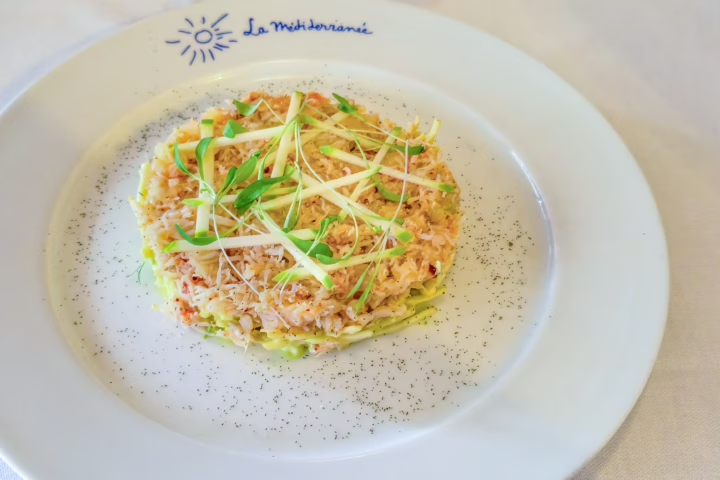
I began with six oysters from Thau Lagoon in France, then tried the crab with celery relish, coriander, apple, and lime. Both dishes were excellent. I like the crap so much I will try to make it at home and serve it to guests.
La Méditerranée crab with celery relish, coriander, apple, and lime, Paris, France
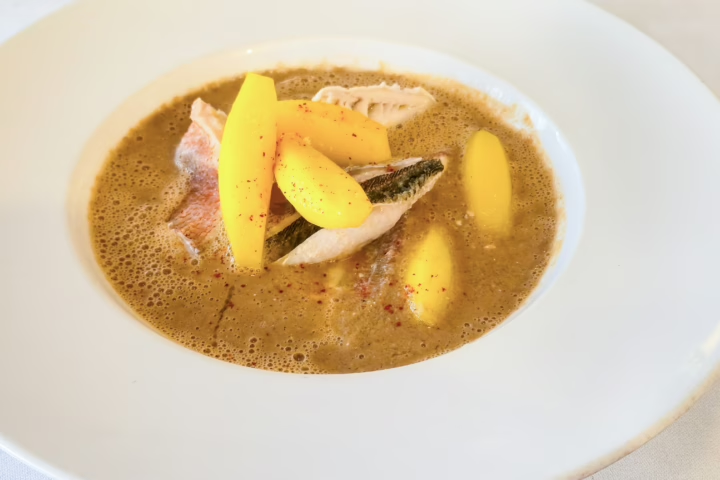
For the main course, my wife chose the royal sea bream with rice and shellfish sauce, while I had the Mediterranean bouillabaisse. Her fish was excellent, and my bouillabaisse was very well prepared.
La Méditerranée’s bouillabaisse, Paris, France
The wines by the glass were fine, but nothing special. I had a Sauvignon Blanc with the oysters and a petite Chablis with the bouillabaisse, which is always tricky to match with wine. My wife had an Aligoté, probably from Burgundy. For dessert, I went with a cognac.
For dessert, I ordered the floating island, a classic French dessert made with soft meringue set atop crème anglaise. The meringue is baked in a water bath and can be served either at room temperature or chilled. This time, it was served chilled. I decided to try it since everyone around us seemed to be ordering it. Honestly, it was just okay. I’ve had better, and I’ve even made better myself.
I liked the restaurant. My wife was not a fan. But as I said, it is like I walked through a time portal and was transported back to the 1970s, to a fish restaurant on the East Coast of the U.S.A. with a Parisian look and feel.
The portions are huge, if that is your thing (It is not ours), and the food is good. If I were in the mood for fish, I would return.
Ambiance, vibe, service: 4 Wine by the glass options or pairing: 3 Presentation and plating: 3 Yummy quotient: 4 Dessert quality: 3
Bonvivant365 score: 17
La Méditerranée Address: 2 Pl. de l’Odéon, 75006 Paris Phone: 01 43 26 02 30 La Méditerranée
Le Pantruche
Le Pantruche is a MICHELIN Bib Gourmand bistro located in the 9th arrondissement that focuses on classic French dishes with a modern touch. We arrived early and found a spot by the window. Le Pantruche has chic vintage décor and offers a typical bistro lunch menu, along with à la carte options.
My wife ordered the smaller menu, which included the “Main of the Day” plus a starter or dessert. For her starter, my wife chose the flatbread with marinated tempura cauliflower, wild herbs, Chimichurri sauce, and a daikon pickle. The main course of the day was yellow pollock served with carrots in three styles: jus, puree, and mousseline, topped with lightly fried chard and a Shishito pepper. Both dishes were excellent.
Le Pantruche’s “Marinated Tempura Cauliflower,” wild herbs, Chimichurri, a sauce, and Daikon pickle, Paris, France
Le Pantruche has a well-curated wine-by-the-glass list (French: vins au verre) written on the large mirror in the main room. For her starter, my wife paired a Domaine Saint Nicolas Les Chemins from the Loire Valley (45% Chenin, 45% Chardonnay, and 10% Grolleau gris). With the main course, she picked the “Famille Lieubeau, Bel Abord, Muscadet Sèvre et Maine, 2023, a 100% Melon de Bourgogne.
Muscadet Sèvre et Maine is a sub-regional appellation located in the Loire Valley, southeast of Nantes. Muscadet Sèvre-et-Maine is the most famous appellation of the Nantes vineyards. According to Google, it represents nearly 70% to 80% of all Muscadet produced in the region. Muscadet from Sèvre et Maine is a bit fuller-bodied than Muscadet from other regions, with more floral and mineral aromas. It paired nicely with the fish.
Le Pantruche’s “Wild Boar Loin,” served with free-range chicken supreme sauce, red cabbage with port, confit potatoes, Cévennes onions, and juniper berries, Paris, France
I chose the larger menu, which came with dessert. For my starter, I selected the Squid Tartare, served with red wine, cuttlefish ink sauce, candied celery, and seaweed oil.
Since it was hunting season, I picked the Wild Boar Loin for my main course, which was served medium (French: demi-anglais). It came with free-range chicken supreme sauce, red cabbage with port, confit potatoes, Cévennes onions or sweet onion, and a juniper berry sauce. Both dishes were excellent.
For dessert, we shared the “Grand Marnier Soufflé,” served with a salted caramel sauce. The soufflé, as a “chef’s dessert,” was well executed, light and fluffy as it should be. My wife, who is not a big fan of soufflé, could not stop raving about it. I paired the soufflé with a Hine V.S.O.P. Cognac.
Le Pantruche’s “Grand Marnier Soufflé,” served with a salted caramel sauce, Paris, France
Le Pantruche is a quintessential Bib Gourmand Paris bistro. The Ambiance, vibe, and service were well above average with a chic vintage décor. The wine-by-the-glass (French: vins au verre), eight in all, were written on the large mirror and were well curated, selected to pair with the starters and the mains. Presentation and plating were well executed and above what you would expect for a bistro. It was more gastronomic. The yummy quotient was above average, and the dessert quality far exceeded my expectations for a bistro. The price–performance ratio was excellent.
Le Pantruche is part of “The Pantruchoise” family of bistros and cafes located in the 9th arrondissement of Paris, which includes for MICHELIN Bib Gourmands: Pantruche, Caillebotte, Belle Maison, and Café Coucou.
Ambiance, vibe, service: 5 Wine by the glass options or pairing: 5 Presentation and plating: 4 Yummy quotient: 4 Dessert quality: 5
Le Petit Lutetia is a restaurant serving classic French cuisine. It’s just outside our Airbnb on Rue de Sèvres. We’ve eaten there three times in as many weeks and already want to go back.
Le Petit Lutetia has a vintage feel and the beautiful, harmonious cacophony of a Paris brasserie. You could scream out loud during your meal, and I do not think the table next to you could even hear you. The wine-by-the-glass options and the broader wine menu are as they should be.
Le Petit Lutetia’s sautéed frog legs with garlic and parsley, Paris, France
Across three visits, we have tried the following: Hard-boiled eggs with mayonnaise; Whole fresh lettuce with olive oil & lemon; Sautéed frog legs with garlic and parsley; Rigatoni, creamy morel mushrooms; Galice beef Cecina, Homemade crispy duck confit and sautéed grenaille potatoes (new potatoes); Quatrehomme’s select cheese plate (Comté 24 mois, Bleu du Vercors, Tonnelet de la Tarentaise); Beef Wellington with red wine sauce, and Tarte tatin with minute homemade vanilla ice cream.
Le Petit Lutetia’s Beef Wellington, Paris, France
Every dish we have ever ordered has been well-plated and presented, and the desserts have been delightful. My wife still talks about Le Petit Lutetia Tarte Tatian and claims it is the best she has ever had (I think because it was served thin and flat like a crepe).
I like Le Petit Lutetia better than Benoît, a MICHELIN 1 Star, classic Paris bistro that I started going to back in the 1980s and now avoid because it has become too touristy for my taste.
Le Petit Lutetia does not have set menus, and ordering a meal requires one main course per person. It costs what you would expect for a high-end Paris brasserie. But for us, it is a very good value for money. Le Petit Lutetia has several locations.
Third visit to Le Petit Lutetia
We had a Friday off from school because we did not go on the Champaign trip. We are going to Champaign on a private tour in April. So we went for lunch again. Le Petit Lutetia never disappoints me.
Ambiance, vibe, service: 5 Wine by the glass options or pairing: 5 Presentation and plating: 5 Yummy quotient: 4 Dessert quality: 5
Les Canailles is a MICHELIN Bib Gourmand bistro in the 9th arrondissement that serves classic French dishes with a modern twist.
For starters, I ordered the Carpaccio de langue de bœuf, sauce gribiche, beef tongue carpaccio, gribiche sauce. My wife ordered salade de poireaux et Vittelote, saucisse de Morteau, espuma au Reblochon, salad of leeks and Vittelote cheese, Morteau sausage, Reblochon cheese espuma.
For her main course, my wife ordered the Poisson de pêche de petit bateau, garniture de saison, Small-boat caught fish, seasonal garnish, which was Pollock served with celeriac and carrot puree and a white wine sauce. I ordered the Tourtière, a duck meat pie with duck liver, served with a mushroom sauce.
Les Canailles’s small boat caught fish, served with celeriac, carrot puree, and a white wine sauce, Paris, France
For dessert, we shared the Soufflé au Grand Marnier, which I paired with a Cognac Grande Champagne Giraud VSOP (40°). Paul Giraud’s family estate is based in Bouteville, at the heart of the Grande Champagne region. Grande Champagne, recognized as the premier cru of Cognac, produces eaux-de-vie with exceptional finesse and aging potential. Its clay-limestone soils contribute to cognacs with distinctive floral and fruity aromas.
Les Canailles’ ambiance, vibe, and service were above average. The wine-by-the-glass options were excellent, allowing us to pair each course with an appropriate glass. Presentation and plating were average, as was the yummy quotient. Everything was very well presented and tasted fine, but average. I thought the Soufflé au Grand Marnier was better than the soufflé we had at Le Pantruche. My wife did not agree.
Les Canailles’ changes weekly, so check the website. It is a typical Paris Bib Gourmand with a 45-euro menu that includes an entrée, plat, and dessert. There is also a smaller menu, and you can order à la carte.
Ambiance, vibe, service: 4 Wine by the glass options or pairing: 5 Presentation and plating: 3 Yummy quotient: 3 Dessert quality: 4
NOMICOS is a MICHELIN 1-star restaurant in the 11th arrondissement of Paris. Overall, it was the best MICHELIN 1-star restaurant we have had in Paris. I highly recommend.
Ambiance, vibe, service: 5 Wine by the glass options or pairing: 5 Presentation and plating: 5 Yummy quotient: 5 Dessert quality: 5
Bonvivant365 score: 19
NOMICOS Address: 16 Av. Hubert Germain, 75116 Paris Phone: 01 56 28 16 16 https://nomicos.fr/lieu
Pilgrim
Pilgrim is a MICHELIN 1-star restaurant in the 15th arrondissement of Paris. My wife and I had lunch there, and we highly recommend it.
Pilgrim’s pork rib back from Normandy served with Jerusalem artichoke and a date puree
Right now, Pilgrim serves a three-course lunch menu for 55 euros, and you can add extra courses if you want. There’s no à la carte menu, but it’s a great deal for a MICHELIN 1-star spot.
The way they serve wine is a bit different from what we’re used to. You can order a bottle, choose a set wine pairing for your meal, or order by the glass. For wine by the glass, you just pick red or white, and the waiter-sommelier brings you a suggestion from what’s open for you to try. There isn’t a list for you to choose from, but this approach worked well. Every wine they suggested paired perfectly with our food.
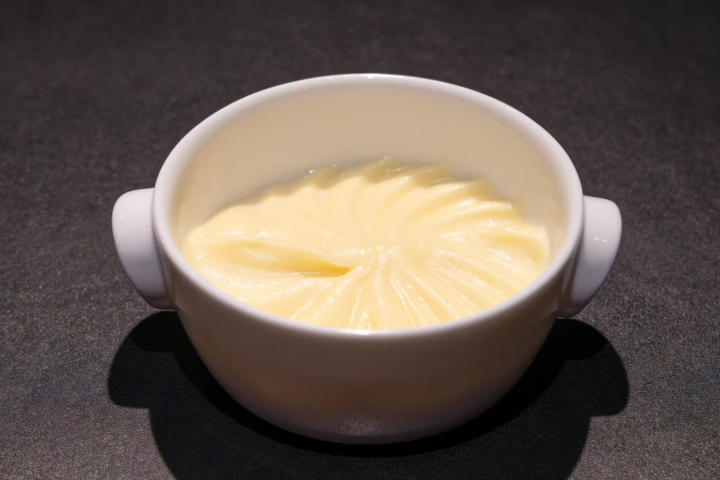
The desserts were another highlight. Pilgrim has its own pastry chef, and she stands out.
Ambiance, vibe, service: 4 Wine by the glass options or pairing: 5 Presentation and plating: 4 Yummy quotient: 5 Dessert quality: 5
Bonvivant365 score: 23
Restaurant Pilgrim Address: 8 Rue Nicolas Charlet, 75015 Paris Phone: 01 40 29 09 71 https://www.pilgrimparis.com/
Madame Brasserie
Madame Brasserie is a restaurant on the first floor of the Eiffel Tower. It was recommended to me by a FERRAND Paris Chef. He went with his wife. He thought the food was ok, but the overall experience was magical. So we are going to give it a try.
Madame Brasserie only lets you book one month in advance online. I want to go in May, when the weather is nice, and the trees have leaves. So, I need to wait to book…
SANCHUAN is a Chinese restaurant bordering the Chinatown neighborhood of Paris. The owner is from China’s Sichuan Province, and it shows in the food, which we found delicious, perfectly seasoned, not too spicy, and full of the complexities you would expect from Sichuan cuisine.
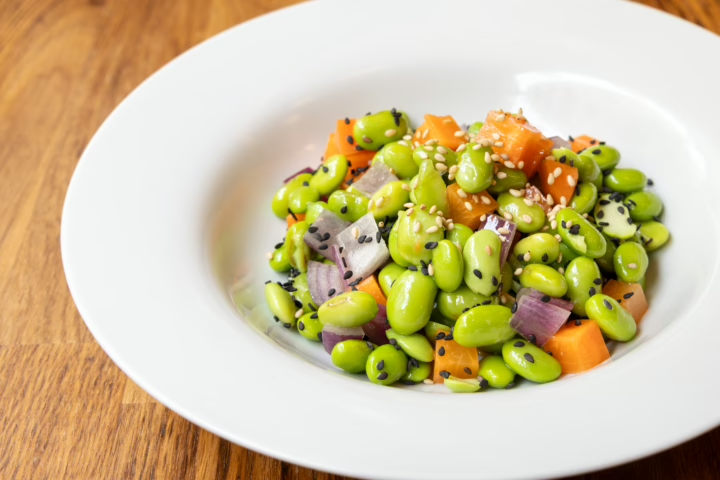
SANCHUAN’s “Scallion Oil Green Beans, Paris, France
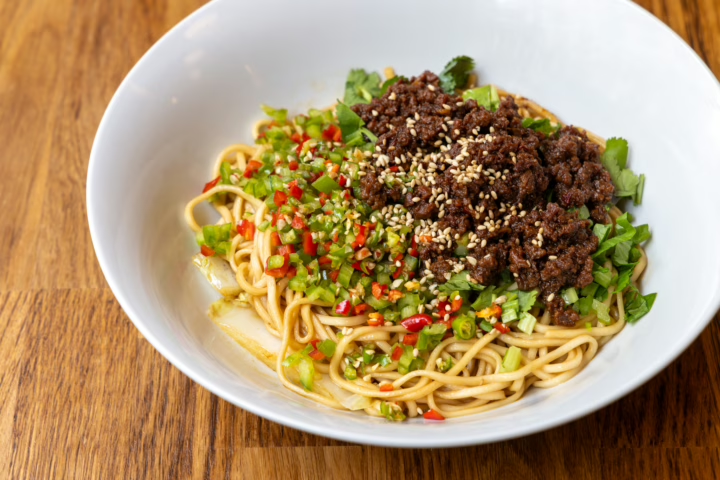
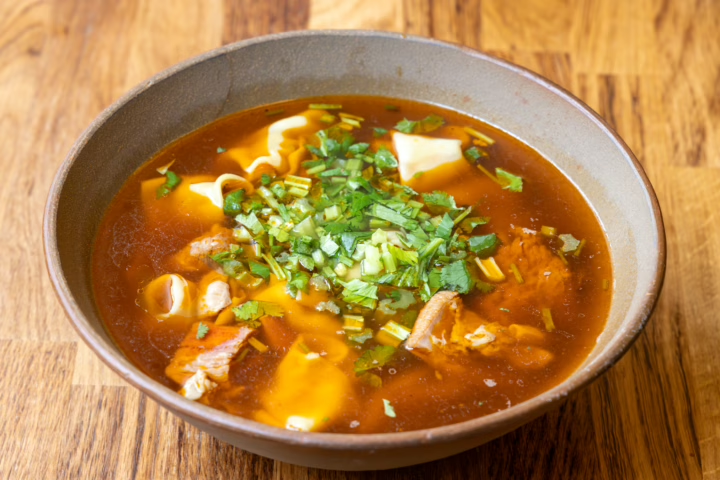
We tried several starters that were very good, but now when we order the same three items: the “Scallion Oil Green Beans,” the “Beef Noodles with Fresh Chili” (which includes minced beef, fresh chili, and coriander), and the “Beef Dumpings in Rich Sichuan Broth” with coriander.
SANCHUAN’s “Beef Noodles with Fresh Chili,” with minced beef, fresh chili, and coriander, Paris, France
We wash it all down with glasses of Domaine des Ruaults SAUMUR, Chenin, 2023, a 100% Chenin Blanc with the aromas of white fruit and white flowers. It is light, fresh, and balanced, and pairs well with the food.
SANCHUAN’s “Beef Dumpings in Rich Sichuan Broth” with coriander, Paris, France
We enjoy SANCHUAN so much that we visit every month. Another great thing is that Pastificio Oronza is right across the street. It’s an Italian grocery store with fresh pasta, sauces, and other prepared foods for takeout, and with a very, very, very small counter to eat in. We always stock up on pasta and sauce to bring home.
Finally, SANCHUAN’s value for money is superb, but they do not have a website. You can only make a reservation by calling, which I highly recommend if you hope to get a seat.
Ambiance, vibe, service: 4 Wine by the glass options or pairing: 4 Presentation and plating: 4 Yummy quotient: 5 Dessert quality: N/A ( SANCHUAN does not offer dessert)
Bonvivant365 score: 22
SANCHUAN Address: 5 rue des Fossés-Saint-Marcel, 75005 Paris Phone: 01 42 19 07 47
Shang Palace
Shang Palace is a Chinese restaurant located in the 8th arrondissement of Paris. Chef Tony Xu is the executive chef of Shang Palace. The Shang Palace used to have a 1-Star rating under the old chef, who has since moved on to SENsations. But I think they will win it back under Chef Tony.
Chef Tony visited FERRANDI Paris for a demo day and showed us how to make some of his signature dishes. Honestly, after the demo, we chose not to visit his Shang Palace restaurant because most of the dishes seemed pretty average, except for his mango dessert, which was fantastic. Later, a Chinese friend of ours and her husband went to the Shang Palace and told us the food there was incredible. She even called it the best gourmet Chinese food in Paris. We found out that FERRADNI Paris hadn’t provided Chef Tony with all the right ingredients for his last-minute visit and demo. So, we decided to try the restaurant ourselves.
The restaurant offers dim sum, an à la carte menu, and five- and seven-course gastronomic menus. I want to try the seven-course gastronomic menu, but there is just too much on it that my wife wouldn’t eat (like shrimp and lobster). So we decided to order à la carte. This is what most people do.
We began our meal with the chef’s signature dim sum, ‘Ravioli aux langoustines et crabe,’ langoustine and crab dumplings. We also tried the ‘Effiloché de volaille de Bresse, poivre vert et cébettes,’ a dish of shredded Bresse poultry with green peppercorn and spring onion sauce. Alongside these, we ordered the ‘Filet de bœuf normand sauté au poivre et aux champignons eryngii,’ which is wok-fried Normand beef fillet with king-oyster mushrooms and black pepper sauce, ‘Porc à la sauce aigre-douce,’ or sweet and sour pork, and ‘Nouilles sautées au canard rôti, pousses de soja, champignons et sauce haricot noir,’ fried egg noodles with shredded roasted duck, bean sprouts, mushrooms, and black bean sauce. The chef also sent over a gift, his “Crevettes Obsiblue panées à l’ail et piment,” Deep-fried Obsiblue prawns with crispy garlic and chili.
For dessert, we ordered the “Crème de mangue et noix de coco,” a chilled coconut-mango cream with pomelo, and a pineapple dessert I can’t remember the name of but was delicious.
The wine-by-the-glass menu is pricey, but that’s expected at some MICHELIN 1-star restaurants and is comparable to prices at L’Atelier de Joël Robuchon. Instead, we chose a bottle: the Alsace Riesling Grand Cru Zinnkoepflé Agathe Bursin 2023. It went well with every course. This grand cru Riesling, whose name means “Mount of the sun,” strikes a great balance between rich aromas and the crispness from the limestone soil.
Every dish was amazing and seemed better than the last. We had plenty to take home. Shang Palace. It’s honestly the best Chinese food, gourmet or not, that I’ve ever had.
Ambiance, vibe, service: 4 Wine by the glass options or pairing: 3 Presentation and plating: 5 Yummy quotient: 5 Dessert quality: 5
Trente-Trois is a MICHELIN 1-star restaurant in a luxury hotel in the Golden Triangle. The menu focuses on fresh Mediterranean flavors, with olive oil, herbs, vegetables, fish, and shellfish. That’s why I picked it. We’re a little tired of the usual heavy French food.
There are 107 MICHELIN 1-star restaurants in Paris. That’s right, 107. I started by trying Bib Gourmand restaurants, and so far, Le Pantruche is my favorite. But overall, we haven’t been impressed by the Bib Gourmand options in Paris. I’m not sure why. So now I’m looking at MICHELIN 1-star places. With so many to choose from, it feels random.
I asked the chefs at FERRANDI Paris, where we go to school, but their recommendations weren’t very enthusiastic. Most chefs think MICHELIN 1-star restaurants in Paris are overpriced and that they could make food just as good at home. This is basically how I think, but since we are in Paris for only 2 more months or so, we want to try as many restaurants as possible.
I picked Trente-Trois out of the 107 on the list because we like Mediterranean food and the Belle Époque-style dining room with wood-paneled walls. I love this kind of atmosphere. We’re going tomorrow, so we’ll see how it goes. Who knows what to expect?
We visited and had a great experience. We picked the lunch menu, which came with two glasses of wine, plus water, coffee, or tea. For each course—starter, main, and dessert—there were two options, so we ordered one of each to share and try everything.
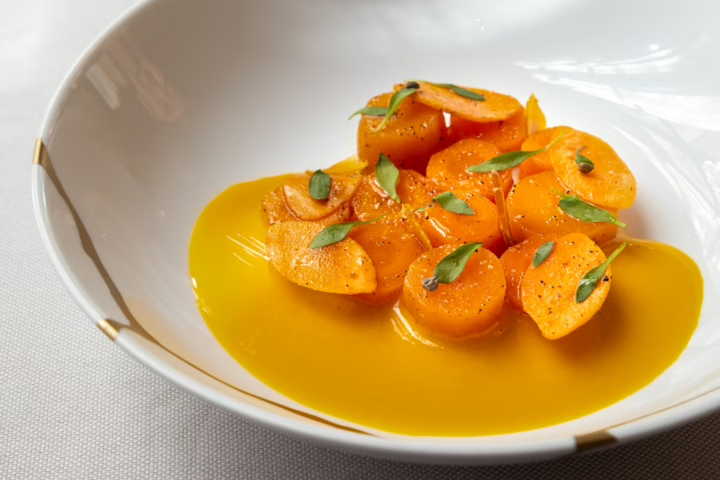
The vegetarian entrees included confit watercress, both cooked and raw sliced carrots, bottarga, and ginger.
Trente-Trois both cooked and raw sliced carrots, bottarga, and ginger, Paris, France
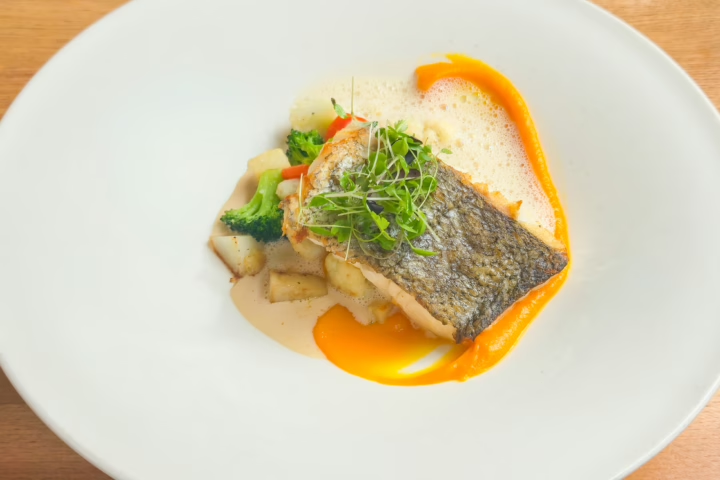
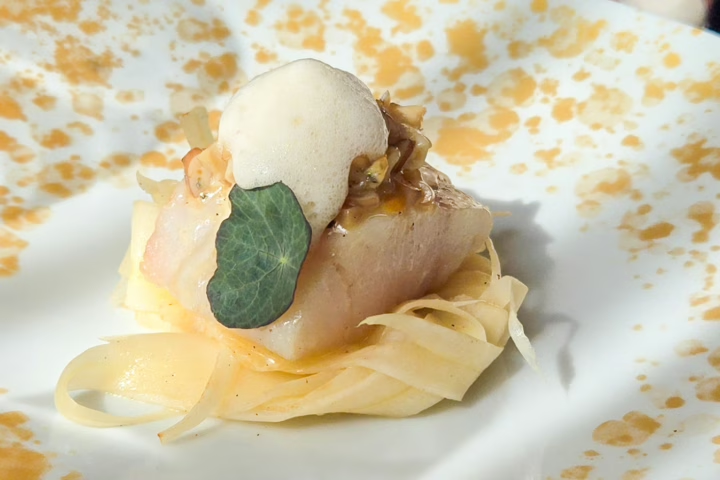
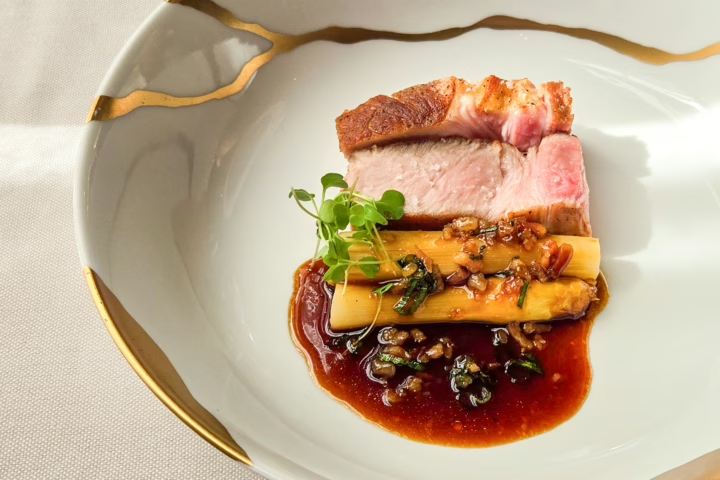
For the main courses, there was a catch of the day—haddock—served lightly pearled with shellfish and parsnip, as well as roast farmhouse pork from le Perche, braised white asparagus, and a rich jus.
Trente Trois catch of the day—haddock—served lightly pearled with shellfish and parsnip, Paris, France
Boucherie du Perche is a butcher shop in Paris that sources its products from farmers in the Perche region. Perche is located in the heart of Normandy and covers several departments: Orne, Sarthe, Eure, and Eure-et-Loir. The area is also famous worldwide for its Percheron horses.
Trente-Trois’ roast farmhouse pork from Le Perche, braised white asparagus, and a rich jus, Paris, France
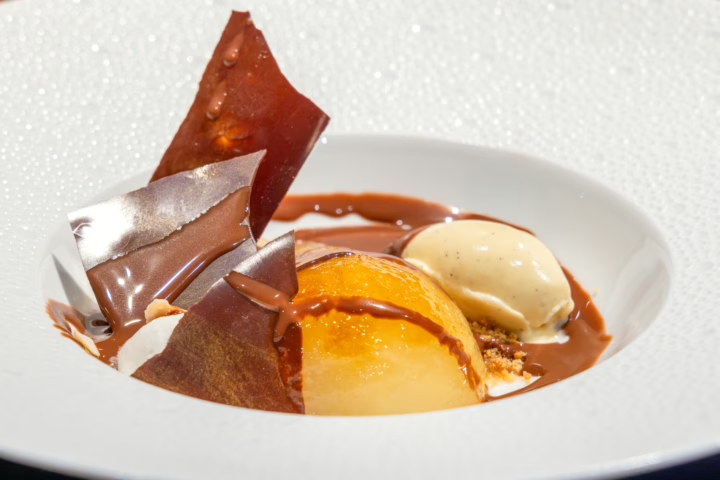
The desserts were: baba; poached pear with lightly whipped cream and orange blossom; Nicolas Berger Madagascar chocolate pecan nut; white coffee; and cocoa nibs.
Trente-Trois’ Nicolas Berger Madagascar chocolate pecan nut, white coffee, and cocoa nibs. Paris, France
There was also a farm-raised cheese platter, selected and matured by the Dubois house, as a dessert option. I missed this. If I had to do it again. I would have first ordered the cheese plate just to try it, and then enjoyed the desserts.
The entire experience was top shelf. I highly recommend lunch at Trente-Trois.
Ambiance, vibe, service: 5 Wine by the glass options or pairing: 5 Presentation and plating: 4 Yummy quotient: 4 Dessert quality: 5
The ZHAO Tavern has 12 locations across Paris. They market themselves as “100% Xi’an flavor, 100% Chinese style.” The food is served hot and fast and is delicious. We highly recommend.
Bonvivant365 is a retired couple that now writes about food, wine, and travel. They completed six months of training at a culinary and pastry school in southern France, followed by six months at a sommelier school in Bordeaux. They currently reside in Paris, where they are enrolled in the FERRANDI Paris Intensive Professional Program in French Cuisine. This four-month course focuses on technical skills in French cooking and examines the cultural heritage and creativity of the French culinary tradition.
Fusion cuisine. (2026, March 28). In Wikipedia. https://en.wikipedia.org/wiki/Fusion_cuisine ↩︎
(n.d.). AOP Fourme d’Ambert. Fourme-Ambert.com. Retrieved March 29, 2026, from https://www.fourme-ambert.com/fromage-aop/produit/. ↩︎
(n.d.). Fourme d’Ambert. The Word on Cheese Culture. Retrieved March 30, 2026, from https://culturecheesemag.com/cheese-library/Fourme-dAmbert ↩︎
In January 2026, my wife and I moved to Paris to attend the FERRANDI Paris Intensive Professional Program in French Cuisine. The program runs for just over four months. I decided to document our experience day by day. Below is an excerpt.
Here’s what we learned along the way:
FERRANDI Paris Week One
School started on Wednesday. It was a short week devoted to program orientation, including uniform fittings, a facilities tour, a kitchen walk-through, and an introduction to the cuisine toolkit, a ballistic, briefcase-like plastic case that holds all your tools.
FERRANDI Paris cuisine toolkit, first trayFERRANDI Paris cuisine toolkit, second tray
On Friday, our team of eleven spent the day in the kitchen learning and practicing fundamental vegetable cuts, including julienne, ciseler, emincer, tourner, macedoine, and brunoise. Most of us did not cut our hands. It was a whirlwind three days, but a lot of fun.
I have to say the support from the staff, chefs, and everyone throughout the entire process was “top shelf.” In fact, it was astonishing how kind and supportive the FERRANDI Paris back-office staff were throughout the entire onboarding process.
FERRANDI Paris Week Two
This was a full week. We had to be in the kitchen ready to go by 7:40 AM, earlier if you are the chef of the week or an assistant. I am glad my wife and I are just an eight-minute walk from school. We stayed at an Airbnb on Rue Saint-Séverin, so it is easy to get back and forth to school, which, after a long day when your feet are tired, is a good thing.
The FERRANDI sessions are 6 hours long and are divided into two parts: techniques, followed by applying those techniques to create classic French dishes.
Three chefs oversee our program. We were assigned to a team when we arrived, and you keep the same main chef throughout the entire program, with guest chefs. My initial take is that all the chefs in the program are top-notch and that this validates our decision to select Ferrandi Paris. The chef we have been assigned has decades of experience.
On Monday, we delved into vegetable preparation techniques, including turning. Vegetable turning is a technique where you rotate (turn) and cut vegetables into the exact same barrel shape and size to ensure a uniform look and even cooking. We practiced turning carrots, celeriac, zucchini, and artichokes. In the end, the vegetables must be the same size and fit inside a large tablespoon. The only good thing about my vegetable turns was that they were all the same size (more or less). However, with the chef’s demo. I did not make progress turning large artichokes into a “vessel.”
There are many varieties of artichokes worldwide. For our purposes at this time, there are primarily two types of artichokes. There are large artichokes whose stems you remove, turn, and use as a “vessel.” And there are small artichokes, which are turned with the stems on and serve as a dish. Our chef demonstrated an excellent method for turning large artichokes into a vessel. I have tried this many times before with limited success. He took me to the next level.
We then learned to “cook in blanc,” a slurry of water, flour, lemon, and salt, to prevent vegetables such as artichokes, which are prone to oxidation, from darkening. We cooked two artichokes. We reserved one artichoke for tomorrow; we cut the other and gave it to the chef, who showed us how to sauté artichokes with oregano (a favorite herb of the chef). I think the dish is called “Carciofi trifolati,” which are perfect as a side dish with lamb, for instance.
Next, we learned how to finely chop mushrooms, clean pearl onions, break down a tomato, hard-boil an egg, white- and brown-glaze vegetables, white-cook mushrooms, and make bechamel sauce. We used these ingredients to make duxelles de champignons, œufs farcis Chimay, bouquetière de légumes, champignons à blanc, essence de champignon, fried artichokes, sundried tomatoes, and tomato powder.
Essence de champignon, or mushroom essence, can be used to enhance sauces and other dishes. It is the old-world version of Aroma Maggi. known throughout France. Maggi ingredients include: iodized salt, sugar, chili pepper, pepper, cloves, cassava, onion, corn starch, monosodium glutamate (MSG), palm oil, soy lecithin, caramel coloring, and lovage.
According to Escoffier in Le Guide Culinaire, essences are concentrated stocks. He continues, “The most one can do is to recommend, in certain circumstances, the use of essences extracted from particularly well-flavored products, as, for instance, mushrooms, truffles, morels, and celery. But it would be well to remember that, nine times out of ten, it is preferable to add the product itself to the stock during the preparation of the same, rather than to prepare essences.”
The recipe for mushroom essence is credited to Marie-Antoine Carême. Carême’s original recipe, translated by Google, is “After slicing two handfuls of mushrooms, you put them in a saucepan with two large spoonfuls of consommé, the juice of one lemon, a pinch of salt, fine pepper, nutmeg, and a little butter. Simmer and reduce over low heat; then you add a large spoonful of veal stock and the same amount of ham essence; after a few boils, you strain the essence through a silk sieve.”1
A simpler way to make mushroom essence is to use small brown mushrooms.
After the session, my feet were killing me, so I ran off and bought a pair of BIRKENSTOCK Tokio Super Grip work clogs. My feet instantly felt better, and by the end of the week, after a 6-hour day, I had no trouble. My wife also bought a pair.
On Tuesday, we focused on steaming leeks in the oven, preparing and cooking julienne carrots, cabbage, and celeriac, making a basic vinaigrette, and preparing rémoulade, a classic French mayonnaise-based sauce.
We then used our new skills to make a French crudités platter, œufs mimosa, and poireaux vinaigrette mimosa (Leeks Mimosa).
French Crudité Platter, FERRADNI Paris
On Wednesday, we focused on stocks. The foundation of French cuisine. We made brown veal stock (French: “Fond Brun de Veau”), Beef Marmite, fish stock (French: “Fumet de Poisson”), vegetable stock (French: “Bouillon de Legumes”), and white chicken stock (French: “Fond Blanc de Volaille”).
The key idea reinforced is that stocks are the “foundation” of French cuisine, used in many dishes and for making sauces. You would be hard-pressed to find a French main course served without a sauce. The fundamental ingredients of all stocks are protein, aromatics, and water.
Stocks can be divided into three classes: brown, white, and clear. In brown stocks, the protein is roasted; in white stocks, it is poached. It is a nonintuitive experience, especially when you look at Beef Marmite, a classic French stock made by poaching three types of meat. Typically: Plat de Côte (Short Ribs), Paleron (flat iron steak), and Quevedo Beef (Oxtail).
The end product is brown but is considered white stock because the meat was poached rather than roasted. This is important to know because, in the end, when you sieve the stock, you may press down on the ingredients to extract any extra stock held in the mixture with the back of a ladle, but NEVER press down on a white stock when skimming, because you will cloud the stock.
After lunch, we had a class on fresh herbs.
Fresh herbs class, FERRANDI PARIS
On Thursday, we focused on the technique for making a chicken jus with intense flavor. It is a slow process that takes patience, involves multiple passes, and requires working the chicken in the pan to develop “suc” gradually. Sucs are the small brown bits that form at the bottom of your pot or pan when you sauté, sear, or pan-fry food, such as meat, or when caramelizing onions due to the Maillard reaction. If you work too fast, you will burn the suc and introduce a bitter taste, which you can try to mitigate with a pinch of sugar or a sprig of thyme, but your jus will never be the same.
We also learned to clarify stock, in this case, our Marmite from the day before, from which we made consommé, pot-au-feu, and chou farci.
Choux farcis served in beef consommé with root vegetables, Paris, France
Friday, we focused on the “Five French Mother Sauces” (No, these are not sauces the chef’s French mother used to make). French mother sauces are the foundational sauces in French cuisine, defined by Auguste Escoffier in 1903 in “Le guide culinaire.” This book is considered a classic. It is still available. The text of the culinary guide is in the public domain and can be found here at the National Library of France (BnF)
Escoffier traveled around France, spoke with many chefs, and wrote down (aka codified) French cuisine in a massive tome called “Le Guide Culinaire.” In it, he defined the “Five French Mother Sauces” from which all other sauces in French cuisine derive (and there are many).
For example, one of the “Five French Mother Sauces” is Béchamel sauce, a white sauce. It is a foundational sauce made by creating a roux (50% flour, 50% butter) and then adding milk, nutmeg, salt, and white pepper. Béchamel sauce can be used to make lasagna. But add cheese to it, and it becomes “Mornay Sauce” and “offspring of Béchamel. This is referred to as a “daughter sauce.” There are “Five French Mother Sauces.” They are Béchamel, Velouté, Espagnole, Hollandaise, and Tomato. More about these sauces and derivatives later.
FERRANDI Paris Week 3
On Monday, we spent more time on “les cinq sauces mères de la cuisine française” (the five foundational sauces of French cuisine) and on other emulsions and their derivatives, including mayonnaise and vinaigrette.
First, we focused on emulsified sauces that are stable at cold or hot temperatures. We made mayonnaise from which we then created tartar sauce, cocktail sauce, and remoulade, which is mayonnaise with mustard added; and since most mayonnaise today is made with mustard, mayonnaise is, by construction, a Remoulade. Then, we made Hollandaise, which we used to create Maltaise and Mousseline Sauces. Then we made Béarnaise sauce, from which we created Choron, Paloise, and Foyot sauces.
Mayonnaise…
Next, we focused on emulsified sauces that are unstable at cold or hot temperatures. The chef demoed vinaigrette (which we made last week), from which he created sauce moutarde and Gribiche sauce. Then, we made Beurre Blanc sauce (White Butter Sauce). After that, the chef demonstrated Beurre Blanc with cider and Beurre Rouge with red wine.
Vinaigrette…
In terms of sauce, it is important to understand what an emulsion is, how to make it, how to break it (split your sauce), and how to fix it.
Fundamentally, when you make an emulsified sauce, you take two liquids that do not mix and force them together through friction. You’ve heard it before: “Like oil and vinegar” is an age-old expression that means certain things don’t go together.
Tuesday was test day. The first part was a 20-question written test, followed by a practical exam in which we had to complete tasks demonstrating the techniques we had learned to date, regarding vegetable cuts, tomato fondue, chicken jus, and fish stock. I did well and was proud that both my seafood stock and chicken jus scored perfectly.
On Wednesday and Thursday, we focused on soups, potages, and veloutés. Here’s how they differ: a soup is any liquid, typically a mixture of vegetables, but in the case ofconsommé, it may be only broth. Potage is a thicker soup that can be blended or left unblended and passed through a sieve to make it more refined. Velouté, on the other hand, is a French term for a soup that is usually thickened with egg yolks, butter, and Crème Fraîche or cream.
Over the two days, we made: potage cultivateur, vegetable broth soup; potage julienne Darblay, cream of leek and potato soup with vegetable garnish; velouté Du Barry, cauliflower soup; potage Saint-Germain, green pea soup; and, of course, soupe à l’oignon, French onion soup.
Making the soup and potages was fun and easy. I had made them before, so there was nothing new. However, the big takeaway was the garnishes, which add variety and give the soup more character. They also improved mouthfeel and aided digestion.
Potage Saint-Germain served with a pea, lardons, and potato garnish topped with dollops of Crème Fraîche, crotons, and parsley oil
We also had two afternoon sessions, one on hygiene and the other on eggs.
Finally, we were broken into four teams for “reverse” teaching, or “flipped classroom” sessions. Each team was assigned a topic and must work together to research and prepare a presentation for the entire class. The topics are citrus, mushrooms, caviar, and Foie gras. My wife and I formed a team and were assigned Foie gras.
Next week, the focus is on cold starters, eggs, and we have a visit from an MOF fishmonger who will demonstrate how to break down a fish.
FERRADNI Week 4
I love eggs. So, in preparation for this week. First, I reviewed all the FERRANDI egg lessons they plan to teach. I have made them all before, but I am looking forward to going through them with a FERRANDI chef.
Then, I spent several hours reviewing the egg section of “A Guide to Modern Cookery” by A. Escoffier, a 799-page magnum opus of French cuisine.
Escoffier begins his formal discussion about eggs in Chapter XII. He states:
“Of all the products put into requisition by the art of cookery, not one is so fruitful of variety, so universally liked, and so complete in itself as the egg. There are very few culinary recipes that do not include eggs, either as a principal constituent or as an ingredient.” – A. Escoffer
Escoffier then goes on to outline 143 separate egg recipes (See Nos. 305 to 538). Now that is a lot of eggs. My goal one day is to make every one of Escoffier’s egg recipes and write about each. You can download for free the complete text version of “A Guide to Modern Cookery” from the “Project Gutenberg.”
After that, I was so inspired, I went shopping for a new omelet pan. I asked the chef last week about the proper size for a French non-stick omelet pan and where to buy one. He told me the proper size is a circumference of 20 cm and a base of 16 cm, and that on Rue Montmartre, at the corner of Rue Étienne-Marcel, there are several professional kitchen-supply stores: A. Simon, Comptoir de la Gastronomie, and MORA. I visited each and bought the best omelet pan I could find by Cristel France.
After that, I raced home and made a French omelet (I have done so before, but not in a number of years). The classic French omelet, “omelet au beurre” (omelet with butter), is made with three well-beaten eggs, butter, salt, and pepper. It is colorless, rolled, and served, brushed with butter, soft in the center with tight curds. It is luxurious.
Building on the basic “omelet au beurre,” and perhaps the most popular, is the “omelet aux fines herbes,” made in the same way as outlined above, but with equal parts of the four classic French herbs: thyme, tarragon, parsley (persil), chervil (cerfeuil), and chives (ciboulette).
No discussion of French omelets would be complete without a discussion of the “omelet de la mère Poulard” (“omelet of Mother Poulard”), which is basically an omelet soufflé, and made differently from above.
The omelet soufflé was developed by Anne Boutiaut Poulard, also known as Mother Poulard, in the 19th century in Mont-Saint-Michel, France. It is served at La Mère Poulard in Le Mont-Saint-Michel today.
Today, while editing this blog, I decided to take a break and make one of my own. Here’s how to do it: First, preheat your oven to 200°C and prepare the egg mixture. Separate the eggs into two medium bowls. Whisk the yolks together and add a pinch of salt. The classic recipe doesn’t use cheese, but I added half a cup of grated Parmesan to see what would happen, and it turned out great. Beat the egg whites until they form firm peaks. Then carefully fold the egg whites into the yolks with a spatula—gentleness is important here.
Then, melt some butter in a non-stick frying pan. I used my new 20 cm pan and three small pieces of butter. Not too little or too much butter. Just enough so the omelet will “float” a bit as it sets.
Next, pour in the mixture and cook over medium heat until it starts to set. You can check by gently shaking the pan to see if it wiggles a bit (The “Jurassic Park” test); if the top is still raw but the bottom is setting, it’s ready for the next step.
After that, put the pan in the oven for 5 minutes. It will finish cooking and stay very fluffy.
Finally, take it out, fold it over, and serve. It should be hard to fold over because it is so fluffy. Gently use a spatula to coat it. The result should be lightly browned on both sides, and the omelet soft and airy like a soufflé. No flour required.
Finally, what I found interesting in exploring Escoffier’s egg recipes was his perspective on hot and cold starters in Chapter XI. He writes:
“The preparations described hereafter all belong to the order of cold hors-d’œuvres. I did not deem it necessary to touch upon the hot kind, for, apart from the fact that these are very seldom served in England, at least under the head of hors-d’œuvres, they are mostly to be found either among the hot Entrées or the Savouries proper. Only ought to be looked upon as absolute… For my own part, I regard cold hors-d’œuvres as quite unnecessary in a dinner; I even consider them counter to the dictates of common sense, and they are certainly prejudicial to the flavor of the soup that follows.” – A. Escoffer
Œufs mollets florentine, soft-boiled eggs with spinach and Mornay sauce, Paris, France
Monday, we focused on eggs. We made œufs mollets florentine, soft-boiled eggs with spinach and Mornay sauce. Œufs pochés bourguignonne, Poached eggs served with red wine sauce, and œufs à la coque, mouillettes, Soft-boiled eggs served with breadsticks.
This week, we moved to an afternoon and early evening schedule. For the first two weeks, your team starts at 7:15, and the other team starts at 13:15. After that, the teams switch, so for the following two weeks, we start at 13:15 and finish at 19:00. So, I felt a little off today with the new schedule, and all you can do is basically come home, take a shower, and go to bed.
Back to eggs. All the dishes we made today are classics I have tried throughout France. Before today, the best œufs pochés bourguignonne I tried was in Lyon at Les Fines Gueules (See my post “Best Bouchons in Lyon, France“), which had an excellent red wine reduction, garnish, and plating. FERRADNI’s wine reduction, garnish, and plating recipe, which I executed to the letter today, is better.
First, we ciselered a medium shallot and sautéed it in butter over medium heat until softened (no color). Next, we add a thumb-sized amount of “lardons scraps,” 350 ml of Cabernet Franc from Chinon, a wine I would actually drink, and toss in an aromatic bunch comprising thyme, a bay leaf, and parsley stems to the seated shallots, and reduce to 50 ml. Pay attention. This concept of “reduction” is a technique used to enhance sauces. If you want to make a good sauce, you need to learn and practice this idea.
Then, once the reduction was complete, we added veal stock that had been enhanced with “essence de champignons” (mushroom essence) and reduced it by half. While the veal stock was reducing, we made large croutons by sauteeing bread cubes in clarified butter. After that, when the veal stock had reduced by half, we removed the lardons used for cooking and the aromatic bunch, and added to the reduction, in equal measure, the lardons we had cubed, blanched, and lightly colored, the mushrooms cut and sauteed to a light brown, along with the pearl onions we had brown-glazed. Finally, we poached an egg
We put it all together, using the reduction as the sauce and garnish, along with large crotons to plate our œufs pochés bourguignonne, pictured below (I should have cut the poached egg open as in the picture above, but I forgot and just ate it).
Œufs pochés bourguignonne, poached eggs served with red wine sauce, Paris, France
As I drift off to sleep, I think about the recipes I made today. They seemed simple at first, but they were actually quite sophisticated. The steps we took to build up the flavors turned basic bistro dishes into something much more interesting. Tomorrow is fish.
On Tuesday, I began my day with a two-hour beginner French class, then spent the afternoon cooking. Even though I’ve lived in France for two years, I tested at the A0 level, the lowest on the CEFR scale, which means I’m a complete beginner. I’m fine with that. Learning French over 60 is very difficult and not worth the “brain drain,” in my opinion.
Honestly, I don’t think most French people want to talk to me about their lives in French, and I don’t really want to talk to them about mine either. I know just enough French to handle daily situations: “S’il vous plaît, je voudrais, [fill in the blank or point], je paie par carte, merci, au revoir.” That covers things like saying what I want, paying by card, and saying thank you and goodbye. If I need to say more, I use Google Translate and show it to people, like at the barber, so I don’t accidentally get a crew cut.
Just when I think FERRANDI can’t get any better, something new surprises me. This time, Arnaud Vanhamme teaches us how to clean and fillet fish. Chef Vanhamme, a fourth-generation fishmonger and shellfishmonger, has earned the title “Meilleur Ouvrier de France Fishmonger-Oyster Shucker” and wrote, “Poissonnerie, Leçons en pas à pas” (Fishmonger, Step-by-Step Lessons). He’s also just a genuinely nice person.
He showed us how to clean and fillet rouget, vive, and sole, and also demonstrated how to fillet a Conger eel.
According to the “Paul Ricard Oceanographic Institute,” The Conger eel is a “big fish that looks like a snake… The smooth, snake-like body of the conger eel has no scales and can be up to 3 meters long! It has a rounded snout, and its upper jaw protrudes over the lower jaw. Its dorsal, caudal,l and anal fins are confluent. Its body can be light or dark grey with a white border on the fins. Conger eels feed on fish, crustaceans, and cephalopods and live in crevices on rocky bottoms, in wrecks, and on sandy bottoms down to depths of 100m. They can be found in the Mediterranean, including the western part of the Black Sea, and from Norway to Senegal in the Atlantic… The conger eel spends most of the day in its hole, only coming out at night to hunt. Larger [conger eels]can be aggressive and may attack scuba divers.”2 I am glad this one was dead!
Conger eel ready to filet, Paris, France
How can you eat a conger eel? BBC Food summarizes it well:
“The tail end of a conger eel is notoriously bony and is best used for stock. The rest can either be grilled, pan-fried, or casseroled. The firm, strong flavor of the meat works well with bacon, garlic, white or red wine, and smoked paprika. Conger eels are sometimes used to make Caldeirada, a Portuguese fish stew. They are also popular in South America, Japan,n and China.”3
Chef Vanhamme held up the eel’s large, fleshy head and shared a story from his childhood. His aunt (I think) used the head to make a tasty fish stew that fed the whole family, with plenty left over. Even now, it’s still his favorite. Whenever someone offers him soup made with a fish head, he always says yes.
I hadn’t cleaned or filleted a fish in almost nine months, so I felt a bit out of practice and nervous with a MOF watching me. Still, I managed all right. I wasn’t completely happy with my fish knife, so since we’ll be working with fish a lot, I ordered a SHAN ZU Fillet Knife (18 cm, 7 inch, German stainless steel) on Amazon.
He wrapped up the class by talking about oysters and brought in some special Gillardeau oysters for us to try, which were paired with a nice Chablis from William Fèvre (See my post 36 Hours in Chablis, France).
The Gillardeau family has been producing these oysters in Bourcefranc-le-Chapus, near La Rochelle and the Île d’Oléron in western France, for more than a century. These oysters stand out for their large size, fleshy texture, and unique flavor. Each one is given plenty of space as it grows and is moved and turned over a thousand times during its development.
We took some photos with the chef and thanked him for his time. When I asked, he said his favorite spot for fish in Paris is Brasserie La Lorraine. We’re planning to go there soon. Right now, though, I need to get some sleep—it’s 5 AM, and I’ve been up since 2:30 writing this blog. It’s going to be a long day. We have a research lab in the morning and make bouillabaisse during our afternoon/evening session.
On Wednesday, we made a hearty fish soup called Bouillabaisse, the signature dish of Marseille, an ancient Phocaean port city in southern France. Fishermen there created Bouillabaisse on their boats to feed themselves with fish they could not sell. For our version, we used five types of fish: petite vive, carrelet, striped red mullet, red gurnard, and conger eel.
Traditional Bouillabaisse differs from other fish soups in that it uses only local Mediterranean fish, Provençal herbs and aromatics, and North African spices. After simmering, the soup is strained through a food mill, then through a chinois, to create its signature texture. It is then reduced until it reaches the desired consistency. Whole fish are gently poached in the soup to finish.
Bouillabaisse is served with thick slices of toasted bread rubbed with fresh garlic and topped with rouille, a garlicky sauce made from egg yolks and olive oil, thickened with bread soaked in the soup or flavored potato puree. A small side of shredded gruyère cheese is also offered to add more flavor and richness to the soup.
People who are passionate about Bouillabaisse believe it should be only served in two courses: first as an entrée, then as a main course. The meal begins with a soup starter served with croutons, rouille, and cheese. After a second helping of the soup has been offered, the whole poached fish used to finish the Bouillabaisse is brought to the table, filleted, and served with more broth as the main course.
Still, Bouillabaisse is often served as a single main dish, with a mix of fish filets in the soup, which is how we plated and served it, as I had at La Méditerranée, a fish restaurant in Paris, where it was made and served as a single dish.
In the 1980s, to protect the dish, the Rhul Restaurant, which has specialized in bouillabaisse in Marseille’s 7th arrondissement since 1948, led a group of restaurants that banded together to create the “Bouillabaisse Charter,” defining the basic ingredients and presentation to ensure the dish’s quality and service.
I like Bouillabaisse, but my favorite fish soup is Cioppino, an Italian American fish stew originating in San Francisco, California, full of shrimp, clams, mussels, crab, and more.
Cioppino was created in the late 1800s by Italian, Spanish, and Portuguese fishermen who worked off Meiggs Wharf and lived in San Francisco’s North Beach. If a fisherman returned without a catch, he would go around with a pot, and the others would add whatever seafood they could spare. This mix became known as his “cioppino.” The fishermen who helped out expected the same kindness if they ever came back empty-handed. As Italian restaurants spread in San Francisco, cioppino became a popular dish.4
Thursday, we made more eggs. We made a tartelette au saumon fumé et aux œufs brouillés (Smoked salmon and scrambled egg tartlet), tarte aux œufs brouillés et au saumon fumé (scrambled egg tart with smoked salmon), œufs cocotte (creamed eggs in a cocotte), œufs parfait aux champignons (perfect egg with mushrooms and hollandaise sauce), and omelette soufflée (omelette soufflé).
Before I started at FERRANDI Paris, my wife and I cooked our way through every recipe in Le Cordon Bleu at Home, a 500-page-plus book from Cordon Bleu Paris. The book has 90 lessons, each a three-course meal. It took us about three years to finish them all, so I was already familiar with every egg dish. Still, FERRANDI Paris brought its own twists.
We finished the class by making a classic French omelet. When the chef was younger, he worked at a restaurant where he made many omelets for brunch and was shown how to roll them in the pan with just his hands. I had never seen this technique before. So I tried it with limited success. I still prefer Jacques Pépin’s method or Donato Russo’s rolling technique from Mirazur.
The chef ended the class with a demo of the omelet de la mère Poulard, for dummies. A very simple recipe that requires three eggs, clarified, meaning the egg yolks and white are separated.
FERRANDI Week 6
On Monday morning, we had a three-hour art class. We received an art kit with drawing tablets, colored pens and pencils, watercolors, and other art supplies. The class focused on color theory and how it can be used to make dishes look more appealing. I found it interesting and understand why it matters, but I hope we also learn about the standard rules for plating food.
I learned that luminosity measures how bright something is, from white to black. Luminosity combines hue, the specific color on the rainbow, and saturation, how intense or pure that color is, ranging from pure color to grey. In cooking, flowers were added to dishes to help balance all the colors across the brightness and saturation scale on a plate.
Monday afternoon, we mise en place the ingredients for most of the week. Mise en place is an important French term meaning “put in place.” It refers to organizing the equipment and preparing the ingredients needed before you start cooking.
We had a new chef this week, so class was a bit chaotic.
This week we will make: saumon fumé, smoked salmon, saumon mariné à l’aneth, marinated salmon with dill, saumon mariné à la betterave, marinated salmon with beetroot, tartare de dorade, seabream tartar, ceviche de dorade, seabream ceviche, carpaccio de dorade, scallop or seabream carpaccio, rillette de maquereaux, mackerel rillette, escabèche de maquereaux et rougets, mackerel and red mullet filets cured the escabeche way, saucisson en brioche, brioche saucisson, and feuillete de bar au beurre blanc, seabass eellington, served with a white butter sauce.
I recently purchased the SHAN ZU Fillet Knife (18 cm, 7 inch, German stainless steel) from Amazon, as previously mentioned. Unfortunately, my experience with this knife was bad. While the blade is flexible, the handle is thick and heavy. As a result, I was unable to achieve the control I was used to when filleting fish. Instead, for the first time, I cut through the backbone and butchered my fillets. That’s not normal for me, since I’m usually pretty good at filleting basic fish.
We also made puff pastry in a way I’d never made it before: by preparing the dough with melted butter, rolling it out, folding it, and letting it rest between folds. In some ways, it was very much like how we learned from Le Cordon Bleu at Home, as I mentioned above. We complete one turn, and then what the chef called a “wallet fold.” So, 1.5 folds in all? This is very different than what we learned in pastry school, but much, much easier.
But I think I did make one fatal mistake. When I placed the “dry butter” in the center, folded it, and rolled it out. I did not use long rolls from end to end. My rolls were choppy, which means my butter was most likely not evenly distributed through the dough, so my puff pastry may not rise well. I am very curious how it will all turn out.
On Tuesday morning, I spent two hours in French class. I really like my teacher. If I had met her when I was five, I’d probably be fluent by now. My wife, on the other hand, is doing great with her French. She studied it when she was younger and has been working on it again for the past three years. She just earned the DELF B1, which is a diploma from the French Ministry of Education. It demonstrates she has obtained B1-level French skills, and it’s valid for life.
Tuesday afternoon, we made tart shells from feuille brick and made ink tuiles. Using the mise en place we prepared on Monday, we assembled and plated four dishes: the tartare, carpaccio, ceviche, and smoked mackerel rillettes.
We also turned our puff pastry 1.5 times again and placed it back in the cooler. We also started to smoke the salmon.
There are several kinds of French pastry: pâte brisée, shortcrust pastry, pâte sucrée, sweet pastry, pâte sablée, shortbread pastry, which is sweeter and more crumbly than shortcrust pastry, pâte feuilletée, puff pastry, and pâte à choux, among others.
Brick pastry sheets are store-bought; they come in very thin sheets, separated by paper. Brick pastry sheets resemble filo pastry but are more robust and elastic when raw. We used them to make a tart shell for the rillettes, which worked very well. I had tried filo dough before with little success.
I also learned that if you peel and steam an avocado for two to three minutes, it will prevent it from turning brown. I asked the chef how I would steam at home, and he mentioned I could use a bamboo steamer or buy the ANOVA Precision Oven.
On Wednesday, we made the French classic starter “cassolette de rouget et maquereau escabeche,” a casserole of red mullet and mackerel in wine, oil, and vinegar. It is a French classic, eaten in the summertime, served and shared family-style with a French baguette, and pairs well with Sauvignon Blanc or a light rosé.
It is easy to make and fun to eat. First, you filet the Mackerel. Then you chop the onions, carrots, and garlic for the marinade. Next, combine all the ingredients in a saucepot, add a bay leaf, thyme, whole peppercorns, coriander seeds, and espelette pepper, and bring to a boil. You remove it from the heat, pour it over the Mackerel, and let it rest. After that, you brunoise tomatoes, white cook small triangles of fennel in water, olive oil, and salt, fry sections of eggplant, pickle red onions, and skin and boil baby new potatoes.
Finally, the “cassolette de rouget et maquereau escabeche” is typically served in a large gratin dish, family-style. Everyone uses a serving spoon to take what they want, assemble it between two slices of bread, and eat it, mopping up the oil with more bread. We were told that for the French, it is all about the carrots and the onions.
On Thursday, we prepared saucisson en brioche, which we served with a wine sauce made from Madeira, Port, Banyuls, the veal stock we made earlier, and a small mirepoix. We also made feuillete de bar au beurre blanc, or sea bass Wellington, served with a classic white butter sauce.
Saucisson en brioche is a famous dish from Lyon, France, which I often had while visiting Lyon and made while at the Paul Bocuse school, now called Lyfe Institut. See my post “Best Bouchons in Lyons, France.”
The key to this dish is ensuring the sausage sticks to the brioche while it cooks. This is done with egg whites and egg white powder. First, you wash the sausage with a brush in egg whites, then sprinkle it well with egg white powder, roll it in the broche, and let it proof before baking.
On Friday, about 80 international students took a bus trip to Champagne. My wife and I didn’t join because we’re planning a private tour to Champaign in April. Today, we talked to some friends who went, and they said it was a great experience. They visited a Champagne cooperative, toured, tasted Champagne, and enjoyed lunch with hors d’oeuvres. Everyone had a lot of fun, and it was a good opportunity to meet and connect with others in the international program outside their usual groups.
FERRANDI Week 7
On Monday, our main program chef returned, which was great. He has been working in kitchens since he was 15 and has taught at FERRDANI for the past 25 years. He is a true French chef and really knows how to teach; no messing around.
He gets straight to the point, with hardly any unnecessary talk. This approach is very different from the first culinary school I attended in France, but I like the serious atmosphere here because it helps me imagine what it would be like to work in a real MICHELIN kitchen. Young friends of ours who have gone on to internships at MICHELIN restaurants have told us there is no extraneous talking or playing in the kitchen; it is all about getting the job done.
We made the iconic quiche Lorraine, cheese-and-bacon flan, and mise en place two puffy pastry doughs. One we will use tomorrow to make an asparagus, morel, and sweet bread vol-au-vent, which is about as classic French as you can get. The other we froze and will use to make “pithiviers de pigeon et foie gras” (pigeon & foie gras pie) later.
According to our chef, the best restaurant in Paris for vol-au-vent is Café des Ministères. The dish is called “Grande Tradition, Sweetbreads, free-range poultry, spinach, truffle jus.”
Quiche Lorraine is a dish from the Lorraine region of France, which borders Belgium, Luxembourg, and Germany. The larger area, Alsace-Lorraine, has switched between French and German rule many times. Today, Lorraine’s culture mixes both German and French traditions. My wife and I spent a month in Strasbourg, and I can say the German influence is strong there, especially when it comes to food.
According to Larousse Gastronomique, quiches, sometimes spelled “kiches,” originated in Lorraine, eastern France. The term may derive from the German word Kuchen, which denotes similar dishes. Numerous varieties of quiche exist, and Larousse observes that each region in Alsace and Lorraine asserts its own as the authentic version. Initially, quiche Lorraine featured a bread dough crust similar to those used for pissaladières and pizzas, but contemporary recipes typically use shortcrust or puff pastry.
Traditional fillings for quiche Lorraine include eggs, thick cream, and lardons or ham. The original recipe did not contain cheese. Notably, in Mastering the Art of French Cooking (1961), Simone Beck, Louisette Bertholle, and Julia Child omitted cheese from their quiche Lorraine recipes.
Our chef made a quiche tart shell that was perfect. He rolled the shortcrust pastry, or pâte brisée, freehand without a rolling pin to ensure an even thickness, then placed it perfectly into the pastry ring and molded it. The edges were the same all the way around when he formed the tart. I was envious.
We blind baked our tart shells before filling them, something I’ve done many times with great success. But this time, I made a mistake. I didn’t spread the beans and seeds evenly in the shell, so it warped a little while baking. When I poured in the custard, it settled at an angle.
I liked the quiche Lorraine we made, but my wife and I both agreed that our favorite is still the quiche aux épinards, quiche with spinach and ham filling, from Lesson 32 of the Le Cordon Bleu at Home cookbook. We have made many times and served friends.
Anyway, I am really tired today, and I am not sure why. I skipped French class because I didn’t think I could get through it feeling like this. Still, I went home and finished my two-hour French homework assignments. Yikes.
Tuesday, we made bouchée à la reine (English: The Queen’s Bite), which consists of a vol-au-vent, puff pastry bowl, and its filling. We had this dish in Strasbourg last summer (See my post “Best Restaurants in Strasbourg, France“).
First, we shaped and baked vol-au-vents using the puff pastry dough we prepared yesterday and left to rest overnight in the refrigerator. Chilling pastry overnight allows the gluten in the flour to relax and the butter to solidify, improving the dough’s integrity and resulting in a more uniform bake.
A vol-au-vent is a light, hollow pastry bowl made from puff pastry and shaped made like a bird’s nest. The name “vol-au-vent” means “flight in the wind” in French, which hints at how airy and delicate this pastry shell is.
The term vol-au-vent initially referred exclusively to the puff pastry bowl; however, its definition has expanded to include the filling as well.
The invention of the vol-au-vent is commonly attributed to Marie-Antoine Carême (1784-1833), a prominent French pastry chef and culinary author. But the term “gâteau vole-au-vent” (vole-au-vent cake) was documented as early as 1750, which predates Carême’s lifetime.
Nonetheless, Chef Carême established the vol-au-vent as the standard for both savory and sweet tarts and pies, which became his specialty. At that time, the term vol-au-vent referred exclusively to the puff pastry shell. While numerous savory recipes were developed, fruit-filled vol-au-vents were generally avoided because fruit tends to make the crust soggy.
Traditionally, the vol-au-vent was designed to serve multiple people and typically measured approximately 15 to 20 cm in diameter. Beginning in the mid-20th century, the size of vol-au-vents was standardized for individual servings, including the bouchée à la reine (10 cm) and the mini-vol-au-vent (4 to 5 cm), which are commonly used as hors d’oeuvres or appetizers.
Originally from France, vol-au-vent has become a popular dish in Belgium and is often featured on menus at traditional Belgian restaurants.
According to our chef, the best restaurant in Paris for vol-au-vent is Café des Ministères. The dish is called “Grande Tradition, Sweetbreads, free-range poultry, spinach, truffle jus.”
I digress. Back to what we made.
As our vol-au-vents baked, we prepared the filling: duxelles topped with chicken à la crème (chicken in cream sauce), asparagus, morel mushrooms, and sweetbreads (French: ris de veau). What are seetbreads? (No, they are not some kind of fun French pastry).
According to Larousse Gastronomique, the definitive reference book on French gastronomy, its history, and culinary techniques, sweetbread is “the culinary term for the thymus gland (in the throat) and the pancreas (near the stomach) in calves, lambs, and pigs.” Today, sweetbreads from the thymus of milk-fed veal calves are most commonly eaten. That is what we used: blanched and steamed.
In the afternoon, we had a knife-sharpening demonstration by a representative from KAMA-ASA, a boutique Japanese kitchen supply store in Paris.
Chefs sharpen their knives using different sharpening stones: wet or dry. They usually start with a coarse grit to reshape the edge, then move to medium grits to smooth it, and finally rub the knife on leather. This is called “stropping.” Usually, done on a leather strap to remove the last imperfections, making the knife even sharper.
He demonstrated the entire process of properly sharpening a knife. As home chefs, my wife and I just use a pull-through sharpener and get our knives professionally sharpened once a year. I found out this method is fine and much better than not sharpening at all.
But in the end, we learned that there is no single right way to sharpen a knife. Many methods can work well. The important thing is to find a technique you like that gives you good results and stick to it. He has a favorite sharpening rhythm: he starts with a 500-grit stone, then moves to an 8000-grit stone. This method, he claimed, is simple and works well most of the time. He challenged us to give it a try.
I also learned that VG-10, a type of stainless steel made in Japan, is considered the gold standard for knives and that the two most essential knives to own are a 21 cm chef knife and a 12 cm paring knife. However, because of something I call the ‘Stainless steel soap’ phenomenon, chefs who handle fish often prefer carbon steel knives. Wait, what exactly is the ‘Stainless steel soap’ phenomenon?
Companies that produce stainless steel soaps claim that odors from foods such as fish, garlic, or onions can be removed from the hands by washing them in water and with a bar of stainless steel soap. But how does this actually work? There are two main ideas, neither of which has been proven yet, and beyond the scope of this post.
Others in the class supported the idea that stainless steel soap removes odors, so I ordered a bar from Amazon to test it myself. My main point is that because stainless steel is supposedly effective at removing fish odors, some chefs who work with fish avoid using stainless steel knives, believing it affects fish. Believe it or not, this is a genuine concern among some chefs.
On Wednesday, we made a Pissaladière, a caramelized-onion-and-anchovy tart that looks like a pizza. It is a specialty of Provence, France. The traditional toppings are sweet caramelized onions, anchovies, and olives on a yeasty pizza-like dough. It is served hot, warm, or at room temperature. I have made Pissaladière many times before when I serve our “Taste of Provence” menu to friends. We also made a tart of fine de sardines.
That afternoon, we gave our Foie gras presentation to the chef and the class as part of FERRANDI’s reverse teaching exercise, which we first heard about in week 3. Preparing for it was tough since school keeps us so busy, so I was relieved when it was over. I felt the exercise had some value, even if it was limited, but my wife completely disagreed and thought it was a waste of time. Honestly.
On the way home, we stopped for some food, but I won’t mention the place. I ended up with a bad bacterial stomach infection that knocked me out with very unpleasant symptoms (if you know what I mean). By Thursday morning, I was still feeling awful, so I decided it was best to stay home from school. Luckily, had a dose of the antibiotic ampicillin in my “first aid kit,” and that took care of it. I was so exhausted that I slept for 20 out of 24 hours.
The only upside was that I missed art class. I want to be clear that the instructor is very nice, knows a lot about art, and has a clear teaching style, but I think the course misses the point. I was hoping to learn the basics of gastronomic plating and the rules used in restaurants. To be fair, his focus on form, color, shapes, and textures, and how they work together in plate design, is valuable. Still, I think he should have started with the basics of plating before moving on to more advanced creative topics.
Stay tuned, there is more to come…
Bonvivant365 is a retired couple that now writes about food, wine, and travel. They completed six months of training at a culinary and pastry school in southern France, followed by six months at a sommelier school in Bordeaux. They currently reside in Paris, where they are enrolled in the FERRANDI Paris Intensive Professional Program in French Cuisine. This four-month course focuses on technical skills in French cooking and examines the cultural heritage and creativity of the French culinary tradition.
Marie-Antonin Carême, L’Art de la Cuisine Française au Dix-neuvième Siècle (Paris: Au Dépôt de Librairie, 1854), vol. 3, pp. 257–258.↩︎
My wife and I visited Caves de Rauzan today, a wine cooperative (Co-op) in Entre-deux-Mers, the largest wine-producing sub-region of Bordeaux. It was a cold, cloudy day, but it gave us a “backstage pass” to the inner workings of a Bordeaux wine cooperative. It was a lot of fun and very informative.
Caves de Rauzan, Rauzan, France
Entre-Deux-Mers Overview
Entre-Deux-Mers is a large, triangular area of land southeast of Bordeaux. It sits between the Garonne and Dordogne tidal rivers, which led people in the Middle Ages to call it “Entre-Deux-Mers,” or “between two seas.” This area is the largest wine-making sub-region in Bordeaux. It is a hilly area with about 7,000 hectares of vineyards.
There are nine Appellations d’Origine Contrôlée (AOCs) across the Entre-Deux-Mers: Entre-Deux-Mers AOC; Premières Côtes de Bordeaux AOC; Sainte-Croix-du-Mont AOC; Cadillac AOC; Loupiac AOC; St-Macaire AOC; Graves de Vayres AOC; and Sainte-Foy-Bordeaux AOC for sweet wines. The soils vary across the AOCs and include sand, clay, clay-limestone, and gravel. The area has a mild, oceanic climate.
Entre-Deux-Mers AOC
It is a bit confusing because the Entre-Deux-Mers is both the name of the general area and an AOC within it. The Entre-Deux-Mers AOC wine appellation was established in 1937 and initially allowed both dry and sweet white wines. In 1957, the rules changed so that only dry white wine could be made, labeled, and sold as Entre-Deux-Mers. The main white grapes grown here are Sauvignon Blanc, Semillon, Muscadelle, and a few others.
Red wines have always been produced in Entre-Deux-Mers, but until recently, they could be labeled only as Bordeaux AOC or Bordeaux Supérieur. On August 25, 2023, the Entre-Deux-Mers Rouge AOC was introduced, allowing red wines to be sold under the Entre-Deux-Mers name. Starting with the 2023 vintage, Entre-Deux-Mers winemakers chose to label their red wines Bordeaux AOC, Bordeaux Supérieur, or Entre-Deux-Mers.
The approved red grape varieties for Entre-Deux-Mers AOC wines are Cabernet Sauvignon, Merlot, Malbec (Cot), Cabernet Franc, and Petite Verdot. Carmenère is an “accessory variety” and can make up no more than 30% of the final blend. Each wine must include at least two grape varieties.
What is a Wine Cooperative
A cooperative is an organization of individuals that come together to share costs. At the heart of all cooperatives is the “mutualization of financial means.” Uh?
Picture yourself as a winemaker. On your own, you don’t want to, or you don’t have the resources, to manage the vineyard and make and sell your own wine. So, what can you do? You team up with other local winemakers in your area, and combine your resources to share the costs of managing all the vineyards and create and staff a central location for making and selling wine. “Mutualization of financial means” is at the center of any cooperative. Almost half the wine produced in Europe is co-op wine.
Caves de Rauzan Wine Cooperative
Caves de Rauzan is a cooperative of 230 Entre-deux-Mers winemakers that have come together to share the cost of making and selling their wine. Members jointly own and manage the cooperative, ensuring every winemaker has a voice in decision-making and a share of the profits based on the quality and quantity of their contributions.
It basically works like this (the exact details may not be 100% correct): When a winemaker joins the cooperative, they pay a fee based on their size and get shares in the cooperative, which are returned to them if and when they leave. Every year at harvest time, the winemakers deliver their grapes to the cooperative’s central winemaking facility, where the GM and his team make and sell the wine.
When the wine is made and sold, each winemaker is compensated based on the quantity, the quality, and, for red wines, the “peripheral” of the grapes they delivered. 70% of the wine is sold by the cooperative as bulk wine and shipped off, for instance, to Canada, where it is bottled and sold by others. The rest is bottled on demand for supermarkets or others, or as the cooperative sees fit for B-to-C sales.
Château Canet was up for sale, so the Co-op bought it and considers it’s mascot.
My wife and I visited the Château de Reignac in Bordeaux’s Entre-deux-Mers region. We learned much about its unique history and wines, including the patented Vatelot method used to make the Château’s flagship wine, BALTHVS.
Château de Reignac, Saint-Loubès, France
The Château was built in the 16th century. In 1990, Yves Vatelot, a French inventor and entrepreneur, bought the estate, restored the buildings, updated the wine-making facilities, and collaborated with oenologist consultant Michel Rollan to focus on the vineyards and winemaking.
Today, Château de Reignac is seen as one of the top estates in Entre-deux-Mers and the larger Bordeaux wine region. It is recognized for its excellent terroir, consistent quality driven by its focus on excellence, and its value for money.
The “inner workings” of the patented Vatelot method
This is my understanding of how the Vatelot method works and why it is effective: The process begins with cold maceration and fermentation of grapes in aluminum vats. Subsequently, oak barrels are filled with the fermented wine and the grape must, which consists of crushed grapes containing juice, skins, and seeds. The barrels are sealed with a head (pictured below) and rotated several times daily. Metal bars within the barrels enhance post-fermentation maceration. Because the barrels remain sealed, the wine experiences significantly less air contact and, consequently, less oxidation than with the pump-over or punch-down methods. After this stage, the wine is racked, meaning it is transferred to barrels for malolactic fermentation.
In the 19th century, a greenhouse attributed to the engineer Gustave Eiffel was added to the estate; see the picture below.
Tasting Notes: BALTHVS, 2016
Tasted in non-blind conditions in my Airbnb in Bordeaux, France.
Bordeaux 2016: According to The Wine Cellar Insider, the 2016 Bordeaux season began with unusually cool and record-setting wet weather. Despite this, early June flowering, particularly for Merlot, was highly successful, resulting in the most significant crop per hectare since 2004. But the summer drought left many vineyards short of moisture by September, causing some vines to nearly halt their growth to conserve energy.
Although Merlot remained abundant and healthy, it required water. Rainfall on September 13 and 14 benefited the Merlot, while additional rain on September 30 and October 1 arrived when Cabernet Sauvignon needed it most. These conditions required winemakers to pick carefully and sort grapes, separating overripe and drought-affected fruit from ripe, fresh ones. Notably, there was virtually no rot on the red grapes for the third consecutive year (See 2016 Bordeaux Harvest and Vintage Report).
Grape varieties: 100% Merlot (old vine 30 years)
About the wine: According to the Château de Reignac 2016 fact sheet, in terms of viticulture, spring de-budding was performed to remove buds on the vine’s spurs or branches that were considered to be of little or no use to the vine. Leaves were manually thinned, and removal was performed on the east-facing side to allow for morning sun. Green harvesting was conducted twice to remove excess green bunches from the vines before the grapes changed color and the sugar content rose, reducing yield, concentrating nutrients, and releasing them to the remaining bunches to build healthier grapes. The grapes were then hand-picked into small baskets and double-sorted both before and after destemming.
In terms of vinification, the grapes were cold macerated at 6°C for 7 days before fermentation. They then fermented for 35 days in two new oak barrels using the patented Vatelot method, which also included post-fermentation maceration. After this, the wine was racked to barrels and underwent malolactic fermentation.
Finally, the wine was aged in 100% new oak barrels, stirring the lees in the barrels stacked using the Oxoline system. Coopers: Garonnaise.
Appearance (Visual examination): A bright, red wine free of sediment and gas with a dark, inky purple color, a cherry-copper rim, and a deep inky purple hue; moderately concentrated with medium-low viscosity.
Nose (Olfactory examination): Medium intensity with notes of black fruit, such as plum, sour cherry, flower aromas of lavender, and nuances of chocolate, tobacco, and black pepper.
Palate (Gustative examination): Elegant, yet fresh. Structured with richness and silky tannins, the finish is well-balanced, with a persistence that leaves a lingering hint of spicy dark chocolate on the palate.
Service: Decant for 1 hour. Serve at 16-18°C (61-64°F) in a Bordeaux wine glass.
Food Pairing: Classic Entrecôte à la Bordelaise, rib steak in red wine and shallot sauce, served with pommes pont neuf (thick-cut fries), is a classic pairing.
I made and paired the BALTHVS, 2016, with an “Aberdeen Angus Steak” from “Gastronomie Des Pyrénées,” a port wine foie gras sauce, and freshly harvested young, small sauteed potatoes.
Bonvivant365’s “Aberdeen Angus Steak” from “Gastronomie Des Pyrénées,” port wine foie gras sauce, and young sauteed potatoes
Summary: Château de Reignac’s “BALTHVS,” 2016, is an easy-drinking red wine that, once awake, is a joy to spend time with, never tiring.
Source and price: Château de Reignac, 60 euros.
Reviews: 92-93/100 J. Suckling
Château de Reignac Address: 38 Chem. de Reignac, 33450 Saint-Loubès Phone: 05 56 20 41 05 https://reignac.com/en/
To learn about our visit to the largest wine cooperative in the Entre-deux-Mers region, see my post Caves de Rauzan Visit.
Maison Nouvelle is a 2-star MICHELIN restaurant in Bordeaux’s Chartrons neighborhood. It is led by Chef Philippe Etchebest and his wife, Dominique. Philippe Etchebest is a renowned chef and celebrity television personality, known for shows such as “Top Chef” and “Kitchen Nightmares.” He holds the prestigious title of “Meilleur Ouvrier de France” (MOF), which signifies that he is among the top chefs in the country and is recognized for his exceptional craftsmanship.
Maison Nouvelle, Chartrons, Bordeaux, France
Upon arriving at Maison Nouvelle, you ring the front doorbell as if you were visiting a friend’s house for lunch. The greeting is warm and friendly. The atmosphere is warm and inviting. Maison Nouvelle exudes a quiet luxury that emphasizes quality and simplicity. We felt right at home.
Maison Nouvelle’s bar, Chartrons, BordeauxMaison Nouvelle bar seating area, Chartrons, BordeauxMaison Nouvelle, dining area, Chartrons, Bordeaux
The communication before lunch was impressive. I was able to convey my wife’s preferences to the chef, who adapted the menu accordingly. Specifically, she prefers beef cooked medium well.
My wife began with a glass of “Tradition Rosé Brute, Fernand Lemaire, Champagne. I began with a glass of Valérie & Gaël Dupont’s “Heureuse Rencontre” Extra Brut Champagne. All of which paired excellently with the small snacks we were served.
Maison Nouvelle’s “Amuse-bouche,” Chartrons, BordeauxMaison Nouvelle’s fruit gel, Chartrons, Bordeaux.
We were then served “Freshwater Squash.” Kabocha squash in a royal sauce, marinated eel, and Saint-Émilion soy sauce.
Maison Nouvelle’s “Freshwater Squash,” featuring Kabocha squash in a royal sauce, marinated eel, and Saint-Émilion soy sauce, Chartrons, Bordeaux.Maison Nouvelle’s “Freshwater Squash,” Kabocha squash in a royal sauce, marinated eel, Saint-Émilion soy sauce, Chartrons, Bordeaux
Next “Shell and Root,” Seared scallops, tuberous chervil, hazelnut milk yogurt.
Maison Nouvelle’s “Shell and Root,” Chartrons, BordeauxMaison Nouvelle’s knives, Chartrons, Bordeaux
I was served the “Grape Harvester Pigeon,” Roast pigeon on the breast, porcini mushrooms, mustard grapes, Merlot reduction jus.
Maison Nouvelle’s “Grape Harvester Pigeon”: roasted pigeon breast with porcini mushrooms, mustard grapes, and Merlot reduction jus.
Since the 1990s, I have dined at numerous MICHELIN-starred restaurants around the world. However, my lunch at Maison Nouvelle was one of the most impressive experiences I have ever had, earning a perfect Bonvivat365 rating of 25.
Ambiance, vibe, service: 5 Wine by the glass options or pairing: 5 Presentation and plating: 5 Yummy quotient: 5 Dessert quality: 5
My wife and I live in Bordeaux, where we are attending wine school. We decided to visit Soléna Restaurant for lunch, a Michelin-starred restaurant in Bordeaux run by chef Victor Ostronzec.
Soléna Restaurant, Bordeaux, France
We received a warm and friendly welcome. The space is small, featuring a window (limited) into the kitchen, and is well-organized, filled with natural colors that evoke a sense of relaxation and serenity, which creates a sense of isolation from the distractions of the outside world. When all guests arrive, the atmosphere becomes lively and energetic, creating a vibrant ambiance.
The MICHELIN-starred restaurant offers multiple menus, with options varying by day and time. We chose the five-course “Balande Par Chez Nous” (English: “Walk Around Our Place”) with wine pairing. It’s important to note that all menus are labeled as “Chef’s Surprise,” so you won’t know what you will be served. However, the staff collects all necessary information to be aware of any allergies or dietary preferences so that the chef can adapt your experience accordingly.
While some people may not enjoy the “Chef’s Surprise” concept, we appreciate it because it encourages us to “taste outside the box.” As someone famously once said, “Life begins at the end of your comfort zone.”
As an apéritif, I ordered the “Cocktail Maison,” which was a Moscow Mule made with ginger beer and vodka, as pictured below. My wife passed on the apéritif.
Soléna Restaurant’s Cocktail Maison,” a Moscow Mule made with ginger beer and vodka, Bordeaux, France
We were served an amuse-bouche featuring a variety of delightful bites: a blackcurrant macaron filled with a hint of foie gras, a strudel filled with Mimolette cheese, steamed bread stuffed with smoked anchovies, crispy pistachio paired with sorrel, cereal, and whelks garnished with shiso and mayonnaise, as shown below. Each was YUMMY.
Soléna Restaurant’s blackcurrant macaron bites filled with a hint of foie gras and strudel bites filled with Mimolette cheeseSoléna Restaurant’s strudel filled with Mimolette cheese and steamed bread stuffed with smoked anchovies, Bordeaux, FranceSoléna Restaurant’s whelks garnished with shiso and mayonnaise, Bordeaux, France
Following the amuse-bouche, we were served two slices of homemade brioche and an olive tasting of Le Carre Des Huiles’ PDO olive oil from the Vallée des Baux-de-Provence, as pictured below.
Soléna Restaurant’s olive tasting of Le Carre Des Huiles’ PDO olive oil from the Vallée des Baux-de-Provence, Bordeaux, France
The starter consisted of scallops accompanied by a watercress coulis and smoked cauliflower, as shown in the picture below. Soléna paired the palate with Domaine Charles Joguet, Les Petites Roches Blanc, 2024.
Soléna Restaurant’s scallops, accompanied by a watercress coulis and smoked cauliflower, Bordeaux, France
The main course began with a fish dish: red mullet, perfectly cooked and served with carrots and a clear shiso bone broth, as shown in the picture below. Soléna paired the plate with Domaine Tempier, Bandol Rosé 2023, a classic Bandol rosé.
Soléna Restaurant’s red mullet, perfectly cooked and served with carrots and a clear shiso bone broth, Bordeaux, France
The next dish was venison ravioli, accompanied by black trumpet mushroom tapenade in a black pepper emulsion, as pictured below. Soléna paired the plate with a Château La Brande, Castillon, Côtes de Bordeaux 2019, featuring dark fruits that lingered on the palate, complementing the earthy dish well.
Soléna Restaurant’s ravioli accompanied by black trumpet mushroom tapenade in a black pepper emulsion, Bordeaux, France
We were served two desserts. The first was Lovita plum served with ginger and Koji ice cream, as shown in the picture below.
Soléna Restaurant’s Lovita plum served with ginger and Koji ice cream, Bordeaux, France
The second dessert was dark chocolate with pecans, accompanied by yogurt sorbet, as depicted in the image below. Soléna paired the plate with a Maury Grenat, a benchmark in Roussillon, made from 100% Grenache Noir, which was a perfect complement to the chef’s chocolate dessert.
Soléna Restaurant’s dark chocolate filled with pecans and yogurt sorbet, Bordeaux, France
In summary, we found Soléna’s ambiance, vibe, and service to be above average. Overall, the wine pairing was well-executed, but we felt the first wine was too acidic to complement the scallop dish. The last three wines were enjoyable but not particularly surprising so that we would categorize them as average. If given the chance to do it again, we would choose our own glasses of wine or opt to buy a bottle. The presentation and plating were mixed, with some aspects being average and others exceeding expectations. The yummy quotient was high, while the desserts, although simple, were above average.
Soléna Restaurant is a fine MICHELIN 1-star restaurant in Bordeaux that is worth trying. We are glad that we did.
Ambiance, vibe, and service: 4 Wine by the glass options or pairing: 3 Presentation and plating: 4 Yummy quotient: 5 Dessert quality: 4
Petit-Figeac is from the Saint-Emilion appellation of the Bordeaux wine region. It is the second wine of Château Figeac.
Château Figeac is situated to the west of Saint-Émilion, bordering Pomerol, and encompasses 41 hectares of vineyards, all classified as Premier Grand Cru Classé “A.” The vineyards rest upon three gravelly hillocks composed of quartz and blue clay in the subsoil. The climate is wet and maritime. The vineyards are planted to Cabernet Sauvignon, Cabernet Franc, and Merlot.
It is a historic Bordeaux vineyard with roots tracing back to the second century during the Gallo-Roman period. The property’s owner at that time, Figeacus, named the villa he built in that location after himself. Figeac is one of the few vineyards in Saint-Émilion that has been continuously inhabited for the past 2,000 years.
Tasting Notes: Petit-Figeac, 2019
Tasted in non-blind conditions in our Airbnb in Bordeaux, France.
Appearance: Red wine with a medium ruby appearance, a light garnet rim, and a deep purple hue, with medium viscosity.
Nose: The nose is of medium intensity with primary aromas of dark fruit, such as plum and peonies, and secondary and tertiary aromas of baking spice.
Palate: The wine is dry, with low acidity, smooth tannins, and a medium alcohol content. It is medium-bodied with a moderate flavor intensity, featuring ripe fruit notes such as plum. Its finish is medium in length. The wine is well-balanced.
Conclusion: The wine is of good quality, suitable for bottle ageing for up to 10 years.
Food pairing:Boeuf de Bresse grilled or roasted with French fries or in a stew or casserole.
Grape variety: 58% Merlot, 33% Cabernet Sauvignon, 9% Cabernet Franc
Temperature: Serve between 16 and 18°C
Rewards: The estate received four stars in the 2023 Guide to the Best Wines of France (RVF) and five stars in the 2023 Bettane & Desseauve Guide.
Today, my wife and I had the fortunate opportunity to join a wine excursion organized by the wine school we are attending (see my post “Wine School in Bordeaux: Firsthand Advice“). We visited Château Batailley, a Grand Cru Classé of 1855, located within the Pauillac AOC.
Château Batailley, Grand-Cru-Classé-en-1855, Pauillac AOC
The name “Batailley” comes from the word “Bataille,” which means “battle.” This refers to the conflict that occurred between the French and the English on the same estate in 1453. Château Batailley is one of the oldest estates in Pauillac.
The Classified Growths of 1885
What is “The Classified Growths of 1885,” you ask? In a nutshell, a world’s fair was going to be held in Paris in 1855, known as the 1855 Paris Exposition (French: Exposition Universelle de 1855).
Emperor Napoleon III sought to showcase Bordeaux wines, which had already gained fame in the Middle Ages due to the marriage of Henry Plantagenet and Eleanor of Aquitaine, whose union had opened the Bordeaux region to the English market and eventually the world.
So, the Emperor requested that the French wine merchants (known as négociants) create a list of the best Bordeaux wines. The wine négociants ranked Bordeaux wines based on each château’s reputation and trading prices, which were directly tied to the quality of the wines produced by each château at that time.
Château Batailley, Pauillac AOC wine cellar
The wine merchants compiled a list ranking the châteaux as first, second, third, fourth, and fifth most important “growths.” Thus, the “Les Grands Crus classés en 1855” (English: The Classified Growths of 1885) was born, and it stuck.
The Classified Growths of 1885 included 58 châteaux: four were ranked as first growths, 12 as second growths, 14 as third growths, 11 as fourth growths, and 17 as fifth growths. Château Batailley was ranked as a first growth.
Château Batailley, Pauillac AOC wine cellar bottles
Château Batailley, Grand Cru Classé en 1855
My wife and I have visited many wineries over the years, but this one stands out as the best. We started our day with a tour of the winemaking operations, led by the winemaker. We were fortunate to witness the process of recovering and pressing the “cap of marc” to obtain press wine that is rich in aromatics and tannins. It was the first time we had seen this done.
After the tour, we enjoyed a tasting of Château Batailley’s wines. This was followed by a lovely lunch hosted by the winery’s president. I cannot express enough how kind and generous our hosts were. The entire day was magical, and I extend my heartfelt thanks to everyone involved.
Recovering and pressing the “cap of marc.”
During alcoholic fermentation of red wine in a tank, yeast converts sugar into alcohol, producing significant amounts of carbon dioxide (CO2). This gas pushes solid components, such as grape skins, pulp, and seeds, upward to the top of the tank, forming a layer known as the “cap of marc.”
Throughout alcoholic fermentation, the cap is pushed down into the fermenting grape juice at the winemaker’s discretion. The technique used to break up the floating fruit skins and solids and push them back into the wine is called “punching the cap.” This practice enhances the wine’s flavor and varies in intensity depending on the winemaker’s goals. Instead of punching down, a winemaker may choose to use the “pouring over method.”
After alcoholic fermentation and any additional maceration are complete, the wine is “racked,” meaning it is transferred from the tank to another tank or barrel. At this stage, the wine is known as free-run wine, which is the liquid that flows out of the tank by gravity when the bottom valve is opened after fermentation.
The “cap of marc” is being removed from the tank for pressing
When the free-run wine is removed, the marc cap, which consists of all the solid parts, such as grape skins and seeds, settles to the bottom of the tank. A person then climbs into the tank to shovel out this material, which is fed into a press to extract the juice known as “must” (using manual, hydraulic, or pneumatic methods). This is called “press wine.”
Pressing the cap of marc to obtain the “press wine.”
The “press wine” is collected, tasted, and typically stored in vats or barrels based on its quality. Normally, the winemaker combines the press wine with the free-run wine, depending on their objectives.
The remaining solids, known as pomace, are discarded or repurposed for other uses, such as producing spirits or fertilizers.
Tasting Note: Château Batailley, 5ème Cru Classé, Pauillac, 2017
We sampled a variety of wines, all excellent. However, I want to highlight the Château Batailley “first wine,” which is the winery’s flagship bottling. This wine is a Pauillac AOC wine and has been classified as a 5th Growth since 1855, as discussed above.
Château Batailley, 5ème Cru Classé, Pauillac, 2017
Bordeaux 2017: According to the Wine Cellar Insider, “The 2017 Bordeaux vintage is notable for the significant frost that affected the region in April. The best wines from this vintage come from the northern Médoc, with quality diminishing further south. On the Right Bank, Pomerol outperforms Saint-Émilion. However, the 2017 Bordeaux vintage is characterized more by localized terroirs than by specific appellations. The gravel slopes in the northern Médoc, particularly in Pauillac, produced powerful wines.”
Visual examination: A dark purple color with a cherry-copper rim and a deep ruby hue.
Olfactory examination: Medium plus intensity with notes of ripe fruit, such as blackcurrants, followed by spicy, dark chocolate notes, and a whiff of tobacco.
Gustative examination: Elegant, yet fresh. Structured with richness and tannins, revealing its good bottle-ageing potential. The finish is well-balanced with silky tannins and a persistence that leaves a lingering hint of dark chocolate on the palate.
Grape varieties: 80% Cabernet Sauvignon, 17% Merlot, 3% Petit Verdot
Serving Temperature: 16-18°C or 61 to 64°F
Aging potential: Drink now or in the next 10-20 years.
Reviews: 92/100 Wine Enthusiast
Food Pairing: Classic Entrecôte à la Bordelaise (Rib steak in red wine and shallot sauce) served with pommes pont neuf (thick-cut fries).
Summary: Château Batailley, a Grand Cru Classé since 1855, beautifully represents Pauillac, offering tremendous value for money with an average price of €33 or $38 on Wine-Searcher.
Note: The five châteaux from 1885 ranked as First Growths, or Premiers Crus Classés, are Château Lafite Rothschild, Château Latour, Mouton Rothschild, Château Margaux, and Haut-Brion.
Paid tasting of Chateau Margaux 2011 at Max Bordeaux, Wine Gallery & Cellar in Bordeaux, France
Manage Cookie Consent
We use cookies to optimize our website and our service.
Functional
Always active
The technical storage or access is strictly necessary for the legitimate purpose of enabling the use of a specific service explicitly requested by the subscriber or user, or for the sole purpose of carrying out the transmission of a communication over an electronic communications network.
Preferences
The technical storage or access is necessary for the legitimate purpose of storing preferences that are not requested by the subscriber or user.
Statistics
The technical storage or access that is used exclusively for statistical purposes.The technical storage or access that is used exclusively for anonymous statistical purposes. Without a subpoena, voluntary compliance on the part of your Internet Service Provider, or additional records from a third party, information stored or retrieved for this purpose alone cannot usually be used to identify you.
Marketing
The technical storage or access is required to create user profiles to send advertising, or to track the user on a website or across several websites for similar marketing purposes.