Since 2019, when I first tasted Chablis Grand Cru, it has been my dream to stand on the hill of Chablis. So, when my wife and I visited Dijon for a month, I planned a day-and-a-half trip from there. If you are asking what to do in Chablis or are interested in wine tasting there, here is what I discovered.
Let’s go!
Porte Noël, Chablis, France
Chablis soil
To understand Chablis, you have to appreciate its soil.
First, it’s essential to know that Chablis was once covered by the sea millions of years ago. As a result, its soil is a mixture of clay and calcium-rich limestone rocks called marl. The vineyards are littered with stones.
Clay and limestone soil, Chablis, France
Why? Limestone rocks form when small sea creatures die, and they sink to the ocean floor. Over time, as their skeletons and shells accumulate on top of one another, the pressure causes them to transform into rock.
Second, you need to know that Chablis has two types of soils: Kimmeridgian and Portlandian. The Kimmeridgian soil is older and is located lower on the hill. It has a higher limestone content and is mineral-rich. The ground is littered with stones (called marl) and contains fossilized oyster shells. Portlandian limestone is younger, located higher on the hill, has less limestone content, and lacks minerality. Its stones do not have sea fossils.
Kimmeridgean Marl Chablis, France
Third, you need to know that the more mineral-rich the soil, the drier and fresher the wines are; the less mineral-rich the soil, the more weighty and richly flavored the wines are.
Chablis in a nutshell
Now that you clearly understand the Chablis soil, here are some essential things to know:
The entire Chablis wine region spans approximately 6,000 hectares, or 14,832 acres (1 hectare = 2.471 acres); it is small.
The Serein River flows through Chablis, dividing the wine region into a right and left bank; the river is smaller than you think when you see it.
Serein River, Chablis, France
When standing at the bottom of the hill and looking up, you can only see the middle, not its peak. The top of the mountain is past the treeline, and it is flatter.
Based on quality, Chablis is classified into four types: Petit Chablis, Premier Cru, and Grand Cru. Petit Chablis is the lesser, and Grand Cru is the queen.
A Chablis vineyard’s microclimate or terroir is defined by its location on the hillside and factors such as sunlight, rainfall, wind, and viticulture practices. There are 47 separate microclimates for Chablis Premier Cru and Chablis Grand Cru: 40 Premier Cru and 7 Grand Cru.
The finest Chablis, known as Chablis Grand Cru, is produced exclusively on the right bank hill bounded by the road. Spanning only 100 hectares. The hill is steeper. It has a southern exposure, more prolonged sun exposure, and thinner topsoil. The soil is 100% Kimmeridgian, rich with fossils. Premier Cru is produced on different hectares on both sides of the hill.
When visiting Chablis, drink Chablis Premier Cru or Chablis Grand Cru; both are widely available and reasonably priced, and you won’t find better access to these wines anywhere else.
Tasting Chablis wine
Chablis is a small town. It is easy to walk around and taste wine. Shops and tasting rooms are owned by individual wine producers, where you can learn about and try Chablis wines. Tastings are not expensive, and in some cases, the tasting cost can be applied to the wine purchased.
A basic tasting includes a Petit Chablis, Chablis, and Premier Cru. Most do not include a Grand Cru because many winemakers do not have a lot of Grand Cru on hand. Why? Because they do not own any Grand Cru vineyards. Instead, they must buy Grand Cru grapes to make a Grand Cru. What they make, they must sell by the bottle.
The best place I found to taste wine in Chablis is William Fèvre. Why? William Fèvre is the largest owner of the Chablis Premier Cru and Grand Cru vineyards on the hill. So, you can taste Petit Chablis, Chablis, and its Chablis Premier Cru and Grand Cru.
William Fèvre Chablis wine tasting, Chablis France
Plus, the wine consultants are highly knowledgeable and, during the tasting, lead you on an in-depth tour of Chablis without the tasting room.
William Fèvre tasting room 8 Rue Jules Rathier, 89800 Chablis
Touring Chablis vineyards
We spent 36 hours in Chablis but managed to go on two wine tours.
The first Cablis wine tour was with Clotilde Davenne’s boutique, a small shop in downtown Chablis. I chose them because they offered a private tour and drove you around Chablis Grand Cru hill in an electric Citroën Méhari, a lightweight car with a plastic body. It is named after the fast-running dromedary camel, the méhari. Citroën stopped making the car in 1988.
“Clotilde Davenne” is owned and operated by Clotilde Davenne, a French woman entrepreneur who grew up in Burgundy at the foot of the Morvan mountains. See my post “The Best Restaurants in Dijon” to learn about Morvan and Morvan ham. She has quite a story to tell, and when we were there, the staff was preparing for the winery’s 20th anniversary.
Blue Citroën Méhari
Zipping around the Chablis Grand Cru vineyard in the Citroën Méhari with my wife was a hoot. The guide who drove us around was knowledgeable enough. After the drive, you return to Clotilde Davenne’s boutique for a short Chablis wine tasting.
Driving around the Chablis Grand Cru hill in a Citroën Méhari
The second wine tour was with Domaine Céline and Frédéric Gueguen, whose tasting room is right across the street from William Fèvre’s tasting room in Chablis (See above). Gueguen offers two options: a Chablis wine tasting only or a Chablis vineyard tour and tasting in English. We did both.
On day one, we began with the Chablis wine tasting, which was very informative. It included maps and a detailed description of the terroir, covering aspects such as soil type, climate and weather patterns, and topography, including elevation, slope, and sun exposure. Additionally, a looping video in French illustrates Chablis’s geographical history and formation, which is very educational even if you do not speak French.
Chablis, France wine map
On the second day, we took a Chablis vineyard tour and wine tasting that perfectly complemented Clotilde Davenne’s boutique experience, which I have previously discussed. Domaine Gueguen’s guide drove us to the top of the hill and parked the van. From there, we walked down to the Grand Cru vineyards for an informative discussion.
View looking down on Valmur Grand Cru, Chablis, France
Afterward, we made our way back up the hill—an easy walk—and strolled through the Petit Chablis vineyards.
Looking back at Chablis, France, from the Petite Chablis vineyards
Then we walked across the Petit Chablis vineyards to view the Premier Cru vineyards on the other side, before returning to the van. I was happy with this tour, especially since we hadn’t reached the top of the hill the day before; I don’t think the plastic Citroën Méhari could have made it.
View of Premium Cru Vineyards from the Petit Chablis vineyards, Chablis, France
My wife and I traveled to Dijon, France, for four weeks. Whenever we decided where to have lunch or dinner, I always referred to the “MICHELIN Guide” to find the restaurants in Dijon. In this case, I zeroed in on “Dijon Bib Gourmand MICHELIN Restaurants“
The MICHELIN Bib Gourmand restaurants are named after Bibendum, commonly known as the Michelin Man, the mascot for the Michelin Group. In the MICHELIN restaurant rating system, they are above MICHELIN “Selected Restaurants ” and below MICHELIN 1 Star. MICHELIN Bib Gourmands are defined as good-quality, good-value cooking. Experienced foodies and lovers often refer to these establishments as “Fat Boys.”
MICHELIN 1-, 2-, and 3-Star restaurants are incredible; I visit them occasionally. However, my visits have decreased since I attended cooking school in France. My culinary instructor, who once ran several 1-MICHELIN-Star restaurants, often said, “MICHELIN Star restaurants leave ‘all the taste on the check.'” I don’t find that to be true for MICHELIN Bib Gourmands. I have discovered that they perfectly embody the idea of the “Gastronomic meal of the French,” recognized as an intangible UNESCO cultural heritage. These restaurants offer excellent food, atmosphere, and service at a fair price.
What is the alternative? Let’s take a look at TripAdvisor. As of the time of this post, the list of “The 10 Best Restaurants in Dijon” on TripAdvisor includes “Foodies,” “Vauban Cellar,” “It Trattoria,” “Five Guys,” “New School Tacos,” “Starbucks,” “Elmas Kebab du Stade,” “La Cabane à Burger Dijon,” “French Tacos,” “Quick Dijon Gare.”
Apart from “Vauban Cellar,” which seems to have a rockin’ wine selection and outdoor seating in “Liberation Square,” I find this list puzzling. Don’t get me wrong; I enjoy pizza, hamburgers, and tacos like anyone else, and I appreciate them as a refreshing break from French cuisine on occasion. But when traveling, my eating philosophy is “When in Rome,” meaning I prefer to eat local cuisine in the country I’m visiting.
Well, you say, ask, “Have you tried Gault&Millau?” Sure, I have. I believe Gault&Millau practices the philosophy of the “Friend to all, enemy to none approach.” Every restaurant and food joint seems to get some level of “Participation trophy.” There are so many listed per toques levels that it is hard to define a selection.
All of this is my own opinion, of course. And you know what they say about opinions, don’t you? I had lunch at all the MICHELIN Bib Gourmand restaurants in Dijon. There are four of them. This is what I experienced:
MICHELIN Bib Gourmand Restaurants in Dijon
SPICA
SPICA was the first Bib Gourmand restaurant I tried in Dijon.
SPICA offers three-course lunch and dinner menus that change regularly.“ Each menu features a variety of options at every course, including “Entrée + Plat + Dessert.” They also have daily suggestions. Like Cave below, SPICA does not list specific menu items on its website.
As an apéritif, we ordered a “Cremant of Burgundy,” which is a sparkling wine from Burgundy made using the traditional Champagne method.
We were served an amuse-bouche, which was excellent.
For her starter, my wife selected the “Tomato soup, balsamic reduction, stracciatella, speck ham, olive oil, basil.” I selected the “Green bean salad, poultry liver mousse, and raspberry vinaigrette.” SPICA offers an excellent wine-by-the-glass menu featuring Premier Crus. So we ordered wine by the glass to taste various Burgundies.
For my main course, I selected the “Boneless chicken thigh, organic tricolor quinoa, seasonal vegetables, and lemon cream,” pictured below. My wife selected the “Fish of the day.”
I had the “Plate of 3 cheeses from Porcheret.” The Porcheret Cheese Factory is one of the area’s most famous cheese dairies, with a nearly century-long family history. The cheeses are aged in the cellar located just below the store, and the shop showcases almost 200 different products. It is a must-visit when in Dijon.
We shared the “Creain cheese terrine with vanilla beans, strawberry-rhubarb sauce, rhubarb sorbet.”
The food was well-prepared, presented, and yummy. At 27 euros for a three-course meal, SPICA represented the spirit of Bib Gourmand.
SPICA is one of the best restaurants in Dijon, France, and is my third choice for a Dijon Bib Gourmand MICHELIN restaurant.
L’Évidence was the second Bib Gourmand restaurant I tried in Dijon.
Since the weather was nice, we stopped for an apéritif at La Brasserie des Loges. They offer Burgundy Premier Cru by the glass. My wife ordered a white wine, and I ordered a Campari Spritz.
L’Évidence offers two—or three—or four-course lunch menus that change regularly.“ Each menu features a variety of options at every course and provides daily suggestions. The menus are regularly updated on the website.
We were served an amuse-bouche, which was excellent.
My wife ordered the two-course menu, which included a choice of “Entree + Main” or “Main + Dessert.” She chose the main and dessert. I chose the three-course menu, which included “Entree + Main + Dessert.”
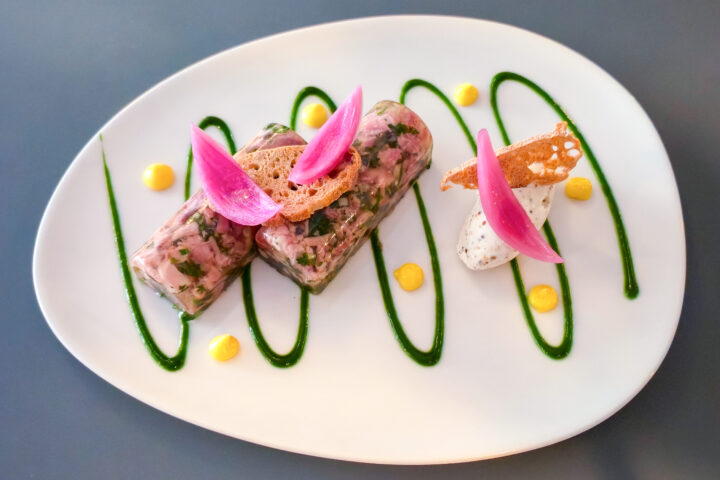
I ordered the “Homemade parsley ham, mustard, whipped cream, red onion pickles” as a starter, pictured below. Parsley ham (Jambon Persillé De Bourgonne) is a traditional Eastertide dish from Burgundy. Think “SPAM® Classic.” Enjoy it and practice the sausage principle: “If you love something, never find out how it’s made,” John Oliver, British comedian.
The classic recipe for Burgundy Parsley ham includes ham, knuckle of veal, calf’s feet, Bouquet Garni, peppercorns, and white wine. I told you not to ask. It is served all year long. Not just during Easterdite.
L’Évidence’s “Parsley ham”
My wife ordered the “Fish of the day, Madras curry sauce” for her main course, and I ordered the “Rack of veal cooked at low temperature, sliced jus with hazelnut butter.” The chef’s special of the day was “sweetbreads.” I know what you are thinking – a giant sweet French pastry for lunch. The French are so cool! No, these are not delicious French pastries made from sugar and bread.
Sweetbreads are the culinary term for the thymus gland of calves, veal, or lambs (a.k.a. organ meat higher up on the body than “Rocky Mountain oysters”). They are sometimes referred to as throat, gullet, or neck sweetbreads. The term “sweet” refers to their richer and sweeter flavor compared to typical meats, while “bread” comes from an old English word, “bræd,” which means flesh.
When I first dabbled in gastronomy in the early 1990s, I always enjoyed sweetbreads. Today, I do not care for the thought of them or their texture, but I did learn to prepare them during my French culinary school training. You can poach, sauté, or deep fry sweetbreads. If I were to serve sweetbreads, I would deep-fry them and serve them as a starter, accompanied by a yummy sauce such as Dijon mustard sauce, gribiche sauce, or maybe just ketchup (I’m only kidding). But then perhaps a homemade barbecue sauce (mmm).
I added the “Plate of 4 cheeses from our region” to try local cheese.
My wife’s menu included “Cherries, namelaka dark chocolate, crumble” for dessert. I selected the “Almond shortbread, strawberries, vanilla diplo nat, mint gel” from my menu choices.
L’Évidence was the most expensive of the four Dijon Bib Gourmand MICHELIN restaurants. But it was perfect and worth the visit—the dishes were executed flawlessly.
L’Évidence is one of the Best restaurants in Dijon, France, and is my second choice for a Dijon Bib Gourmand MICHELIN restaurant.
Cave was the third Bib Gourmand restaurant I tried in Dijon.
Cave Restaurant is the baby brother of its big sister, CIBO, Chef Angelo Ferrigno’s 1-star MICHELIN restaurant just across the street.
Like its big sister, Cave serves creative, modern food and is committed to sourcing its ingredients locally, exclusively within a 200km radius. It offers a simple yet elegant three-course menu with a fixed set of dishes created by the chef, served to everyone at the table. I could not find the menu on the website, so I am unsure how often it changes. I suppose we could call to find out what was offered before going. But we did not. So for us, it was like a chef’s surprise menu.
As is my usual practice, my wife and I arrived early so that I could choose our seats, which is not always possible. In this instance, I could select two seats at the counter, only four of which overlook the small galley kitchen.
The restaurant features one chef and server, making “mise en place” crucial. (Mise en place is a French culinary term that means “putting in place” or “gathering.” It refers to the organization and setup required before cooking.) Watching the chef and server work is akin to watching a ballet unfold.
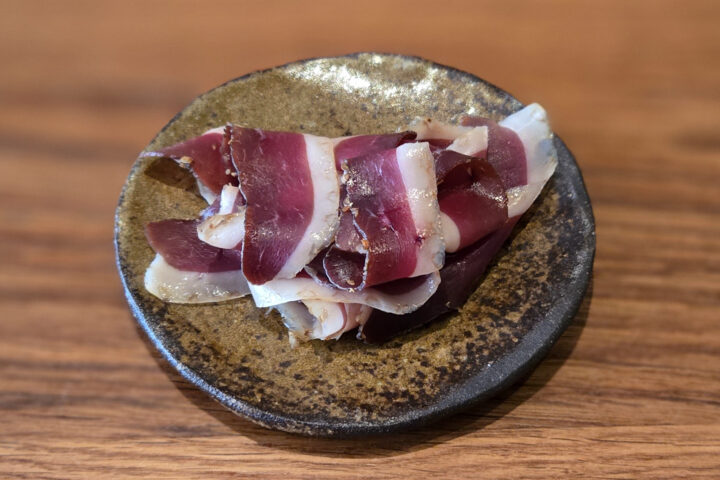
Cave served Morava ham as an amuse-bouche, see picture below.
Cave’s Morvan ham amuse-bouche
Morvan ham (“Jambon du Morvan”) is a “Historic” Burgundy ham made from pigs raised in the Morvan mountain range in Burgundy-Franche-Comte, France, approximately 63 km west of Dijon.
Dry salted, seasoned, and matured in the maturing cellars for 9 to 18 months, the ham gives it its distinctive aromas and taste. One of the oldest and most noted producers is Fernand Dussert, a founding member of the “Jambon du Morvan association.” Follow the association on Facebook HERE.
On a side note, an alternative to the traditional Burgundy parsley ham described above (See “L’Évidence”post) is Morvan parsley ham (“Jambon Persillé du Morvan”), which is made by marbling Morvan ham with parsley and garlic, flavored with Aligoté white Burgundy wine, and coated with a light jelly.
The “Chef’s Surprise” lunch menu included:
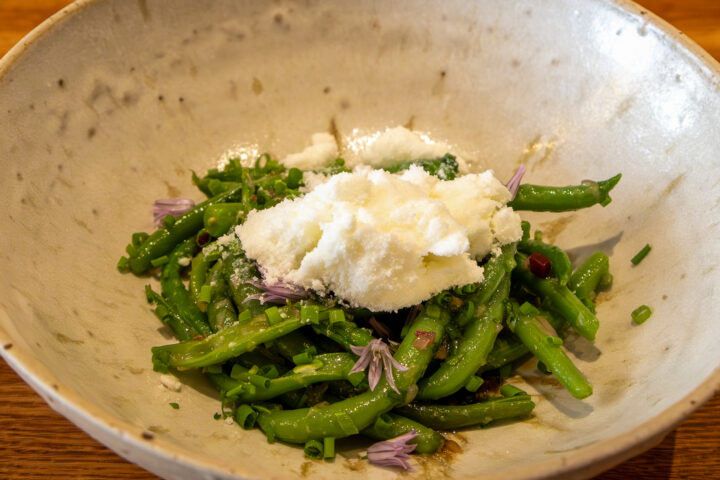
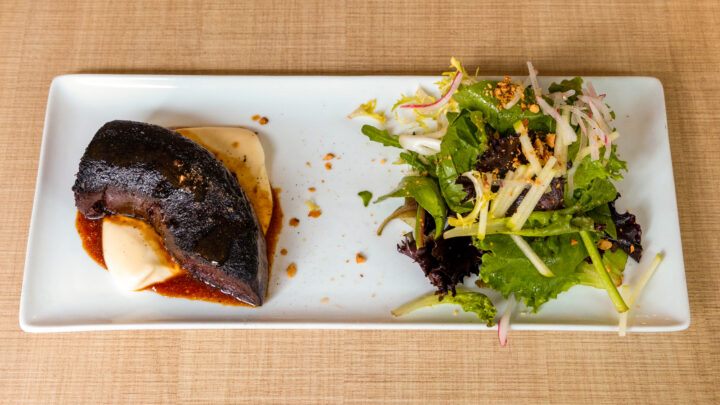
Cave’s “French green bean salad of Mr Vachon, Burgundy mozzarella sorbet,
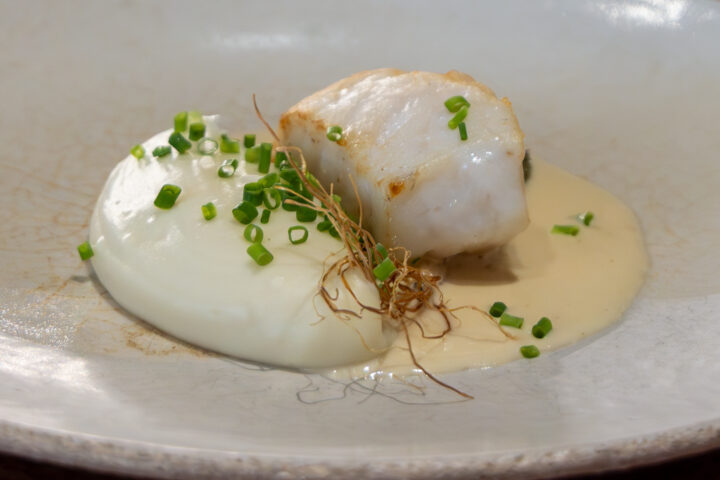
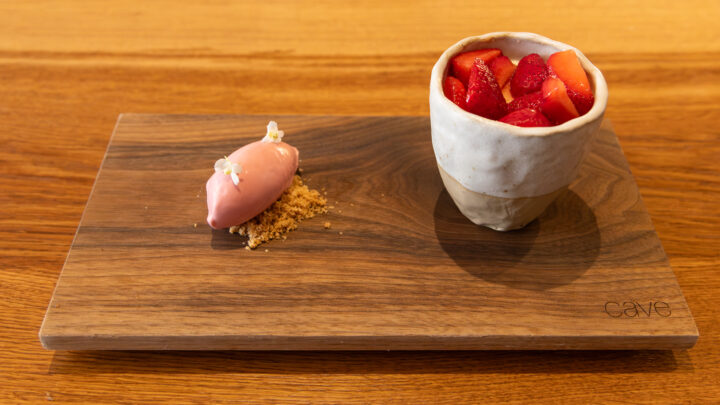
and dried beef”Cave’s “Saône catfish of Simon Collin served with grilled spring onion, cauliflower puree, and fermented cream sabayon sauce”Cave’s “Strawberries of Jean Luc Valliot served with fresh panna cotta, flouve and raspberry ice cream”
Mr Vachon, Simon Collin, and Luc Valliot are the local growers or sources. Flouve is an aromatic spirit infused with Flouve Odorante, “Sweat vernal grass,” with a distinctive, pleasant scent of freshly cut hay. The Saône is one of the many rivers running through the Val de Saône, approximately 35 km from Dijon. It is full of trout, pike, carp, or catfish.
The entire dining experience was, as the French would say, parfait! Or simply, super! It was the best three-course meal I have ever had for just 30 euros, and one of the finest Bib Gourmand restaurants I have ever encountered. I enjoyed it so much that I made a reservation for next week at CIBO. I will provide an update here afterward.
If I lived in Dijon, I would go whenever the menu changed. Cave is one of the best restaurants in Dijon, France, and is my first choice for a Dijon Bib Gourmand MICHELIN restaurant.
SO was the fourth Bib Gourmand restaurant I tried in Dijon.
A husband-and-wife team operates the restaurant. He is the chef, while she manages the front of the house. The menu is straightforward and affordable. There is a three-course menu, which includes “Entree + Main + Dessert,” or a four-course menu, which provides for “Entree + Main (Fish) + Main (Meat) + Dessert,” or you can order à la carte. You can also add a cheese plate. Each stage featured a choice between two starters, two main courses, and two desserts. In situations like this, we usually order one of each to sample everything. So, we ordered the “Entree + Main + Dessert” menu.
We were not served an amuse-bouche.
For starters, we shared the chef’s variation of the classic “Oeufs en Meurette” (Poached Eggs in Red Wine Sauce), a traditional Burgundy dish. In this case, the chef presented a poached egg nestled in a bowl of smooth pea velouté, accompanied by a quenelle of pepper cream and the black pudding (a.k.a. blood sausage), potato puree, and salad, pictured below.
SO’s “Black pudding (a.k.a. blood sausage), potato puree, and salad.”
Blood sausage is precisely what its name suggests—sausage made from thickened and encased animal blood, which can come from pigs, sheep, lambs, cows, chickens, or geese. I have always avoided blood sausage, but I decided to try it since it was the only other entrée option available. The taste was okay, but I didn’t like the consistency. The salad was welcomed. The dish’s presentation sparked a conversation between my wife and me about how to serve sausage to our guests.
For the main course, we shared the catch of the day dish and a pork tenderloin dish. The pork was cooked perfectly, lightly pink inside—the way the French eat it. For dessert, we shared a panna cotta infused with Earl Grey tea and topped with exotic fruits and a clafoutis with apricots and Chantilly cream.
Overall, I was not very impressed with the restaurant. It felt like too many shortcuts were taken, especially with the sauces. The dishes seemed like something I could have made at home before attending cooking school. On a positive note, the three-course meal cost was only 24 euros each, so I can’t complain too much, aside from the fact that it felt like a waste of calories. We spent more on wine than on the food itself.
The most intriguing aspect of my experience at the MICHELIN Bib Gourmand restaurant in Dijon was not what I discovered but what I did not find. Many Burgundy dishes were absent from the menu, including classic Oeufs en Meurette, Burgundy Snails, Gougères, Foie gras and gingerbread paring, beef bourguignon, Coq au vin, poulet Gaston Gérard, Rabbit in Mustard Sauce, and poulet de Bresse, which is regarded as the best-quality table chicken in the world (imagine the perfect trifecta: Bresse chicken stuffed with Foie gras and gingerbread).
We use cookies to optimize our website and our service.
Functional
Always active
The technical storage or access is strictly necessary for the legitimate purpose of enabling the use of a specific service explicitly requested by the subscriber or user, or for the sole purpose of carrying out the transmission of a communication over an electronic communications network.
Preferences
The technical storage or access is necessary for the legitimate purpose of storing preferences that are not requested by the subscriber or user.
Statistics
The technical storage or access that is used exclusively for statistical purposes.The technical storage or access that is used exclusively for anonymous statistical purposes. Without a subpoena, voluntary compliance on the part of your Internet Service Provider, or additional records from a third party, information stored or retrieved for this purpose alone cannot usually be used to identify you.
Marketing
The technical storage or access is required to create user profiles to send advertising, or to track the user on a website or across several websites for similar marketing purposes.