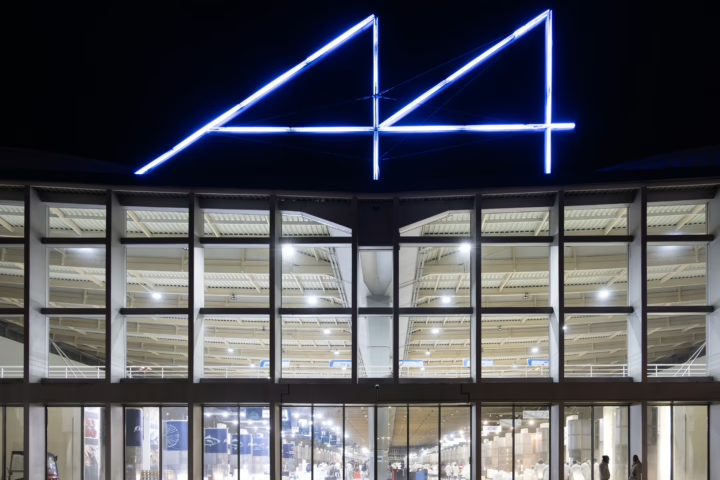
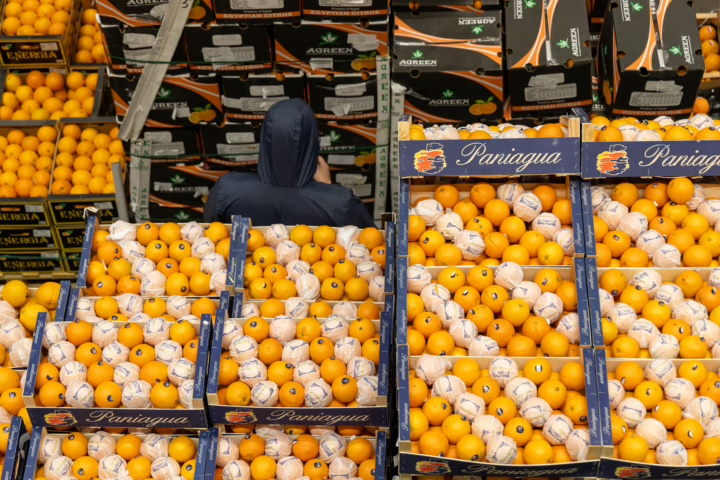
The Rungis International Market is the “belly of the Ile-de-France region.” It is the most populous of France’s 18 regions. It was created as the “District of the Paris Region” in 1961 and renamed after the historic province of Île-de-France in 1972 (English: ‘Island of France’). The region comprises eight administrative departments, including Paris.1
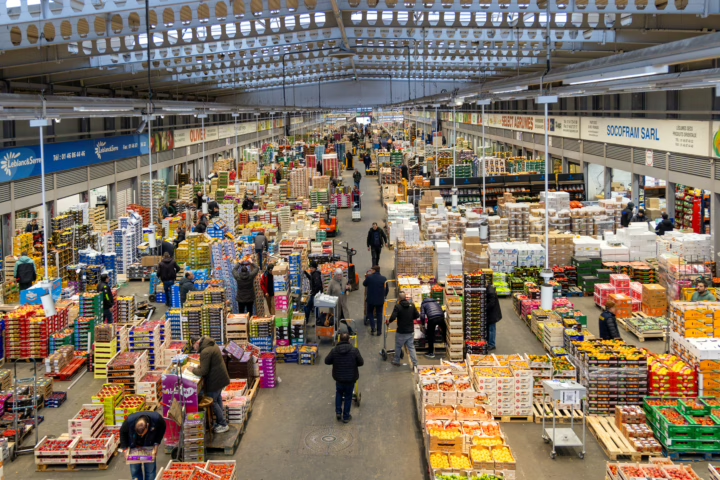
Rungis Market, situated adjacent to Orly Airport south of Paris, is the largest fresh food market in Europe. It operates as a wholesale business-to-business market, requiring professional membership for both buyers and sellers. At the time of this post, Rungis covers 232 hectares, accommodates over 1,200 companies, and employs nearly 13,000 individuals. The market provides stringent guarantees regarding food hygiene, traceability, and regulatory compliance, although some argue this comes at the expense of production quality.2
Rungis Market is a large market comprising submarkets: seafood and freshwater products; dairy products; fruits and vegetables; gastronomy and organic pavilion; butcher shop; pork, offal, poultry, and game; cut flowers, potted plants, and nursery growers; and accessories and decoration. Market openings are staggered to accommodate trucking logistics, which involves planning and coordinating freight transportation to maximize efficiency across the market’s supply chain.
Today, my wife and I went to the Rungis International Market on a field trip with FERRANDI Paris. We met at 3:00 AM and took a bus with the other international business students to get there. Rungis is a wholesale market, so only professional sellers or buyers are allowed to enter. However, you can find different tour options online if you want to visit.
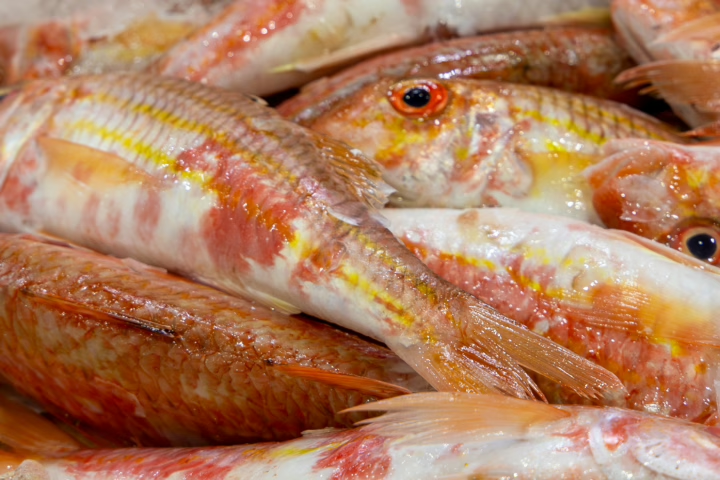
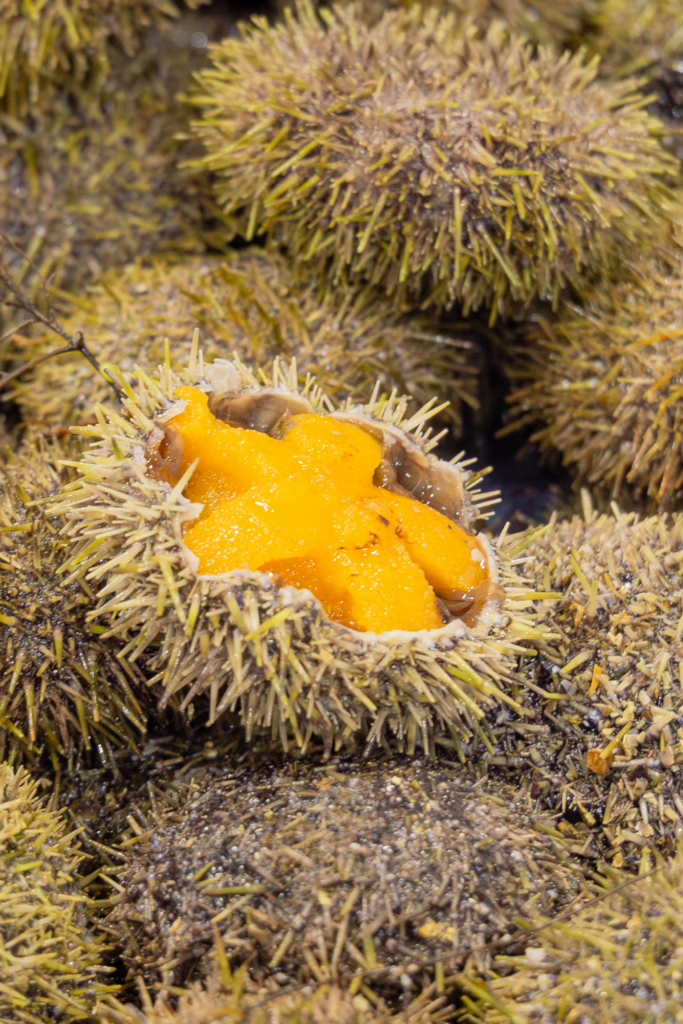
We started at the fish pavilion. When we got there, the vendors were finishing up their sales, counting their stock, and preparing to close. Still, we walked through, got a feel for the market, and saw many kinds of fish and shellfish.
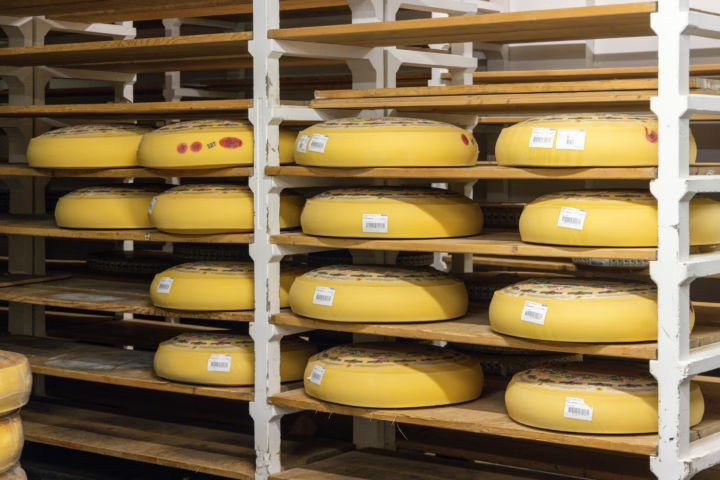
After that, we went to the pavilion for dairy, poultry products, and gastronomy.
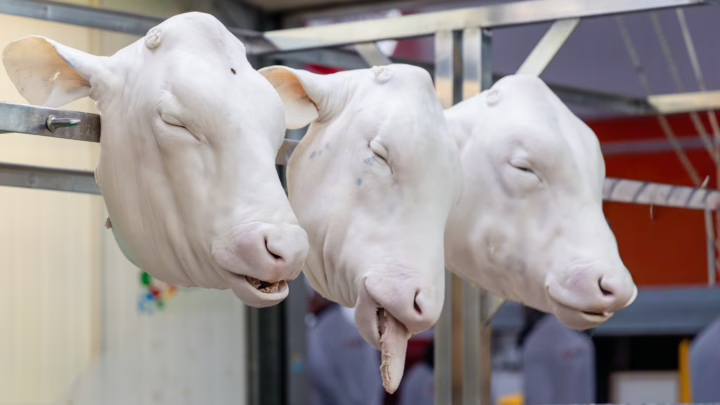
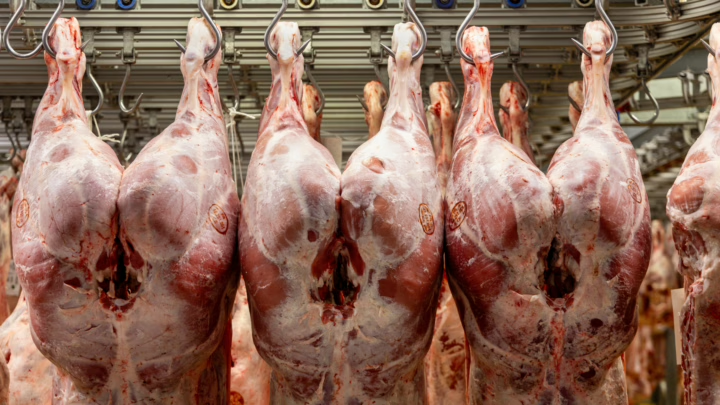
Next, we visited the butcher shop, which included pork, offal, poultry, and game.
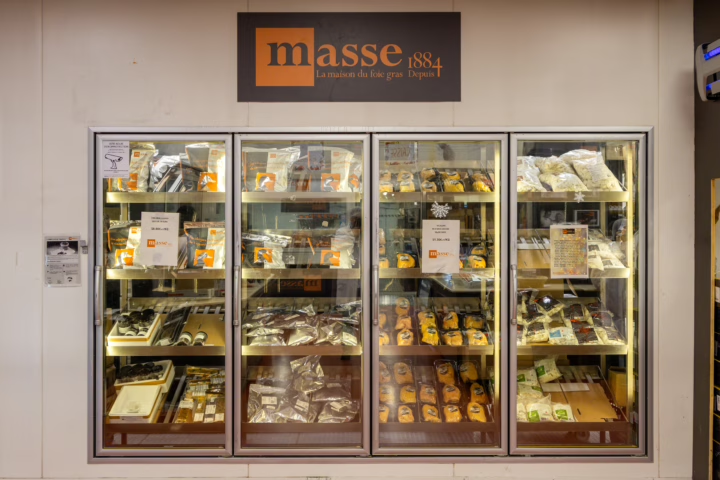
Then we went to the fruit and vegetable market, the largest section of the Rungis market. Our guide also took us to visit Masse House.
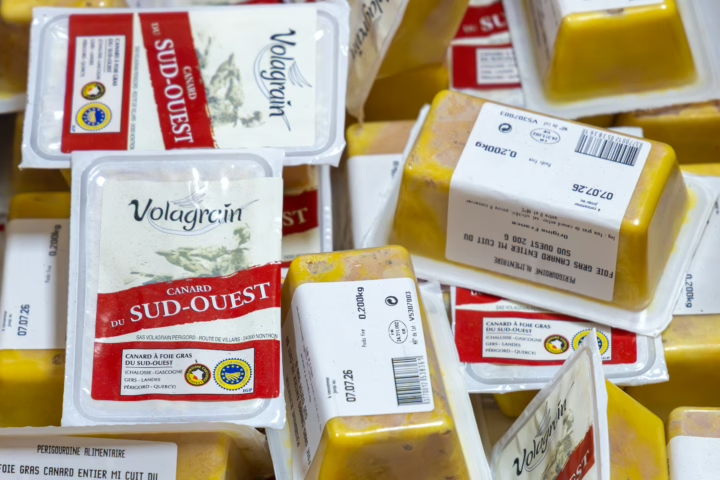
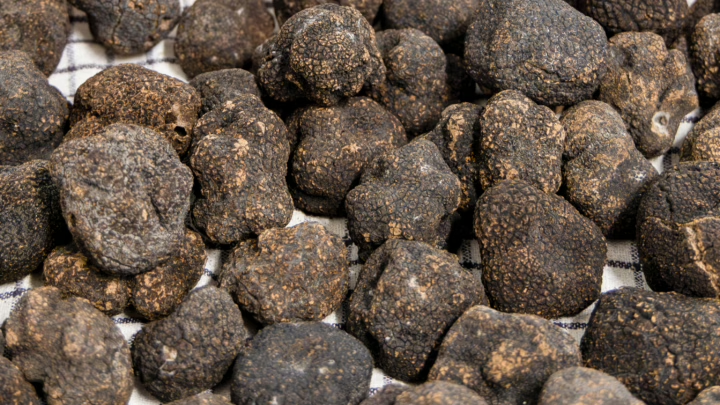
Masse House has focused on raw foie gras and truffles since 1884, selling only to chefs worldwide. They have locations in four regions of France and now also offer a variety of Spanish products, such as Ibérico Bellota ham and cecina.
At the end of our tour, the school hosted a breakfast for us before we returned to Paris.
My wife and I visited Caves de Rauzan today, a wine cooperative (Co-op) in Entre-deux-Mers, the largest wine-producing sub-region of Bordeaux. It was a cold, cloudy day, but it gave us a “backstage pass” to the inner workings of a Bordeaux wine cooperative. It was a lot of fun and very informative.
Caves de Rauzan, Rauzan, France
Entre-Deux-Mers Overview
Entre-Deux-Mers is a large, triangular area of land southeast of Bordeaux. It sits between the Garonne and Dordogne tidal rivers, which led people in the Middle Ages to call it “Entre-Deux-Mers,” or “between two seas.” This area is the largest wine-making sub-region in Bordeaux. It is a hilly area with about 7,000 hectares of vineyards.
There are nine Appellations d’Origine Contrôlée (AOCs) across the Entre-Deux-Mers: Entre-Deux-Mers AOC; Premières Côtes de Bordeaux AOC; Sainte-Croix-du-Mont AOC; Cadillac AOC; Loupiac AOC; St-Macaire AOC; Graves de Vayres AOC; and Sainte-Foy-Bordeaux AOC for sweet wines. The soils vary across the AOCs and include sand, clay, clay-limestone, and gravel. The area has a mild, oceanic climate.
Entre-Deux-Mers AOC
It is a bit confusing because the Entre-Deux-Mers is both the name of the general area and an AOC within it. The Entre-Deux-Mers AOC wine appellation was established in 1937 and initially allowed both dry and sweet white wines. In 1957, the rules changed so that only dry white wine could be made, labeled, and sold as Entre-Deux-Mers. The main white grapes grown here are Sauvignon Blanc, Semillon, Muscadelle, and a few others.
Red wines have always been produced in Entre-Deux-Mers, but until recently, they could be labeled only as Bordeaux AOC or Bordeaux Supérieur. On August 25, 2023, the Entre-Deux-Mers Rouge AOC was introduced, allowing red wines to be sold under the Entre-Deux-Mers name. Starting with the 2023 vintage, Entre-Deux-Mers winemakers chose to label their red wines Bordeaux AOC, Bordeaux Supérieur, or Entre-Deux-Mers.
The approved red grape varieties for Entre-Deux-Mers AOC wines are Cabernet Sauvignon, Merlot, Malbec (Cot), Cabernet Franc, and Petite Verdot. Carmenère is an “accessory variety” and can make up no more than 30% of the final blend. Each wine must include at least two grape varieties.
What is a Wine Cooperative
A cooperative is an organization of individuals that come together to share costs. At the heart of all cooperatives is the “mutualization of financial means.” Uh?
Picture yourself as a winemaker. On your own, you don’t want to, or you don’t have the resources, to manage the vineyard and make and sell your own wine. So, what can you do? You team up with other local winemakers in your area, and combine your resources to share the costs of managing all the vineyards and create and staff a central location for making and selling wine. “Mutualization of financial means” is at the center of any cooperative. Almost half the wine produced in Europe is co-op wine.
Caves de Rauzan Wine Cooperative
Caves de Rauzan is a cooperative of 230 Entre-deux-Mers winemakers that have come together to share the cost of making and selling their wine. Members jointly own and manage the cooperative, ensuring every winemaker has a voice in decision-making and a share of the profits based on the quality and quantity of their contributions.
It basically works like this (the exact details may not be 100% correct): When a winemaker joins the cooperative, they pay a fee based on their size and get shares in the cooperative, which are returned to them if and when they leave. Every year at harvest time, the winemakers deliver their grapes to the cooperative’s central winemaking facility, where the GM and his team make and sell the wine.
When the wine is made and sold, each winemaker is compensated based on the quantity, the quality, and, for red wines, the “peripheral” of the grapes they delivered. 70% of the wine is sold by the cooperative as bulk wine and shipped off, for instance, to Canada, where it is bottled and sold by others. The rest is bottled on demand for supermarkets or others, or as the cooperative sees fit for B-to-C sales.
Château Canet was up for sale, so the Co-op bought it and considers it’s mascot.
My wife and I visited the Château de Reignac in Bordeaux’s Entre-deux-Mers region. We learned much about its unique history and wines, including the patented Vatelot method used to make the Château’s flagship wine, BALTHVS.
Château de Reignac, Saint-Loubès, France
The Château was built in the 16th century. In 1990, Yves Vatelot, a French inventor and entrepreneur, bought the estate, restored the buildings, updated the wine-making facilities, and collaborated with oenologist consultant Michel Rollan to focus on the vineyards and winemaking.
Today, Château de Reignac is seen as one of the top estates in Entre-deux-Mers and the larger Bordeaux wine region. It is recognized for its excellent terroir, consistent quality driven by its focus on excellence, and its value for money.
The “inner workings” of the patented Vatelot method
This is my understanding of how the Vatelot method works and why it is effective: The process begins with cold maceration and fermentation of grapes in aluminum vats. Subsequently, oak barrels are filled with the fermented wine and the grape must, which consists of crushed grapes containing juice, skins, and seeds. The barrels are sealed with a head (pictured below) and rotated several times daily. Metal bars within the barrels enhance post-fermentation maceration. Because the barrels remain sealed, the wine experiences significantly less air contact and, consequently, less oxidation than with the pump-over or punch-down methods. After this stage, the wine is racked, meaning it is transferred to barrels for malolactic fermentation.
In the 19th century, a greenhouse attributed to the engineer Gustave Eiffel was added to the estate; see the picture below.
Tasting Notes: BALTHVS, 2016
Tasted in non-blind conditions in my Airbnb in Bordeaux, France.
Bordeaux 2016: According to The Wine Cellar Insider, the 2016 Bordeaux season began with unusually cool and record-setting wet weather. Despite this, early June flowering, particularly for Merlot, was highly successful, resulting in the most significant crop per hectare since 2004. But the summer drought left many vineyards short of moisture by September, causing some vines to nearly halt their growth to conserve energy.
Although Merlot remained abundant and healthy, it required water. Rainfall on September 13 and 14 benefited the Merlot, while additional rain on September 30 and October 1 arrived when Cabernet Sauvignon needed it most. These conditions required winemakers to pick carefully and sort grapes, separating overripe and drought-affected fruit from ripe, fresh ones. Notably, there was virtually no rot on the red grapes for the third consecutive year (See 2016 Bordeaux Harvest and Vintage Report).
Grape varieties: 100% Merlot (old vine 30 years)
About the wine: According to the Château de Reignac 2016 fact sheet, in terms of viticulture, spring de-budding was performed to remove buds on the vine’s spurs or branches that were considered to be of little or no use to the vine. Leaves were manually thinned, and removal was performed on the east-facing side to allow for morning sun. Green harvesting was conducted twice to remove excess green bunches from the vines before the grapes changed color and the sugar content rose, reducing yield, concentrating nutrients, and releasing them to the remaining bunches to build healthier grapes. The grapes were then hand-picked into small baskets and double-sorted both before and after destemming.
In terms of vinification, the grapes were cold macerated at 6°C for 7 days before fermentation. They then fermented for 35 days in two new oak barrels using the patented Vatelot method, which also included post-fermentation maceration. After this, the wine was racked to barrels and underwent malolactic fermentation.
Finally, the wine was aged in 100% new oak barrels, stirring the lees in the barrels stacked using the Oxoline system. Coopers: Garonnaise.
Appearance (Visual examination): A bright, red wine free of sediment and gas with a dark, inky purple color, a cherry-copper rim, and a deep inky purple hue; moderately concentrated with medium-low viscosity.
Nose (Olfactory examination): Medium intensity with notes of black fruit, such as plum, sour cherry, flower aromas of lavender, and nuances of chocolate, tobacco, and black pepper.
Palate (Gustative examination): Elegant, yet fresh. Structured with richness and silky tannins, the finish is well-balanced, with a persistence that leaves a lingering hint of spicy dark chocolate on the palate.
Service: Decant for 1 hour. Serve at 16-18°C (61-64°F) in a Bordeaux wine glass.
Food Pairing: Classic Entrecôte à la Bordelaise, rib steak in red wine and shallot sauce, served with pommes pont neuf (thick-cut fries), is a classic pairing.
I made and paired the BALTHVS, 2016, with an “Aberdeen Angus Steak” from “Gastronomie Des Pyrénées,” a port wine foie gras sauce, and freshly harvested young, small sauteed potatoes.
Bonvivant365’s “Aberdeen Angus Steak” from “Gastronomie Des Pyrénées,” port wine foie gras sauce, and young sauteed potatoes
Summary: Château de Reignac’s “BALTHVS,” 2016, is an easy-drinking red wine that, once awake, is a joy to spend time with, never tiring.
Source and price: Château de Reignac, 60 euros.
Reviews: 92-93/100 J. Suckling
Château de Reignac Address: 38 Chem. de Reignac, 33450 Saint-Loubès Phone: 05 56 20 41 05 https://reignac.com/en/
To learn about our visit to the largest wine cooperative in the Entre-deux-Mers region, see my post Caves de Rauzan Visit.
Today, my wife and I had the fortunate opportunity to join a wine excursion organized by the wine school we are attending (see my post “Wine School in Bordeaux: Firsthand Advice“). We visited Château Batailley, a Grand Cru Classé of 1855, located within the Pauillac AOC.
Château Batailley, Grand-Cru-Classé-en-1855, Pauillac AOC
The name “Batailley” comes from the word “Bataille,” which means “battle.” This refers to the conflict that occurred between the French and the English on the same estate in 1453. Château Batailley is one of the oldest estates in Pauillac.
The Classified Growths of 1885
What is “The Classified Growths of 1885,” you ask? In a nutshell, a world’s fair was going to be held in Paris in 1855, known as the 1855 Paris Exposition (French: Exposition Universelle de 1855).
Emperor Napoleon III sought to showcase Bordeaux wines, which had already gained fame in the Middle Ages due to the marriage of Henry Plantagenet and Eleanor of Aquitaine, whose union had opened the Bordeaux region to the English market and eventually the world.
So, the Emperor requested that the French wine merchants (known as négociants) create a list of the best Bordeaux wines. The wine négociants ranked Bordeaux wines based on each château’s reputation and trading prices, which were directly tied to the quality of the wines produced by each château at that time.
Château Batailley, Pauillac AOC wine cellar
The wine merchants compiled a list ranking the châteaux as first, second, third, fourth, and fifth most important “growths.” Thus, the “Les Grands Crus classés en 1855” (English: The Classified Growths of 1885) was born, and it stuck.
The Classified Growths of 1885 included 58 châteaux: four were ranked as first growths, 12 as second growths, 14 as third growths, 11 as fourth growths, and 17 as fifth growths. Château Batailley was ranked as a first growth.
Château Batailley, Pauillac AOC wine cellar bottles
Château Batailley, Grand Cru Classé en 1855
My wife and I have visited many wineries over the years, but this one stands out as the best. We started our day with a tour of the winemaking operations, led by the winemaker. We were fortunate to witness the process of recovering and pressing the “cap of marc” to obtain press wine that is rich in aromatics and tannins. It was the first time we had seen this done.
After the tour, we enjoyed a tasting of Château Batailley’s wines. This was followed by a lovely lunch hosted by the winery’s president. I cannot express enough how kind and generous our hosts were. The entire day was magical, and I extend my heartfelt thanks to everyone involved.
Recovering and pressing the “cap of marc.”
During alcoholic fermentation of red wine in a tank, yeast converts sugar into alcohol, producing significant amounts of carbon dioxide (CO2). This gas pushes solid components, such as grape skins, pulp, and seeds, upward to the top of the tank, forming a layer known as the “cap of marc.”
Throughout alcoholic fermentation, the cap is pushed down into the fermenting grape juice at the winemaker’s discretion. The technique used to break up the floating fruit skins and solids and push them back into the wine is called “punching the cap.” This practice enhances the wine’s flavor and varies in intensity depending on the winemaker’s goals. Instead of punching down, a winemaker may choose to use the “pouring over method.”
After alcoholic fermentation and any additional maceration are complete, the wine is “racked,” meaning it is transferred from the tank to another tank or barrel. At this stage, the wine is known as free-run wine, which is the liquid that flows out of the tank by gravity when the bottom valve is opened after fermentation.
The “cap of marc” is being removed from the tank for pressing
When the free-run wine is removed, the marc cap, which consists of all the solid parts, such as grape skins and seeds, settles to the bottom of the tank. A person then climbs into the tank to shovel out this material, which is fed into a press to extract the juice known as “must” (using manual, hydraulic, or pneumatic methods). This is called “press wine.”
Pressing the cap of marc to obtain the “press wine.”
The “press wine” is collected, tasted, and typically stored in vats or barrels based on its quality. Normally, the winemaker combines the press wine with the free-run wine, depending on their objectives.
The remaining solids, known as pomace, are discarded or repurposed for other uses, such as producing spirits or fertilizers.
Tasting Note: Château Batailley, 5ème Cru Classé, Pauillac, 2017
We sampled a variety of wines, all excellent. However, I want to highlight the Château Batailley “first wine,” which is the winery’s flagship bottling. This wine is a Pauillac AOC wine and has been classified as a 5th Growth since 1855, as discussed above.
Château Batailley, 5ème Cru Classé, Pauillac, 2017
Bordeaux 2017: According to the Wine Cellar Insider, “The 2017 Bordeaux vintage is notable for the significant frost that affected the region in April. The best wines from this vintage come from the northern Médoc, with quality diminishing further south. On the Right Bank, Pomerol outperforms Saint-Émilion. However, the 2017 Bordeaux vintage is characterized more by localized terroirs than by specific appellations. The gravel slopes in the northern Médoc, particularly in Pauillac, produced powerful wines.”
Visual examination: A dark purple color with a cherry-copper rim and a deep ruby hue.
Olfactory examination: Medium plus intensity with notes of ripe fruit, such as blackcurrants, followed by spicy, dark chocolate notes, and a whiff of tobacco.
Gustative examination: Elegant, yet fresh. Structured with richness and tannins, revealing its good bottle-ageing potential. The finish is well-balanced with silky tannins and a persistence that leaves a lingering hint of dark chocolate on the palate.
Grape varieties: 80% Cabernet Sauvignon, 17% Merlot, 3% Petit Verdot
Serving Temperature: 16-18°C or 61 to 64°F
Aging potential: Drink now or in the next 10-20 years.
Reviews: 92/100 Wine Enthusiast
Food Pairing: Classic Entrecôte à la Bordelaise (Rib steak in red wine and shallot sauce) served with pommes pont neuf (thick-cut fries).
Summary: Château Batailley, a Grand Cru Classé since 1855, beautifully represents Pauillac, offering tremendous value for money with an average price of €33 or $38 on Wine-Searcher.
Note: The five châteaux from 1885 ranked as First Growths, or Premiers Crus Classés, are Château Lafite Rothschild, Château Latour, Mouton Rothschild, Château Margaux, and Haut-Brion.
Paid tasting of Chateau Margaux 2011 at Max Bordeaux, Wine Gallery & Cellar in Bordeaux, France
My wife and I are currently in Bordeaux, France, attending the CAFA Wine School’s “Go to Wine School in Bordeaux” program. Before our classes began, we visited Cyprus, known for its delicious Cypriot cuisine. One of the most intriguing dishes I tried was sheep’s head, called “Kefalaki” in Greek, which means “little head” (goat head can also be used). Not to be confused with tasty Sheepshead fish.
Traditionally, preparing and serving sheep’s head was essential to ensure that no part of the animal went to waste. Today, it is considered a delicacy appreciated for its different textures: flavorful meat, chewy tongue, and tender brain. The practice of serving sheep’s head at feasts and special occasions remains popular among Cypriots.
I Tried Sheep Head at Militzis Restaurant
Militzis Restaurant in Larnaca is where I tried Cypriot sheep’s head. Militzis is one of the oldest family-run restaurants on the island, renowned for its local meat dishes. They prepare the sheep’s head by first grilling the entire head, then placing it in a pressure cooker to tenderize it. The dish was served whole, featuring the jaws, tongue, cheeks, eyeballs, and brain, pictured below.
Before serving, the head was cut in half to expose the brain, making it easier to access for eating, as pictured below.
A Look Inside Militzis Restaurant’s “Sheep’s Head” in Larnaca, Cyprus.
What my Friends had to Say
When I sent the images to some friends on WhatsApp, I received a variety of responses.
The FlanMan: “Ouch. No, thank you.” The Sicilian: “😳prehistoric cuisine?!” The Bernmister: “Whoa! Not sure about that, man 😆” The Hawaiian: “Oh my!” The Cypriot: “Wow? How did u like it?” I answered, “The potatoes were good.”
Sheep’s head is not only a Cypriot Dish
Sheep’s head is not only a dish from Cyprus; it is also prepared and served in various ways throughout Western Asia. Countries such as Armenia, Azerbaijan, Bahrain, Georgia, Iraq, Israel, Jordan, Kuwait, Lebanon, Oman, Palestine, Qatar, Saudi Arabia, Syria, Turkey, the United Arab Emirates, and Yemen all have their own versions of this dish.
However, sheep’s head is not limited to Western Asia. For instance, in Norway, it is a traditional dish served during Christmas time, known as “Smalahove.” This consists of a salt-cured, smoked, and steamed sheep’s head.
According to the “Visit Norway” tourism website, the Voss family produces and sells 70,000 portions of smalahove every autumn, from September to December—now that is a lot of sheep heads!
Iceland also has its own version of this dish, called Svið, in which the sheep’s head is cut in half and boiled.
In Kazakh culture, which belongs to a Turkic ethnic group native to Central Asia and Eastern Europe, presenting a boiled sheep’s head to the most respected guest is a long-standing tradition during celebrations.
Overall, sheep’s head is a traditional and nostalgic dish found worldwide—a culinary trophy for true food enthusiasts. If you ever have the chance, consider giving it a try.
If you missed your train from Gare Montparnasse (English: Montparnasse train station). Spend the night in Montparnasse. That is what we did.
We were flying back from Cyprus to Bordeaux, France, to attend the CAFA Wine School. (see my post, “Wine School in Bordeaux: Firsthand Advice“). It was delayed by 90 minutes. So, we missed our train from Gare Montparnasse to Bordeaux by just five minutes.
I managed to book a room at the Hôtel de Paris Montparnasse through Booking.com. It’s a decent three-star hotel for a one-night stopover. The room was small but recently renovated, featuring hardwood floors, a decent-sized bathroom, a large new TV, air conditioning, and a big window with a view of the city. The staff was helpful and accommodating. The best part is that you can walk out the door, cross the street, and find yourself at Gare Montparnasse (Montparnasse train station).
Église Notre-Dame des Champs, Montparnasse, Paris, France
Fortunately, this allowed us to spend the night in the Montparnasse area of Paris, which is our favorite district. We enjoyed drinks at an outdoor café. I especially like the square around the Edgar Quinet subway station because it is bustling with cafés, making it an excellent spot for people-watching since the subway entrance and exit are located in the square.
St-Germain spritz, Place Edgar Quinet, Montparnasse, Paris
Generally, we “café” at “Café de la Place,” but there were no good seating options, so we walked across the street to La Liberté, located at 11 Boulevard Edgar Quinet, 75014 Paris. It turned out to be a fantastic choice. The wine-by-the-glass selection was more extensive than our usual haunt, the service was exceptional, and the fries were as they should be, pictured below.
La Liberté French Fries, Montparnasse, Paris, France
While I was “cafing” (sitting at the café), I asked the waiter the best place to have dinner. The week before, on our way to Cyprus, we stopped in Montparnasse for the night. We had dinner at “Le Dôme Café,” where I enjoyed the sole meunière, a classic French fish dish made with floured, fried sole, served with hot melted butter, lemon juice, and parsley, pictured below.
Le Dôme Café’s “Sole Meunière,” Montparnasse, Paris, France
This time, I was craving steak. The waiter wasn’t very helpful, but a fellow diner sitting next to me at the café recommended “Les Grillades de Buenos Aires.” He claimed it was the best place to get steak in Paris.
To say the least, I was a bit skeptical, but my entenas were up, so I checked Google Maps, saw that it was 3 minutes away, called, and made a reservation. My wife thought I was nuts. But I reminded her that you never know where or by whom you might find a good idea, and since he was so adamant and didn’t seem insane, his claim warranted further investigation.
“Les Grillades de Buenos Aires” is located across the square from La Liberté, hidden away in plain sight, on “Rue du Montparnasse,” a street littered with crêperies that serve crêpes and galettes. Crêpes are a traditional dish throughout most regions of France, while Galettes are specifically from Brittany (French: Bretagne), and made with buckwheat flour. I walked down this street many times and never noticed “Les Grillades de Buenos Aires.” It is easy to miss.
The door opened at 7:30 PM, and people started to flow in—a promising sign, I thought. Once inside, you are transported to Buenos Aires, surrounded by rustic decor featuring gaucho motifs, pictured below. We managed to get a table for two right by the window.
Les Grillades de Buenos Aires “gaucho motifs” example
My wife ordered a salad, while I opted for the “Bife Ancho,” or Entrecôte beef. I requested my steak to be cooked very rare; I prefer it to be still “mooing” when it arrives at the table—fries, a salad, and Chimichurri sauce accompany the steak.
While we were waiting for the meal to arrive, I saw what looked like a “Chorizo Criollo” (grilled sausage) fly past me on the way to another table. So, we ordered one to try, and it was excellent; pictured below.
Les Grillades de Buenos Aires’ “Chorizo sausage,” Montparnasse, Paris, France
My platter arrived. The steak was perfectly cooked, the fries were just right, and the salad was appropriately dressed. It appeared I had made a good choice as I looked around the now-full restaurant and noticed that everyone else had ordered the same dish, pictured below.
Les Grillades de Buenos Aires Entrecôte steak, Montparnasse, Paris, France
For dessert, we ordered the “Banana con Dulce De Leche” (Banana with milk jam). Dulce De Leche. Dulce de leche, commonly known as caramelized milk or milk jam, is a sweet treat made by slowly heating sugar and milk together for several hours. It is the most popular dessert in Argentina. In this case, the Dulce de leche was wrapped around a banana. It was delicious, as pictured below.
Les Grillades de Buenos Aires’ “Banana con dulce de leche,” Montparnasse, Paris, France
We paid and returned to the hotel, channeling my inner “Carrie Bradshaw.” I asked myself, “Did I just eat the best steak in Paris?” I thought, maybe.
We arrived in Bordeaux in late August 2025 to start full-time studies at the CAFA Wine School to pursue a “Diplôme de Conseiller en Vin,” or “Wine Consultant Diploma,” and professional title “Sommelier Advisor.” Before this, we had been traveling around France since April (See https://bonvivant365.com/).
Here’s what we thought about our experience at the CAFA Wine School.
Why CAFA Wine School
First and foremost, location, location, location. Bordeaux, France, is one of the premier destinations for studying wine, thanks to its historical significance in viticulture, its renowned wineries, and its proximity to international trade events.
Porte Cailhau, Bordeaux, France
Second, the CAFA Wine School program offers in-depth training recognized by the French State and is registered with the RNCP under No. 38134 at Level 5 of the Training Framework. If you complete all the testing, you can earn a “Wine Consultant Diploma.”
Third, we received fine support throughout the entire application and visa extension process from CAFA Wine School.
Update:
We just wrapped up our time in Bordeaux and completed the CAFA Wine School program. Now we’re in Paris, getting ready to start the Ferrandi Paris Intensive Professional Program in French Cuisine, which will last four months. Here are our pros and cons of the CAFA Wine School program, along with a summary of what to expect.
PROS: CAFA Wine School
We spent six months living in the Chartrons neighborhood of Bordeaux, 10 minutes from the school. It was a magical experience.
The wine school’s training program is thorough.
We attended about 10-12 conferences. Some were day trips to wine regions and winemakers, while others involved visits from winemakers or their representatives; fantastic exposure.
A core instructor leads the class, and guest speakers often visit, which makes the experience even richer.
We tried so many different wines—probably over 400, though I lost count. Tasting that many was really helpful for learning to taste wine in a structured way and for identifying different grape varieties and the wine’s origin.
The class was international and small, with just 10 people; our classmates were well-educated, professional, and very friendly.
It’s great value for money. You really get a lot for what you pay.
CONS: CAFA Wine School
When we enrolled at CAFA Wine School, we believed we understood the requirements for obtaining the “Wine Consultant Diploma.” However, on the first day, we realized that our expectations did not align with reality. The school did not adequately communicate the program details during the registration process or prior to the program’s start.
Approximately 25 percent of the program focuses on esoteric wine topics that are not relevant to the level of training, diploma requirements, or entry into the wine industry. Allocating this time to reinforce core knowledge already covered in the program would be more beneficial.
Wine Consultant Diploma Requirements
At the time of this blog post, to earn the Wine Consultant Diploma, which is officially recognized by the French Ministry, you need to do more than just attend classes and complete quizzes. There are also some additional requirements:
Curate, publish, and print in book format a detailed wine and spirits list featuring 175 to 225 wines from around the world.
Write, publish, and print in book format a 40 to 50-page paper on marketing and selling a wine of your choice.
Write, publish, and print in book format a 10- to 15-page wine event paper.
Attend at least 80% of your classes.
Complete a rigorous two-day testing regimen at the end of the course, which includes several tests, including presenting your papers to an external jury and answering questions to assess your wine knowledge. If you do not pass the test, you may reapply to retake it next cycle if a spot opens up.
In addition to the required coursework, I recommend setting aside 8 to 10 hours of independent study each week to learn the material and do well on the weekly quizzes.
Summary
We would go to the CAFA Wine School again and recommend it to others. Before you sign up, check with the school about their current requirements, as these might have changed. This way, you will know what to expect from the start. If you are thinking about doing an internship, make sure to get clear answers from the school in writing about how the process works and the support they offer, so there are no misunderstandings.
I spent one month in Strasbourg, France. While many people recommend visiting the city’s iconic historical sites, such as Petite France, Strasbourg Cathedral, and the Alsatian Museum—all of which are worth exploring—my focus is on food, wine, and play. Below is a brief list of my recommendations for what to do in Strasbourg, France.
The Quai de la Petite France, Strasbourg, France
Enjoy Flammekueche (Tarte flambée) at Le METEOR
The Germans call it Flammkuchen, while the French refer to it as Flammeküche or tarte flambée. It’s half tart and half pizza.
The story goes that in feudal times, French peasants used a communal oven, known as a Four Banal, to bake their bread. To test the oven’s temperature, they would place thin slices of bread inside. Instead of wasting this “test” bread, people began adding toppings to it and sharing it as a meal. Thus, Flammkuchen was born. However, it faded into obscurity until the revival of pizza in the United States in the 1960s brought it back into the spotlight.
When done well, Flammkuchen is delicious. When done poorly, it is disgusting. I have had both. The first was at the main Christmas market in Toulouse, France, situated at Place du Capitole (Le Grand Marché de Noël), which features over 100 chalets, an ice rink, and beautiful Christmas lights. Le METEOR in Strasbourg makes Flammkuchen right and offers both savory and dessert Flammkuchen.
The traditional savory Flammeküche is made with thin, unleavened dough rolled out into a rectangle and spread with crème fraîche or fromage blanc; in my opinion, fromage blanc is the best choice. It is then topped with thinly sliced onions and lardons before being baked at a high temperature in a wood-fired oven.
The result is a crispy texture with slightly burnt edges. It is then cut into squares and served piping hot. To eat it, take a slice, roll it, and take a bite. Flammekueche is meant to be shared among friends and eaten with a glass of local Riesling or a beer (Alsace is France’s leading brewing region).
The traditional Flammekueche is a bit boring. The French prefer to eat it with cheese, which is called “Flammekueche gratinée.” Typical cheeses are Emmenthal, Gruyère, or Raclette. I agree and find this the best way to enjoy it.
Le METEOR’s tarte flambée la gratinée with Emmenthal cheese, Strasbourg, France
Once you’ve finished the savory Flammeküche, and not before, Flammeküche is intended to be served and eaten hot. Order the sweet Flammeküche for dessert. Done right, dessert Flammeküche is made with thinly sliced apples, crème fraîche, or fromage blanc, and sprinkled with cinnamon immediately after baking. Then, it was brought piping hot to the table and flambéed with Calvados, as shown in the image below.
Le Meteor’s Apple Cinnamon Flammkuchen, Strasbourg, France
Many places in Strasbourg offer Flammeküche, which, like pizza, comes with a variety of toppings. For the best experience, resist the urge to try new variations and stick with the classic Flammekueches mentioned above.
Le METEOR Address: 10 Rue du 22 Novembre, 67000 Strasbourg Phone: 03 88 65 66 30 https://www.lemeteor.fr/
Feast on typical Alsatian food at a Winstub
A winstub is a restaurant that serves traditional Alsatian foods. I visited the best winstubs in Strasbourg. See my post, “Best Restaurants in Strasbourg, France.”
Au Pont Corbeau winstub, Strasbourg, France
As a side note, when you’re in Strasbourg or anywhere in Alsace, you may come across a unique wine glass with a green base and long, slender green stem, known as the “Ballon d’Alsace” (pictured below). The story behind this glass is that Alsatian wine used to be of poor quality and had a greenish hue. To combat this perception, Alsatian winemakers served their wines in these glasses, claiming that the green tint in the wine was a result of the glass itself. Today, these glasses have become more of a novelty and are commonly used in traditional Alsatian cafés, winstubs, and festivals.
There is only one AOC cheese in the Alsace region of France, Munster, also known as Munster-géromé or (Alsatian) Minschterkaas, depending on which side of the Vosges Mountains you are standing. AOC translates to “controlled designation of origin,” a classification system in France that is applied to specific products, such as wine and cheese.
In terms of the origin of Munster cheese, the story goes that a long time ago, hundreds of monks crossed the Vosges Mountains from Gérardmer. Why do you ask? I don’t know. Maybe, like the chicken, to get to the other side? They founded Saint Gregory Abbey, also known as the “Munster Abby.”
The town that developed became known as “Munster” from the Latin word monasterium, meaning a monastery or a church. Anyway, somehow, the monks created a recipe for making Munster cheese and shared it with the local population. People like it, so it stuck.
The impression is that Munster is a “stinky cheese” with a strong odor. It is not the case when you eat fresh Munster cheese in Alsace or Strasbourg, since the cheese is fresh and has not aged much. I also found this to be true of Époisses cheese in Burgundy. You can purchase a variety of Munster Cheeses at Maison Lorho, including “Fume,” or smoked Munster cheese.
Maison Lorho’s cheese assortment box, Strasbourg, France
The “other” famous cheese from Alsace is Tomme d’Alsace, Alsace Tomme, a soft cheese made from cow’s milk, which is also available at Maison Lorho. There are a few lesser-known Alsatian cheeses also available. You can build a custom cheese box for you to take away any cheese you like (as pictured above).
But be cautious not to accidentally touch the counter where cheese is cut, as I did. This mistake resulted in a public reprimand from the staff. To make matters worse, another customer—an elderly French lady—joined in and began yelling at me as well. I apologized to the staff, told the lady to “mind her own business,” (She laughed in my face), and quickly left the store.
Go on a worthwhile chase at George Bruck Foie Gras
I have gone on many “wild goose chases” in pursuit of good gastronomy, but Georges Bruck’s goose foie gras is a pursuit worth taking. In Strasbourg, France, Georges Bruck is regarded as the “Rolls-Royce” of foie gras.
Foie gras has its origins in ancient Egypt, but it was the Romans who introduced it to Gaul, which is now present-day France. In ancient times, before the establishment of modern France, this region was known as Gallia and was inhabited by a Celtic people called the Gauls (Anyway, I digress.)
According to popular accounts, Jean-Pierre Clause, the chef for the governor of Alsace, created the first foie gras pâté in the late 18th century in Strasbourg. As a result, “Strasbourg foie gras” gained fame throughout France and spread across the country, including to southwestern France, where duck foie gras production began to take hold.
Today, around 98% of goose foie gras is still made in Strasbourg, making it the “Goose Foie Gras Capital of France.” Meanwhile, Sarlat, located about 2 hours and 20 minutes by train from Bordeaux in the Dordogne Valley, is recognized as the capital of duck foie gras production in France.
Once, over 60 foie gras companies operated in Strasbourg. Today, Maison Georges Bruck is the only family-owned foie gras company from Strasbourg that remains, now managed by the fifth generation. There are several methods for cooking foie gras, including searing in a pan, using a water bath, semi-cooking at 70°C, sealing in a can, or thoroughly cooking at 90°C to 100°C, depending on the maker, and sealed in a jar.
Semi-cooked foie gras is smoother. Maison Georges Bruck offers both goose and duck foie gras in various formats, along with everything you need for pairing, except for fresh fruits. My personal favorite is semi-cooked goose foie gras (Pictured below). However, I enjoy all forms of foie gras, whether from duck or goose, whether seared or prepared in a water bath.
Georges Bruck’s goose foie gras, Strasbourg, France
Hamming it up at Avellina bakery in Strasbourg, France, is no joke. Theo, a young pastry chef, along with his chef girlfriend (whom I did not meet), makes the best ham sandwich in Strasbourg, France (as pictured below). Theo claims that they are made fresh every day. However, to ensure I always ask for one from the front of the case.
Avellina bakery’s ham sandwich, Strasbourg, France
When I travel to a new town, I prefer hiring a local guide to show me around. I’m not a fan of structured group tours for various reasons. Instead, I look for a private tour guide who can tailor the experience to my interests. For example, I might give them a list of foods I want to taste or ask where the locals go for specific activities.
In Strasbourg, France, I found the best guide named Atreyu. He claimed to be a history buff and a foodie, so I decided to put him to the test. He exceeded my expectations by providing the perfect customized tour that included food, wine, beer, and entertainment in Strasbourg. I highly recommend withlocals guide Atreyu.
Build, buy, or partner with Porcus for Choucroute garnie
According to Jeffrey Steingarten, author of the book “The Man Who Ate Everything,” authentic Choucroute Garnie, also known as Choucroute Garnie à l’Alsacienne, is made with braised sauerkraut topped with various cuts of pork. But there is no definitive recipe, only traditions.
I found that Porcus offers the best selection of choucroute garnie in Strasbourg, with the broadest range of options. You can purchase the sauerkraut and various cuts of pork individually to build your own or opt for a preconfigured “Garniture Choucroute” package. Alternatively, you can enjoy choucroute garnie at Porcus’ restaurant.
I purchased sauerkraut and multiple cuts of pork from Porcus and created my own Choucroute Garnie à l’Alsacienne, as pictured below. It included sauerkraut and cuts of pork: Knack d’Or, Cervelas Alsacien, Poitrine Fumée Cuite, Palette Fumée Cuite, and Saucisse Fumée Cuite.
Bonvivant365.com’s “Choucroute Garnie à l’Alsacienne with sauerkraut and various cuts of pork”
Instead of boiled potatoes, I served Porcus’ “Salade de Pomme Terre,” potato salad, because it was July and hot. Potato salad is more refreshing. I served additional sauerkraut and potato salad on the side, along with Riesling mustard (“Moutarde Riesling”), a blend of sweet mustard and Riesling, and a ready-to-use mild horseradish (“Raifort Doux”).”
Choucroute Variation #1: Sauerkraut with Duck Confit
A delicious variation of Choucroute (sauerkraut) known as sauerkraut is “Choucroute “au confit de canard, sauerkraut with duck confit (pictured below). It’s easy to make at home, enjoy, or serve to guests.
Choucroute Variation #2: Sauerkraut with three fish
A second delicious variation of Choucroute (sauerkraut) is known as sauerkraut with three fish. This dish was created by Guy-Pierre Baumann, who once owned the Kammerzell House, situated at the foot of the Strasbourg Cathedral. From what I can tell, essentially, the dish is Sauerkraut with three river fish filets, salmon, and white fish laid on top, then baked in the oven. I would make the sauce by reducing the fish with a cup of fume. Riesling is then thickened with a liaison, using a ratio of 4 parts cream to 1 part egg yolks.
From what I can tell, essentially, the dish is Sauerkraut prepared with fish fume, with three thin poached fish filets layered on top: one salmon and two white fish, each layer and the final dish smothered in sauce. The dish was delicious, so I recreated it to enjoy at home and with guests.
Kammerzell House’s “Les Choucroutes Baumann,” three fish choucroute, Strasbourg, France
To prepare this dish at home, I start by making a fish fumet, also known as fish stock. Next, I make the sauce by sweating shallots in a bit of butter for about two minutes. Then, I add a cup of fish stock and dry Alsace wine, reducing the mixture by half. After that, I strain the sauce and return it to the saucepan, thickening it with a tempered liaison made from a ratio of 4 parts cream to 1 part egg yolks. I set the sauce aside and keep it warm.
Second, I warm the prepared sauerkraut and set it aside. Third, I gently poach the fish fillets in fish stock and set them aside to drain. To serve, I place the sauerkraut in a bowl, layer the fish on top, cover it generously with the sauce, and finish with a garnish. For the fish, I chose fresh from my local fishmonger, with delicate flesh and a mild taste.
Porcus Address: 6 Pl. du Temple Neuf, 67000 Strasbourg Phone: 03 88 23 19 38 https://www.porcus.fr/
Find the beef at Starling Burgers
“Where’s the beef?” You can find it at Sterling Burger in Strasbourg, France, hands down the best hamburger in the city. Everything that goes into a Sterling Burger is handmade in-house (pictured below), except for the hand-cut French fries, which are sourced from a small, family-owned business in the Netherlands (I believe).
Starling’s signature “Starling Burger,” Strasbourg, France
I ordered mine “blue” like the French (pictured below). But Starling will prepare it anyway you like.
The inside of Starling’s signature “Starling Burger,” Strasbourg, France
I discovered Junk Smash burgers in Lyon, France, and was glad to see that they made it to Strasbourg. Junk takes a minimalist approach to its ingredients, resulting in a perfectly balanced flavor.
I recommend starting with the small Smash Burger straight up (pictured below). No additions (pictured above), which include a smashed beef patty, melted American cheese, and homemade Junk sauce, all encased in a soft brioche bun. It is the perfect expression of Junk’s minimalist approach to ingredients, resulting in an ideal balance of flavors. Junk is, by far, the best Smash burger in Strasbourg, France.
Listen to my barber and eat more salad at Café de l’Ill
This is a wild card.
Last month, while I was in Dijon, France, I visited a barber several times. He spoke very little English, and my French is almost nonexistent.
Nonetheless, I managed to convey to him that I had gained 20 pounds since arriving in France. He responded in French, “Tu dois manger plus de salade,” which means “You need to eat more salad.”
As it so happened, a few weeks later, as I was walking around Strasbourg, I stopped at Café de l’Ill in the tourist center. Usually, I wouldn’t choose to stop at a place like this, but it was hot, I was tired, and they served wine. So, I decided to sit down.
I noticed the person next to me was eating a salad. It looked decent, so I checked the menu and saw that the “side salads” were priced at either €3.50 or €4.50. I decided to order the one for €4.50, which included various vegetables (as shown in the picture below).
Café de l’Ill salad, Strasbourg, France
I couldn’t say this is the “best salad in Strasbourg.” Frankly, I eat very little salad, so I would never search for, nor find, the “best salad in Strasbourg.” However, I bet it’s the best “budget-friendly salad” in the city.
Or, as I like to say, “Mikey likes it!” This is a shoutout to my friend Mike, the “cheapest man I have ever known,” who once proudly bragged that he never spent more than 10 euros on a meal.
Café de l’Ill doesn’t have a website and, like many tourist spots in the city center, tends to receive mediocre reviews overall. But the service is good, the wine is wet, and the salad is a bargain. Mikey likes it!
Café de l’Ill Address: 9 Pl. du Marché-aux-Cochons-de-Lait, 67000 Strasbourg Phone: 03 88 23 22 74
Roll your pizza at 22 mai
As I mentioned earlier, “I love French food, but I occasionally need a change.” Sometimes, only a pizza will do. But not just any pizza. I have been to Italy over 25 times (and we will go there next, after France, for wine and cooking school). I am always on the lookout for the best Neapolitan pizza, which is the traditional round pizza typically prepared in the Italian city of Naples and characterized by a soft, thin dough with high, burnt edges. Hands down, the best “Neapolitan pizza” in Strasbourg is found at 22 mai.
22 Mai’s Margarita pizza with spicy Italian ham added, Strasbourg, France
Not cheap. A Margarita with spicy Italian ham added will cost you 20 euros. But it is equal to or greater than any Neapolitan pizza I have ever tried.
Satisfy your sweet tooth with blueberry tart and more at Naegel
Naegel is the best bakery in Strasbourg, France (in fact, “Avellina Baker Theo,” mentioned above, apprenticed here). They offer a wide range of items, but I found their “Tarte aux myrtilles,” a blueberry tart, to be exceptional (pictured below).
Maison Naegel blueberry tart, Strasbourg, France
Naegel is famous in Strasbourg, France, not only for its pastries but also for its savory tort, made of veal, pork, mushrooms, and flan encased in puff pastry (pictured below). It’s more of a winter dish, but my gluttonous curiosity made me need to try it. Maison Naegel tort would be terrific served with a salad tossed with Thomas Keller’s Classic Vinaigrette. A pâté version is also available.
The inside of Naegel’s veal, pork, and flan torte, Strasbourg, France
Finally, as if a blueberry tart, a savory veal, pork, and mushroom flan, and a torte were not enough, Naegel makes excellent “vol au vent puff pastry shells” (pictured below) that, if you ask nicely, you can buy, take home and fill with anything you like (they use them instore to serve their dish).
Naegel’s puff pastry vol-au-vents as a takeaway, Strasbourg, France
What comes next is, as far as I know, my creation. In Burgundy, ” Oeufs en meurette, eggs poached in red wine and served with a sauce bourguignonne (a red wine sauce), is a classic starter. It is also served throughout Lyon, France, as I highlighted in my post “Best Bouchons in Lyon, France.” Of course, it is made with Rhone Valley wine.
I digress, in Burgundy, they also make another version of Oeufs en meurette called “Œufs meurettes à l’époisses,” which consists of poached eggs floating in a melted mixture of Époisses cheese, white wine, and cream, which I have made and love (as pictured below).
So, my idea was to make an “Alsatian version,” that I call “Œufs meurettes à la Munster fumé,” using smoked mustard cheese, Resling wine, and cream for the “cheese sauce” served in a Naegel “vol au vent puff pastry shell” topped wth a poached egg (as pictured below). It was delicious.
Bonvivant365.com’s “Œufs meurettes à la Munster fumé,” served in Naegel’s “vol au vent,” Strasbourg, France
Additionally, you can purchase “vol au vents” from Naegel and fill them with “soup à la maison” (homemade soup) or even store-bought soup. Pictured below is my “Cream of mushroom soup à la maison” from Auguste Escoffier served in Maison Naegel’s “vol au vent.”
Bonvinat365.com’s “Cream of Mushroom Soup from Auguste Escoffier served in Naegel’s “vol au vent,” Strasbourg, France
I stood on the observation deck of the Vauban Barrage, a dam in Strasbourg, France, and took a moment to capture the city in a photograph (pictured below). I almost overlooked this experience, but once I realized my mistake, I hurried over in the mid-afternoon, which is the best time to take the picture because the sun is behind you. I was grateful that I took the time to enjoy Strasbourg from this perspective.
View of the three towers for the Observation Deck of the Barrage Vauban, Strasbourg, France
Barrage Vauban Address: Pl. du Qur Blanc, 67000 Strasbourg Phone: 03 88 52 28 28 https://www.visitstrasbourg.fr/en/things-to-see-and-do/visiting/places-to-visit/historical-sites-and-monuments/F223005692_the-vauban-dam-strasbourg/
Take a break from French food at the Great Wall Restaurant
I love French food, but occasionally I need a change. For me, Chinese cuisine does the trick, so I make it a point to discover the best Chinese restaurant in every town I visit. In Strasbourg, the top place for Chinese food is the “Great Wall Restaurant,” which is even open on Sundays. However, the service can be inconsistent; at times, it’s excellent, but other times, it can be lacking or even rude.
Great Wall Restaurant Imperial Chicken, Strasbourg, France
Ordering à la carte can be pretty expensive, as we typically spend an average of €60 to €80, excluding drinks. However, we usually order enough to have leftovers to take home. During the week and sometimes on weekends, the restaurant offers a three-course “menu du jour” for €14.95. This menu includes an appetizer, a dish of the day—typically chicken served with a generous portion of white rice—and a dessert, usually fresh fruit. Please note that the staff may not mention this menu, so it’s essential to ask for it if interested.
Great Wall Restaurant Address: 29 Rue du Vieux-Marché-aux-Vins, 67000 Strasbourg Phone: 03 88 22 11 67
Taste Alsatian wines at Le Comptoir des Vignerons Alsaciens
Almost every day, a different local winegrower visits to offer a tasting for just 8 euros. This is a fantastic opportunity to meet Alsatian winegrowers and sample their wines. They also offer “Themed Tastings & Events,” including regional focuses and organic and biodynamic showcases, which are detailed on their website or TripAdvisor page.
Le Comptoir des Vignerons Alsaciens’ wine tasting, Strasbourg, France
The day we visited, we sampled five wines from François Bleger and met the owner’s granddaughter (pictured above). For the tasting schedule, please check their website.
Le Comptoir des Vignerons Alsaciens Address: 10 Pl. Gutenberg, 67000 Strasbourg Phone: 03 88 88 10 11
Take your honey for a cake at Pain d’épices Mireille Oster
Gingerbread dates back to ancient Egypt and was introduced to Alsace by monks in the distant past. I am a fan of gingerbread only insofar as to select the best to serve with Foie Gras.
Mulot & Petitjean’s transitional gingerbread is made solely with ginger and honey, without additional spices, making it a perfect pairing with foie gras. I found Pains d’Epices Fortwenger gingerbread to be too sweet and not to my taste. Pain d’épices Mireille Oster’s traditional gingerbread is made with seven spices (picture below), and it is hands-down my favorite of the three.
Pain d’épices Mireille Oster’s traditional gingerbread pairs perfectly with foie gras or is delicious on its own, right out of the bag. It is the most expensive of the three, but I think it is worth the extra cost.
Pain dépices Mireille Oster’s seven spices used in its traditional gingerbread, Strasbourg, France.
Pain d’épices Mireille Oster packages its traditional, seven-spice gingerbread as bite-sized squares in a bag or as a loaf. I bought the loaf for foie gras and a bag for a snack (pictured below). The small-sized squares were like potato chips; I couldn’t stop eating them. I finished the entire bag that afternoon—so much for my diet.
Pain dépices Mireille Oster’s seven spice gingerbread, Strasbourg, France
Pain d’épices Mireille Oster Address: 14 Rue des Dentelles, 67000 Strasbourg Phone: 03 88 32 33 34 https://www.mireilleoster.com/en/accueil/
Visit the oldest in the world aged in a barrel
The oldest white wine aged in a barrel lives in Strasbourg, France, at the Cave Historique des Hospices de Strasbourg. As a self-proclaimed oenophile, I went to pay homage. Admission is free (picture below).
The wine has only been served three times in the past five centuries, but can no longer be drunk. The staff told us that the last person who tasted the wine died a day later in a plane crash (Urban myth?).
Nonetheless, several years ago, they attempted to save the wine by transferring it to another barrel, but the effort was unsuccessful. I guess they should have drunk more of it when they had a chance. As Ernest Hemingway said, “My only regret in life is that I did not drink more wine.”
The oldest white wine in the world, aged in a barrel, Strasbourg, France
Manage Cookie Consent
We use cookies to optimize our website and our service.
Functional
Always active
The technical storage or access is strictly necessary for the legitimate purpose of enabling the use of a specific service explicitly requested by the subscriber or user, or for the sole purpose of carrying out the transmission of a communication over an electronic communications network.
Preferences
The technical storage or access is necessary for the legitimate purpose of storing preferences that are not requested by the subscriber or user.
Statistics
The technical storage or access that is used exclusively for statistical purposes.The technical storage or access that is used exclusively for anonymous statistical purposes. Without a subpoena, voluntary compliance on the part of your Internet Service Provider, or additional records from a third party, information stored or retrieved for this purpose alone cannot usually be used to identify you.
Marketing
The technical storage or access is required to create user profiles to send advertising, or to track the user on a website or across several websites for similar marketing purposes.