

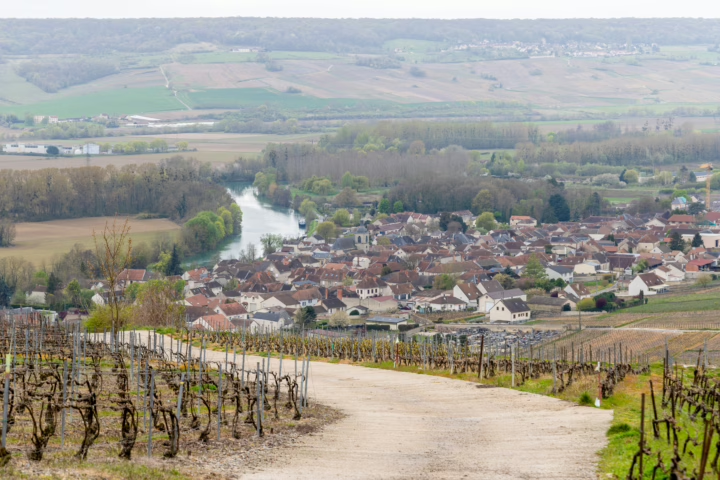
My wife and I visited the Champagne Wine Region in northeastern France, about 150 km east of Paris. Reims is the region’s capital. Epernay is the wine capital. The four “cradle villages” of Champagne are Dizy, Hautvillers, Cumières, and Damery. It is the only region authorized to produce Champagne, so if your wine sparkles but does not come from Champagne, it cannot be called Champagne. Here is what we learned and experienced.
History
Champaign has a unique history. It first produced red and white wines, but as Champagne gained popularity, local producers shifted to making Champagne because it was a luxury product with better profits.
Terroir
It is all about the hills and the soil.
Climate
Champagne’s vineyards experience a mix of continental and oceanic climates. This combination is unique to Champagne and does not occur in any other French wine region.1
In practice, these two climates interact in Champagne. The oceanic influence brings mild temperatures, so winters are not too cold, and summers are not too hot. The average yearly temperature is 11°C.
But the continental climate can cause sudden winter freezes. In some places, temperatures have dropped below -10°C, causing frosts that damage the vines. In summer, the opposite can happen, with high temperatures sometimes leading to strong storms.
These climate conditions also help the vines in several ways. Champagne gets lots of summer sun, which helps the grapes grow. Rainfall is steady and moderate year-round, providing the grapes with nearly ideal water conditions.
Grapes
Champagne wines are made solely from three main grape varieties (Chardonnay, Pinot Noir, and Meunier), but that’s not quite true! Five other varieties are also authorized within the AOC area and are used to make some: Arbane, Petit Meslier, Chardonnay Rose, Pinot Blanc, and Pinot Gris.
How Champagne is made
The vines and the pressings: first, second, and third, and the “extra” wine
Vintage versus non-vintage Champagne
Non-vintage is made from a blend of multiple years to ensure consistency. At this level of wine, each Champagne maker’s goal is to provide a consistent expression, flavor profile, and brand year after year.
Vintage Champagne is different. All the Champagne in the bottle comes from grapes from a single year. Champagne makers declare a vintage only when everything aligns in the vineyard, allowing them to create a unique expression that is not possible with non-vintage Champagne.
Producers
There are large Champagne Houses that grow their own grapes and make their own Champagne, such as Moët & Chandon, owned by the luxury goods conglomerate LVMH (Moët Hennessy Louis Vuitton). LVMH is a multinational luxury goods company, and has been since 1987.
The interesting point is that only 20% of the wine in a bottle of Moët & Chandon comes from grapes grown by Moët & Chandon. The Moët & Chandon has to buy. This brings us to the next level, growers and producers, which are divided into two categories.
First, there are small growers/producers who grow their own grapes, make their own Champagne, and, in many cases, also sell their excess to large Champagne Houses such as Moët & Chandon. Second, there are growers who do not produce Champagne at all and just sell to Champagne Houses such as Moët & Chandon. There are all kinds of nuances, but this is the basics.
Finally, there are a few key points: Magnums are better because they allow less air. You can store Champagne at home for the same amount of time it was kept in the Champagne maker’s cellar before disgorgement, meaning if it were stored for 15 months, then you can store it for 15 months. Light is the enemy of Champagne, so buy Champagne that has been stored in boxes out of the light and keep it in the box out of the light. After
What to do
We hired a private expert Champaign guide to take us around for the day. He picked us up at our hotel in Reims and drove us to Epernay.
Along the way, we discussed the Champagne wine region. When we arrived in Epernay, he drove us up and down the “L’Avenue de Champagne” (English: Champaign Avenue), pointing out key factoids.
He dropped us off for our private Moët & Chandon tour. The Moët & Chandon tour was well done and finished with a tasting of two Champagnes.
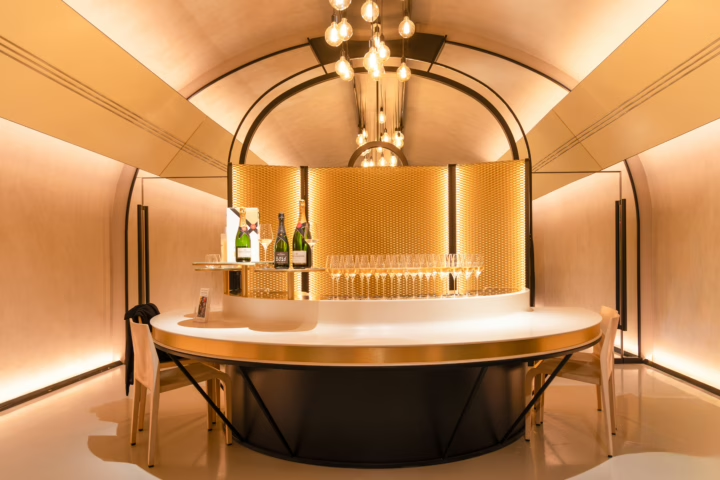
Then, we visited Boutique Champagne Pierre Mignon for small bites and to taste Maison Pierre Mignon Champagne. We tried nne different Champaigns. It was a good lunch!
Next, he drove us to BLAH, a small village, where we finished with a Dom Pérignon photo op.
After that, we drove through the countryside, stopped for a scenic view, and visited the Champagne Roger-Constant Lemaire, a small Champagne grower, producer, and maker. We met Gilles and Bernadette Tournant. Lemaire is Bernadette’s maiden name.
Finally, he returned us to our hotel.
Where to stay
We stayed at the Hyatt Reims because it was only six months old, and I thought it would be cleaner than the other hotels, especially the carpets. We do not like carpet. But after visiting Reims, I think the Gregorian Hotel would also be a good option. It is right across from the Cathedral. I looked at it but decided on the Hyatt because it was new.
As an alternative, if I did not want to stay in Reims, I would stay in Epernay on the “L’Avenue de Champagne” (English: Champaign Avenue). There are two good choices: Château Comtesse Lafond and La Villa Eugène. Both are located on the Avenue and allow you to walk from Champagne house to Champagne house.
Where to eat
Brasserie Excelsior
On Easter Sunday, we stopped by the Cathedral and then had lunch at Brasserie Excelsior, located in the heart of Reims. This was a great choice.
Brasserie Excelsior
Address: 96 Pl. Drouet d’Érlon, 51100 Reims
Phone: 03 26 91 40 50
https://www.excelsior-reims.fr/
Brasserie Le Jardin
Brasserie Le Jardin is a MICHELIN Bib Gourmand restaurant located a short drive from the center of Reims. It is one of the restaurants at Domaine Les Crayères, a luxury hotel located in a seven-hectare park in the heart of Reims.
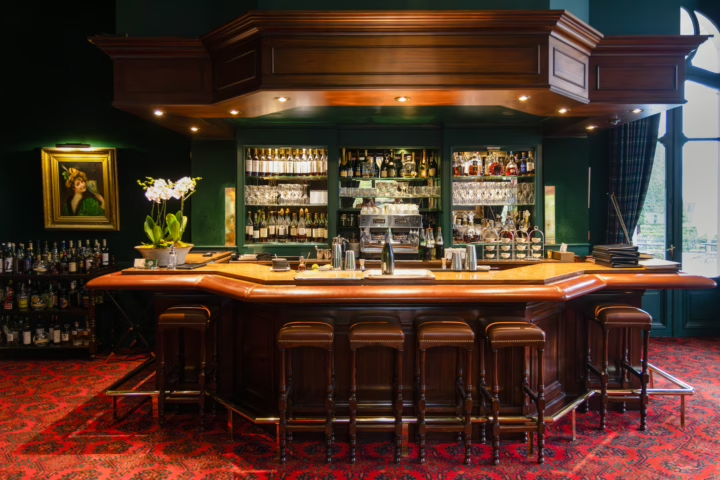
We arrived early, had a drink at Bar La Rotonde at the Hotel Domaine Les Crayères, and then went to dinner. Both were excellent choices.
Brasserie Le Jardin
Adresse: 7 av. du Général Giraud, 51100 Reims
Phone: 03 26 24 90 90
https://lescrayeres.com/
Café du Palais
Café du Palais Reims is not in the MICHELIN guide. Café du Palais, in the center of Reims, has been a family business for more than seventy years. Over time, children and grandchildren have taken on the management, now representing the fifth generation of the Vogt family. It was a good choice.
Address: 14 Pl. Myron Herrick, 51100 Reims
Phone: 03 26 47 52 54
https://www.cafedupalais.fr/
If visiting the Chablis Wine Region, see my post https://bonvivant365.com/wine/chablis-wine-region/
- (n.d.). Champagne and its climate. Comité Champagne. Retrieved April 14, 2026, from https://www.champagne.fr/en/about-champagne/the-champagne-terroir/champagne-and-its-climate ↩︎